• HOME
  • NEWS
  • EXPLORE
    • CAREER
      • Companies
      • Jobs
    • EVENTS
    • iGEM
      • News
      • Team
    • PHOTOS
    • VIDEO
    • WIKI
  • BLOG
  • COMMUNITY
    • FACEBOOK
    • INSTAGRAM
    • TWITTER
Saturday, February 7, 2026
BIOENGINEER.ORG
No Result
View All Result
  • Login
  • HOME
  • NEWS
  • EXPLORE
    • CAREER
      • Companies
      • Jobs
        • Lecturer
        • PhD Studentship
        • Postdoc
        • Research Assistant
    • EVENTS
    • iGEM
      • News
      • Team
    • PHOTOS
    • VIDEO
    • WIKI
  • BLOG
  • COMMUNITY
    • FACEBOOK
    • INSTAGRAM
    • TWITTER
  • HOME
  • NEWS
  • EXPLORE
    • CAREER
      • Companies
      • Jobs
        • Lecturer
        • PhD Studentship
        • Postdoc
        • Research Assistant
    • EVENTS
    • iGEM
      • News
      • Team
    • PHOTOS
    • VIDEO
    • WIKI
  • BLOG
  • COMMUNITY
    • FACEBOOK
    • INSTAGRAM
    • TWITTER
No Result
View All Result
Bioengineer.org
No Result
View All Result
Home NEWS Science News Biology

Early indications of thrombosis help in preventing postoperative complications

Bioengineer by Bioengineer
October 27, 2020
in Biology
Reading Time: 2 mins read
0
IMAGE
Share on FacebookShare on TwitterShare on LinkedinShare on RedditShare on Telegram

A paper saw light in Scientific Reports
IMAGE

Credit: Kazan Federal University

The co-authors are employees of the Protein-Cell Interactions Lab of Kazan Federal University (Natalia G. Evtugina, Alina D. Peshkova, and Lab Head Rustem I. Litvinov) in cooperation with Interregional Clinical Diagnostic Center, Kazan, Russia (Arseniy A. Pichugin) and University of Pennsylvania (John W. Weisel and Rustem I. Litvinov by his primary employment).

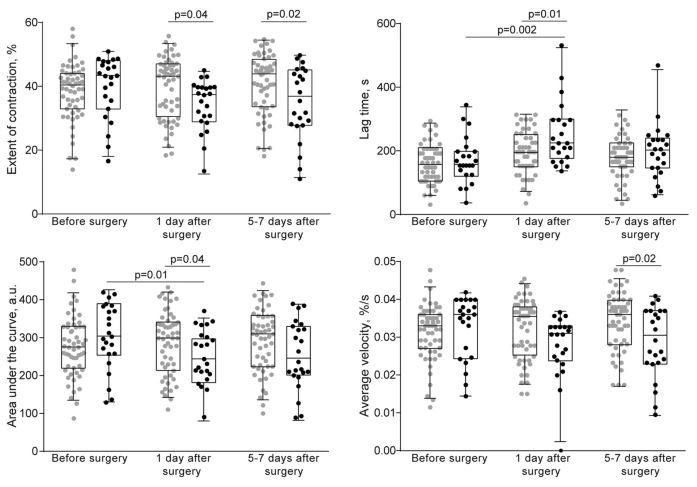
It is well-known that surgeries can be complicated by life-threatening thromboses that are hard to predict and not easy to prevent. The authors managed to find a new prognostic laboratory sign of the imminent postoperative thrombosis; remarkably, this sign appears on the first postoperative day, a few days before deep vein thrombosis of the lower limbs develops. The laboratory indication of the upcoming thrombosis is the impaired contraction or shrinkage of a clot made from the blood of a patient. It has been shown that if blood clot contraction is normally strong and fast, the risk of thrombotic complications is quite small. On the contrary, if on the first day after surgery clot contraction is suppressed, there is a high likelihood of thrombosis development, and immediate prophylactic measures should be taken to prevent this adverse postoperative complication. This study is a continuation of a series of publications in international scientific journals on a novel and original clinical laboratory assay based on the quantitative characterization of the blood clot contraction kinetics.

The published work is a vivid example of translational medicine that uses accomplishments of fundamental biomedical science to promote enhancements in the prevention, diagnosis, and therapies of diseases. Based on the basic studies of molecular and cellular mechanisms underlying blood clot contraction, the authors consistently implement their laboratory test into clinical practice to aid physicians who often deal with the problems of bleeding and thrombosis. An important feature of severe thrombotic complications is that they occur in various diseases, which emphasizes the extreme importance of research and development in this field.

The potential area of practical applications of the clot contraction assay is growing gradually but surely. The authors continue to use the test to evaluate the risk of thrombotic complications in other pathologies, such as COVID-19, fetal loss and miscarriage, autoimmune diseases, and other conditions associated with disorders of blood clotting.

###

Media Contact
Yury Nurmeev
[email protected]

Original Source

https://kpfu.ru/eng/news-eng/early-indications-of-venous-thrombosis.html

Related Journal Article

http://dx.doi.org/10.1038/s41598-020-75234-y

Tags: BiologyCardiologyCell BiologyHematology
Share12Tweet8Share2ShareShareShare2

Related Posts

Florida Cane Toad: Complex Spread and Selective Evolution

Florida Cane Toad: Complex Spread and Selective Evolution

February 7, 2026
New Study Uncovers Mechanism Behind Burn Pit Particulate Matter–Induced Lung Inflammation

New Study Uncovers Mechanism Behind Burn Pit Particulate Matter–Induced Lung Inflammation

February 6, 2026

DeepBlastoid: Advancing Automated and Efficient Evaluation of Human Blastoids with Deep Learning

February 6, 2026

Navigating the Gut: The Role of Formic Acid in the Microbiome

February 6, 2026
Please login to join discussion

POPULAR NEWS

  • Robotic Ureteral Reconstruction: A Novel Approach

    Robotic Ureteral Reconstruction: A Novel Approach

    82 shares
    Share 33 Tweet 21
  • Digital Privacy: Health Data Control in Incarceration

    63 shares
    Share 25 Tweet 16
  • Study Reveals Lipid Accumulation in ME/CFS Cells

    57 shares
    Share 23 Tweet 14
  • Breakthrough in RNA Research Accelerates Medical Innovations Timeline

    53 shares
    Share 21 Tweet 13

About

We bring you the latest biotechnology news from best research centers and universities around the world. Check our website.

Follow us

Recent News

Evaluating Pediatric Emergency Care Quality in Ethiopia

TPMT Expression Predictions Linked to Azathioprine Side Effects

Improving Dementia Care with Enhanced Activity Kits

Subscribe to Blog via Email

Enter your email address to subscribe to this blog and receive notifications of new posts by email.

Join 73 other subscribers
  • Contact Us

Bioengineer.org © Copyright 2023 All Rights Reserved.

Welcome Back!

Login to your account below

Forgotten Password?

Retrieve your password

Please enter your username or email address to reset your password.

Log In
No Result
View All Result
  • Homepages
    • Home Page 1
    • Home Page 2
  • News
  • National
  • Business
  • Health
  • Lifestyle
  • Science

Bioengineer.org © Copyright 2023 All Rights Reserved.