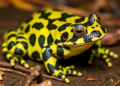
Credit: Illustration by Amy Koehler
Poop is full of secrets. For scientists, digging into feces provides insights into animal diets and is particularly useful for understanding nocturnal or rare species. When animals eat, prey DNA travels all the way through animal digestive tracts and comes out again. Poop contains very precise information about the prey species consumed. At the Smithsonian Tropical Research Institute (STRI), a team explored the eating habits of the fringe-lipped bat (Trachops cirrhosus) by examining its poop.
Bats hunt at night. This makes it challenging to observe their foraging behavior in nature. Analyzing DNA traces in bat guano offers a more specific way to explore how bats feed in the wild and to study how bat behavior changes depending on their eating habits.
“Because bats forage at night, and in the dense forest, you can’t observe what they are eating the way you can with a diurnal bird or mammal,” said Patricia Jones, former STRI fellow, assistant professor of biology at Bowdoin College and main author of the study. “It feels so momentous, therefore, to have a glimpse into the diet of this species that we thought we knew so much about, to discover they are eating prey we had no idea were part of their diet.”
The fringe-lipped bat, also known as the frog-eating bat, is well adjusted to hunting frogs. The bats’ hearing is adapted to their low-frequency mating calls, and their salivary glands may neutralize the toxins in the skin of poisonous prey. Fringed-lipped bats also feed on insects, small reptiles or birds and other bats. Researchers knew that these bats often find their prey by eavesdropping on mating calls, but it was unknown if they could find prey that was silent.
As expected, most of the DNA recovered from the poop samples in the study belonged to frog species and plenty of lizards, but researchers also found evidence that the bats were eating other bats and even a hummingbird. In additional experiments, wild-caught fringe-lipped bats exposed to recordings of prey sounds and stationary prey models were able to detect silent, motionless prey, as well as prey that made sounds. This led researchers to conclude that the fringe-lipped bat is more capable of locating prey by echolocation than previously thought.
“This is interesting because we didn’t know that these bats were able to detect silent, still prey,” said May Dixon, STRI fellow, doctoral student at the University of Texas at Austin and co-author of the study. “Detecting silent, still prey in the cluttered jungle is thought to be a really hard task for echolocation. This is because when the bats echolocate in the jungle, the echoes of all the leaves and branches bounce back along with the echoes of their prey, and they ‘mask’ the prey.”
These results may offer a new line of research on the sensory abilities and foraging ecology of T. cirrhosus. It also adds to a growing body of work that suggests that, in the tropics, bats may be important nocturnal predators on sleeping animals like birds. The team also found unexpected frog species among its common prey.
“We found T. cirrhosus were often eating frogs in the genus Pristimantis,” Jones said. “I think this will open new avenues of research with T. cirrhosus, because Pristimantis call from the canopy and their calls are hard to localize, so if T. cirrhosus are consuming them it means that they are foraging differently than we understood before.”
Going forward, this novel combination of dietary DNA analysis with behavioral experiments may be used by other ecologists interested in the foraging behaviors of a wide range of animal species.
“It’s really exciting to see the doors that open when animal behavior is combined with metabarcoding,” said STRI staff scientist Rachel Page. “Even though we have studied Trachops intensely for decades, we actually know very little about its behavior in the wild. It was completely surprising to see prey items show up in the diet that we never anticipated, such as frog species whose mating calls seemed to lack acoustic parameters helpful for localization and, more surprising, prey that it seems the bats must have detected by echolocation alone, like hummingbirds. This work makes us rethink the sensory mechanisms underlying this bat’s foraging behavior, and it opens all kinds of new doors for future questions.”
###
Members of the research team are affiliated with STRI, Bowdoin College, SWCA Environmental Consultants and the University of Texas at Austin. Research was funded by the Smithsonian, the National Science Foundation DDIG #1210655 and a P.E.O. Scholar Award.
The Smithsonian Tropical Research Institute, headquartered in Panama City, Panama, is a unit of the Smithsonian Institution. The institute furthers the understanding of tropical biodiversity and its importance to human welfare, trains students to conduct research in the tropics and promotes conservation by increasing public awareness of the beauty and importance of tropical ecosystems.
Media Contact
Leila Nilipour
[email protected]
Related Journal Article
http://dx.