• HOME
  • NEWS
  • EXPLORE
    • CAREER
      • Companies
      • Jobs
    • EVENTS
    • iGEM
      • News
      • Team
    • PHOTOS
    • VIDEO
    • WIKI
  • BLOG
  • COMMUNITY
    • FACEBOOK
    • INSTAGRAM
    • TWITTER
Sunday, February 8, 2026
BIOENGINEER.ORG
No Result
View All Result
  • Login
  • HOME
  • NEWS
  • EXPLORE
    • CAREER
      • Companies
      • Jobs
        • Lecturer
        • PhD Studentship
        • Postdoc
        • Research Assistant
    • EVENTS
    • iGEM
      • News
      • Team
    • PHOTOS
    • VIDEO
    • WIKI
  • BLOG
  • COMMUNITY
    • FACEBOOK
    • INSTAGRAM
    • TWITTER
  • HOME
  • NEWS
  • EXPLORE
    • CAREER
      • Companies
      • Jobs
        • Lecturer
        • PhD Studentship
        • Postdoc
        • Research Assistant
    • EVENTS
    • iGEM
      • News
      • Team
    • PHOTOS
    • VIDEO
    • WIKI
  • BLOG
  • COMMUNITY
    • FACEBOOK
    • INSTAGRAM
    • TWITTER
No Result
View All Result
Bioengineer.org
No Result
View All Result
Home NEWS Science News

A new ultrafast control scheme of ferromagnet for energy-efficient data storage

Bioengineer by Bioengineer
October 16, 2020
in Science News
Reading Time: 2 mins read
0
IMAGE
Share on FacebookShare on TwitterShare on LinkedinShare on RedditShare on Telegram

IMAGE

Credit: Shunsuke Fukami and Stéphane Mangin

The digital data generated around the world every year is now counted in zettabytes, or trillions of billions of bytes – equivalent to delivering data for hundreds of millions of books every second. The amount of data generated continues to grow. If existing technologies remained constant, all the current global electricity consumption would be devoted to data storage by 2040.

Researchers at the Université de Lorraine in France and Tohoku University reported on an innovative technology that leads to a drastic reduction in energy for data storage.

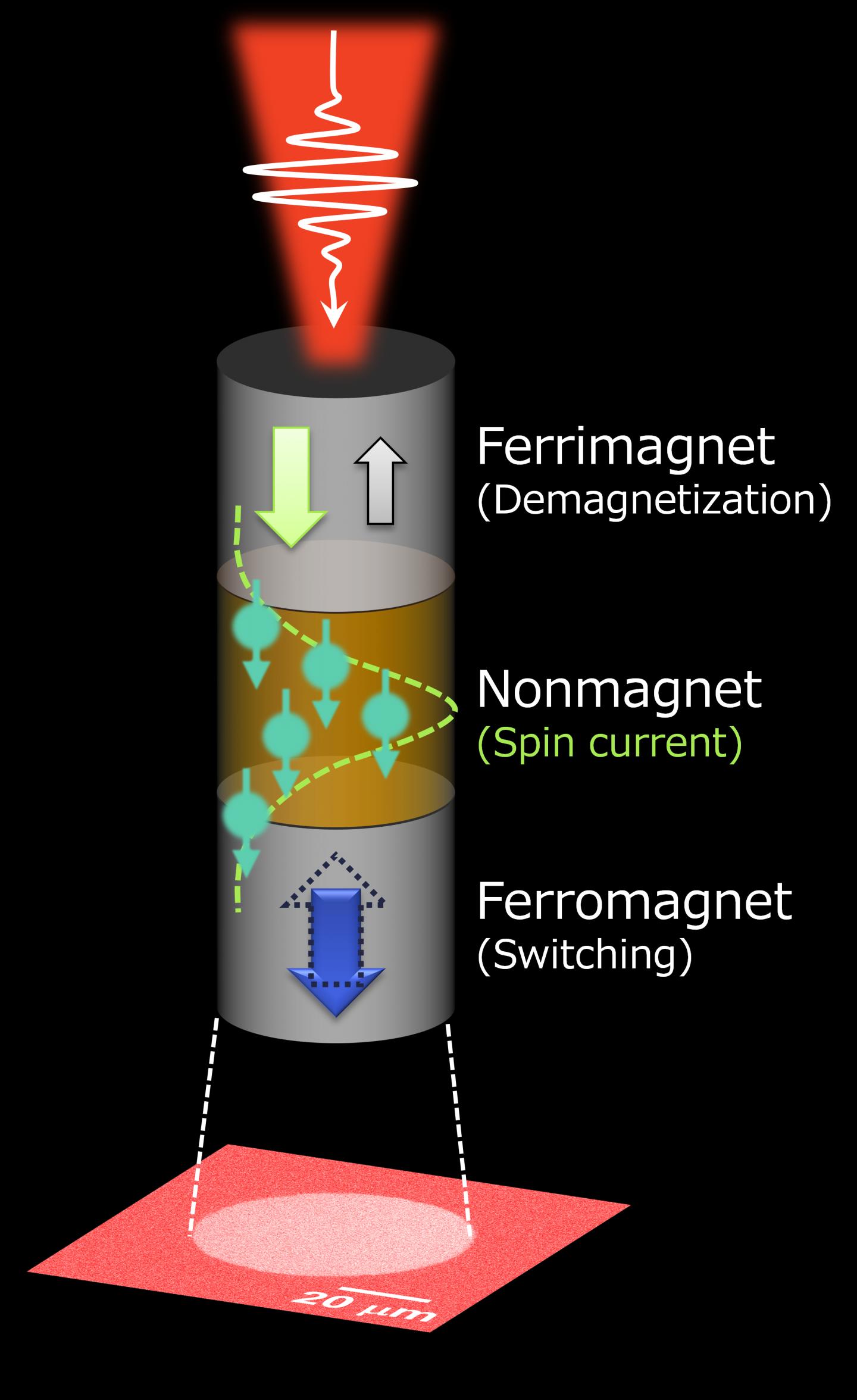
The established technology utilizes an ultrafast laser pulse whose duration is as short as 30 femto seconds – equal to 0.0000000000000003 seconds. The laser pulse is applied to a heterostructure consisting of ferrimagnetic GdFeCo, nonmagnetic Cu and ferromagnetic Co/Pt layers.

“Previous research, conducted by a subset of the current research group, observed magnetic switching of the ferromagnetic layer after the ferrimagnetic layer had been switched.” This time, the researchers uncovered the mechanism accounting for this peculiar phenomena and found that a flow of electron spin, referred to as a spin current, accompanying the switching of ferrimagnetic GeFeCo plays a crucial role in inducing the switching of ferromagnetic Co/Pt (Fig. 1).

Based on this insight, they demonstrated a much faster and less energy consuming switching of the ferromagnet. This was driven by a single laser pulse without a switching of the ferrimagnetic layer. “This is very good news for future data-storage applications as this technology can provide an efficient scheme to write digital information to a magnetic medium, which is currently based on a magnetic-field-induced switching,” says Shunsuke Fukami, co-author of the study.

###

The partnership between the Université de Lorraine and Tohoku University is driven, in large part, by the exchanges of graduate students and post-docs between the two universities. More than a dozen exchanges on both sides have already taken place for periods of several months. This partnership was supported by Presidents Hideo Ohno and Pierre Mutzenhardt, who signed a consortium agreement in 2019 during the World Materials Forum.

Media Contact
Shunsuke Fukami
[email protected]

Original Source

https://www.tohoku.ac.jp/en/press/ultrafast_controle_sceme_ferromagnet.html

Related Journal Article

http://dx.doi.org/10.1002/advs.202001996

Tags: Research/DevelopmentTechnology/Engineering/Computer Science
Share12Tweet8Share2ShareShareShare2

Related Posts

Evaluating a Self-Care App for Chest Trauma Patients

February 8, 2026

Anesthesia Method’s Impact on Elderly Hip Fracture Recovery

February 8, 2026

Menopause Care: Insights from Workforce Review and Consultation

February 7, 2026

LRRK2R1627P Mutation Boosts Gut Inflammation, α-Synuclein

February 7, 2026
Please login to join discussion

POPULAR NEWS

  • Robotic Ureteral Reconstruction: A Novel Approach

    Robotic Ureteral Reconstruction: A Novel Approach

    82 shares
    Share 33 Tweet 21
  • Digital Privacy: Health Data Control in Incarceration

    63 shares
    Share 25 Tweet 16
  • Breakthrough in RNA Research Accelerates Medical Innovations Timeline

    53 shares
    Share 21 Tweet 13
  • Mapping Tertiary Lymphoid Structures for Kidney Cancer Biomarkers

    50 shares
    Share 20 Tweet 13

About

We bring you the latest biotechnology news from best research centers and universities around the world. Check our website.

Follow us

Recent News

Evaluating a Self-Care App for Chest Trauma Patients

Anesthesia Method’s Impact on Elderly Hip Fracture Recovery

Menopause Care: Insights from Workforce Review and Consultation

Subscribe to Blog via Email

Enter your email address to subscribe to this blog and receive notifications of new posts by email.

Join 73 other subscribers
  • Contact Us

Bioengineer.org © Copyright 2023 All Rights Reserved.

Welcome Back!

Login to your account below

Forgotten Password?

Retrieve your password

Please enter your username or email address to reset your password.

Log In
No Result
View All Result
  • Homepages
    • Home Page 1
    • Home Page 2
  • News
  • National
  • Business
  • Health
  • Lifestyle
  • Science

Bioengineer.org © Copyright 2023 All Rights Reserved.