• HOME
  • NEWS
  • EXPLORE
    • CAREER
      • Companies
      • Jobs
    • EVENTS
    • iGEM
      • News
      • Team
    • PHOTOS
    • VIDEO
    • WIKI
  • BLOG
  • COMMUNITY
    • FACEBOOK
    • INSTAGRAM
    • TWITTER
Sunday, November 15, 2026
BIOENGINEER.ORG
No Result
View All Result
  • Login
  • HOME
  • NEWS
  • EXPLORE
    • CAREER
      • Companies
      • Jobs
        • Lecturer
        • PhD Studentship
        • Postdoc
        • Research Assistant
    • EVENTS
    • iGEM
      • News
      • Team
    • PHOTOS
    • VIDEO
    • WIKI
  • BLOG
  • COMMUNITY
    • FACEBOOK
    • INSTAGRAM
    • TWITTER
No Result
View All Result
Bioengineer.org
No Result
View All Result
Home NEWS Science News

Machine learning predicts how long museum visitors will engage with exhibits

Bioengineer by Bioengineer
October 13, 2020
in Science News
Reading Time: 3 mins read
0
IMAGE
Share on FacebookShare on TwitterShare on LinkedinShare on RedditShare on Telegram

IMAGE

Credit: Jonathan Rowe, NC State University

In a proof-of-concept study, education and artificial intelligence researchers have demonstrated the use of a machine-learning model to predict how long individual museum visitors will engage with a given exhibit. The finding opens the door to a host of new work on improving user engagement with informal learning tools.

“Education is an important part of the mission statement for most museums,” says Jonathan Rowe, co-author of the study and a research scientist in North Carolina State University’s Center for Educational Informatics (CEI). “The amount of time people spend engaging with an exhibit is used as a proxy for engagement and helps us assess the quality of learning experiences in a museum setting. It’s not like school – you can’t make visitors take a test.”

“If we can determine how long people will spend at an exhibit, or when an exhibit begins to lose their attention, we can use that information to develop and implement adaptive exhibits that respond to user behavior in order to keep visitors engaged,” says Andrew Emerson, first author of the study and a Ph.D. student at NC State.

“We could also feed relevant data to museum staff on what is working and what people aren’t responding to,” Rowe says. “That can help them allocate personnel or other resources to shape the museum experience based on which visitors are on the floor at any given time.”

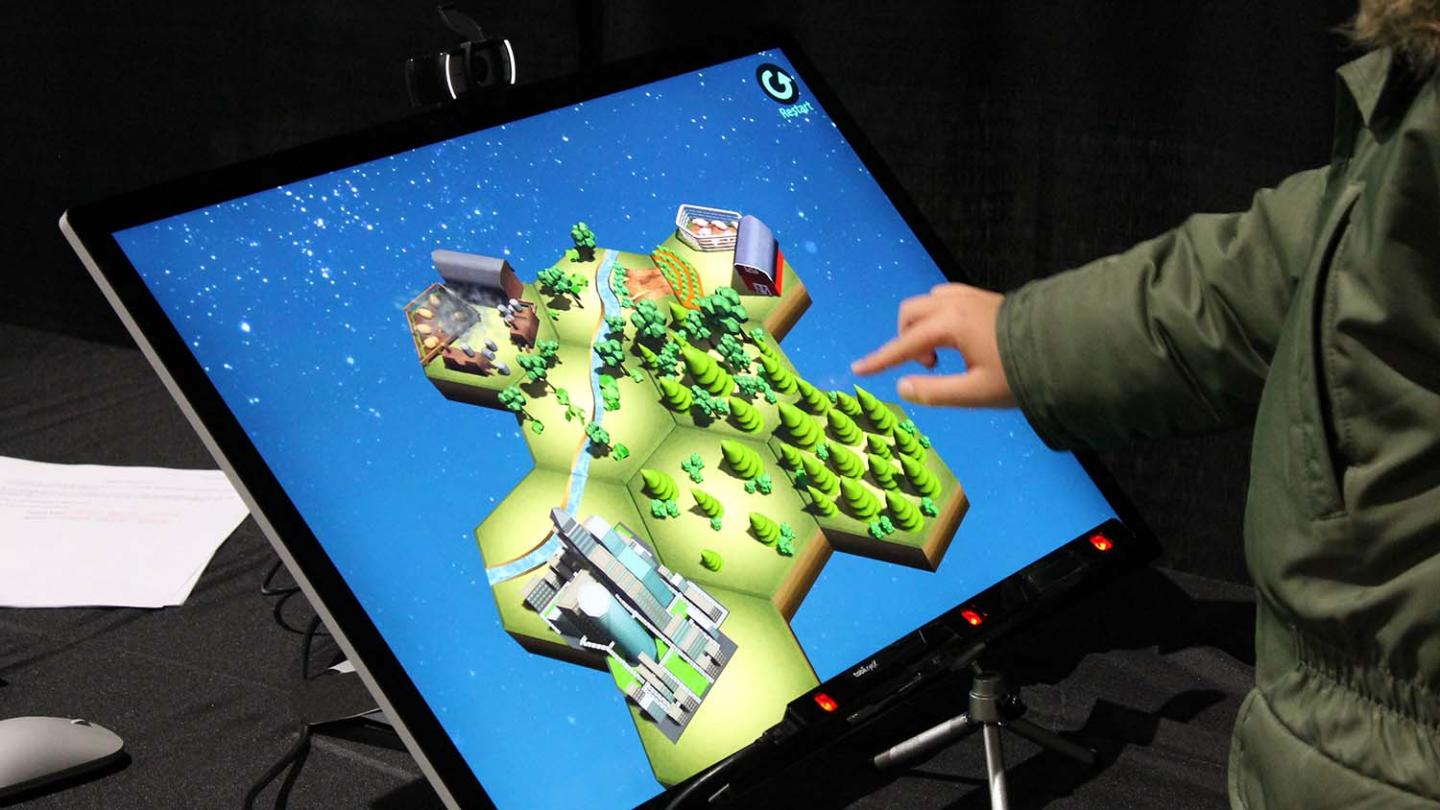
To determine how machine-learning programs might be able to predict user interaction times, the researchers closely monitored 85 museum visitors as they engaged with an interactive exhibit on environmental science. Specifically, the researchers collected data on study participants’ facial expressions, posture, where they looked on the exhibit’s screen and which parts of the screen they touched.

The data were fed into five different machine-learning models to determine which combinations of data and models resulted in the most accurate predictions.

“We found that a particular machine-learning method called ‘random forests’ worked quite well, even using only posture and facial expression data,” Emerson says.

The researchers also found that the models worked better the longer people interacted with the exhibit, since that gave them more data to work with. For example, a prediction made after a few minutes would be more accurate than a prediction made after 30 seconds. For context, user interactions with the exhibit lasted as long as 12 minutes.

“We’re excited about this, because it paves the way for new approaches to study how visitors learn in museums,” says Rowe. “Ultimately, we want to use technology to make learning more effective and more engaging.”

###

The paper, “Early Prediction of Visitor Engagement in Science Museums with Multimodal Learning Analytics,” will be presented at the 22nd ACM International Conference on Multimodal Interaction (ICMI ’20), being held online Oct. 25-29. The paper was co-authored by Nathan Henderson, a Ph.D. student at NC State; Wookhee Min and Seung Lee, research scientists at NC State’s CEI; James Minogue, an associate professor of teacher education and learning sciences at NC State; and James Lester, Distinguished University Professor of Computer Science and the director of CEI at NC State.

The work was done with support from the National Science Foundation under grant 1713545.

Media Contact
Matt Shipman
matt_shipman@ncsu.edu

Original Source

https://news.ncsu.edu/2020/10/ai-predicts-exhibit-engagement/

Related Journal Article

http://dx.doi.org/10.1145/3382507.3418890

Tags: Algorithms/ModelsComputer ScienceEducationRobotry/Artificial IntelligenceSocial/Behavioral ScienceTechnology/Engineering/Computer Science
Share12Tweet8Share2ShareShareShare2

Related Posts

Decision Framework Evaluates Six Building Nanotechnologies for Egypt's Hot Arid Architecture

Decision Framework Evaluates Six Building Nanotechnologies for Egypt’s Hot Arid Architecture

November 15, 2026
Interactive Web Tool Calculates Precise Pediatric Body Mass Index Scores in Italy

Interactive Web Tool Calculates Precise Pediatric Body Mass Index Scores in Italy

November 15, 2026

Split-Parameter Federated Learning Detects Cyber Threats Across Incompatible Network Infrastructures

November 15, 2026

Family History and Reproductive Timing Linked to Cervical Cancer in Weighting Analysis

November 15, 2026
Please login to join discussion

POPULAR NEWS

  • Self-Supervised Vision Model Estimates Live Pig Weight Within Three Kilograms

    Self-Supervised Vision Model Estimates Live Pig Weight Within Three Kilograms

    29 shares
    Share 12 Tweet 7
  • Custom YOLO26 Architecture Improves Grapevine Disease Detection on Embedded Devices

    29 shares
    Share 12 Tweet 7
  • Survey Synthesizes Remote Sensing and Edge Computing Pathways for Rice Monitoring

    29 shares
    Share 12 Tweet 7
  • Urine FujiLAM II Test Shows High Specificity but Limited Tuberculosis Sensitivity in Vietnam

    29 shares
    Share 12 Tweet 7

About

We bring you the latest biotechnology news from best research centers and universities around the world. Check our website.

Follow us

Recent News

Decision Framework Evaluates Six Building Nanotechnologies for Egypt’s Hot Arid Architecture

Interactive Web Tool Calculates Precise Pediatric Body Mass Index Scores in Italy

Split-Parameter Federated Learning Detects Cyber Threats Across Incompatible Network Infrastructures

Subscribe to Blog via Email

Enter your email address to subscribe to this blog and receive notifications of new posts by email.

Join 87 other subscribers
  • Contact Us

Bioengineer.org © Copyright 2023 All Rights Reserved.

Welcome Back!

Login to your account below

Forgotten Password?

Retrieve your password

Please enter your username or email address to reset your password.

Log In
No Result
View All Result
  • Homepages
    • Home Page 1
    • Home Page 2
  • News
  • National
  • Business
  • Health
  • Lifestyle
  • Science

Bioengineer.org © Copyright 2023 All Rights Reserved.