Credit: Randy Montoya, Sandia National Laboratories
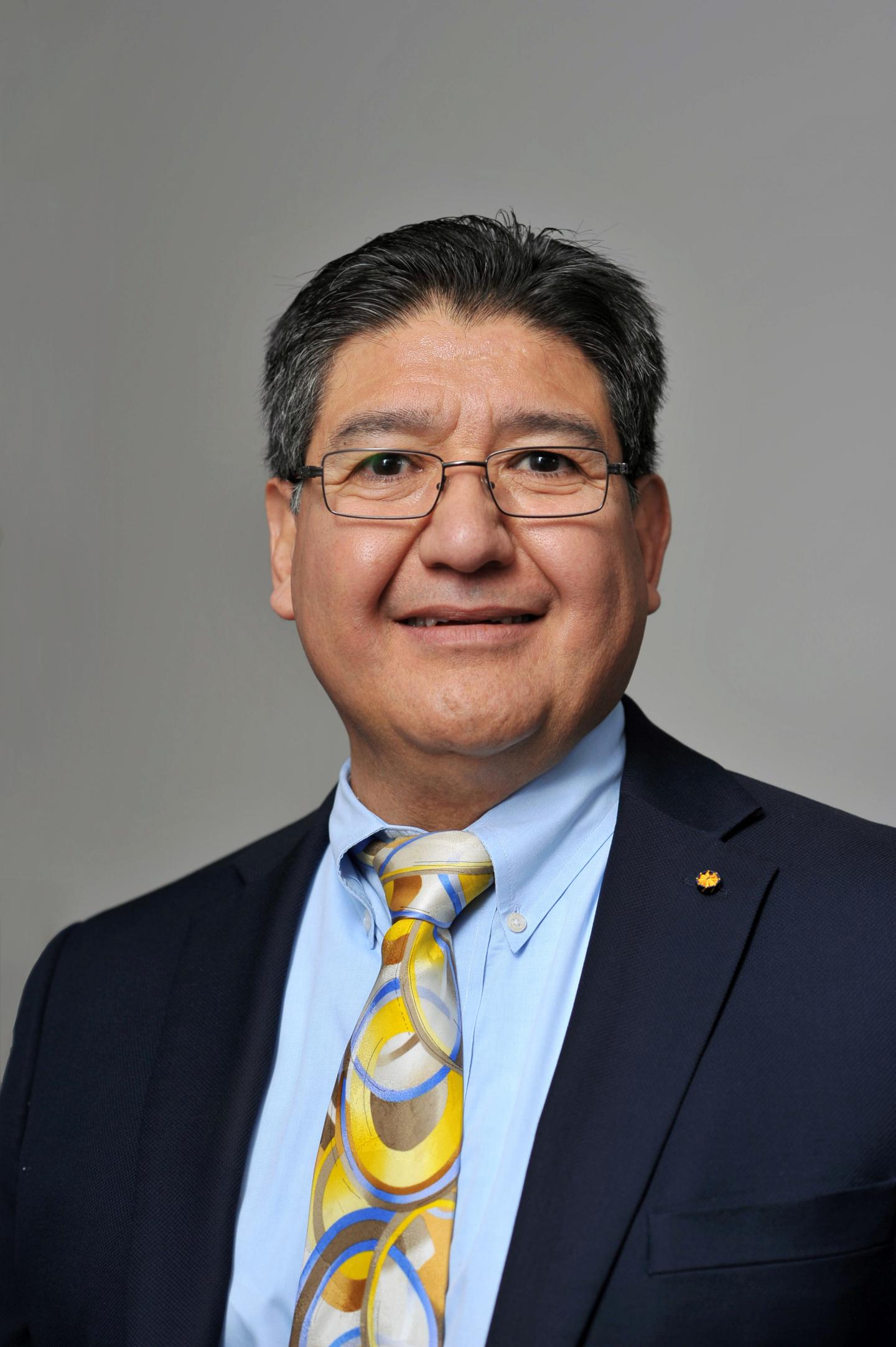
ALBUQUERQUE, N.M. — Sandia National Laboratories Fellow Gil Herrera has been appointed to the newly established U.S. National Quantum Initiative Advisory Committee.
Herrera is one of two committee members representing the Department of Energy national laboratories. He joins 20 others from government, industry and academia tasked with advising the nation’s highest offices on matters concerning quantum information science. His appointment is for three years.
Quantum information science — a broad field of study that includes quantum computing — concerns machines that accomplish extraordinary tasks by manipulating matter at the smallest scales.
“Quantum computing represents both an exceptional opportunity and a dire threat,” Herrera said. “On the positive side, when useful quantum computers can be built, they could solve molecular chemistry problems that could significantly reduce worldwide energy consumption or facilitate the rapid development of pharmaceuticals. On a more negative note, a quantum computer threatens public key encryption that protects almost all secure web communications.”
In August, Sandia and more than a dozen collaborators, collectively called the Quantum Systems Accelerator, were selected as one of five national quantum research centers.
The national advisory committee, established on Aug. 28, informs offices such as the president and the secretary of energy about how to maintain U.S. leadership in this area of technology.
“To me, leadership means that U.S. companies have the highest performing quantum computers, from qubits through apps, and the best quantum sensors and communication systems,” Herrera said. “Of equal importance, the U.S. quantum information technologies are not reliant on supply chains or intellectual property outside of the U.S., and the benefits of the U.S. government investments in quantum information science extend to all Americans, including those who manufacture quantum computing, sensing and communications systems.”
A qubit is the basic processing unit of a quantum computer, analogous to a bit in a conventional computer.
Of his new appointment, which he will hold concurrently with his position at Sandia, Herrera said, “I hope to help the program achieve a balance between the needs of scientific advancement, commercial interests of U.S. businesses, and national security interests.”
Herrera has recently been coordinating COVID-19 research efforts across Sandia’s 14,000-strong workforce. A Sandia fellow since 2018, he also has spearheaded efforts to expand discovery research, served on an independent review team for a U.S. Department of Defense microelectronics program and has mentored staff members ranging from new hires to directors.
He previously served as the director of Sandia’s Microsystems Engineering, Science and Applications complex, which researches and produces quantum technology in addition to its main mission of producing specialized microelectronics for the nation’s nuclear stockpile.
Herrera has been director of the Laboratory for Physical Sciences — a joint University of Maryland and U.S. government research institute — and served at the White House Office of Science and Technology Policy as an American Association for the Advancement of Science/Sloan Fellow under President George H.W. Bush, where he worked on semiconductor and technology transfer policies.
He has received numerous awards for his service, including three Civilian Service medals from the Pentagon and the National Security Agency Research Medallion, and has received two distinguished alumni awards from the University of New Mexico.
Herrera earned his master’s degree in electrical engineering from the University of California, Berkeley. An Albuquerque native, he received his bachelor’s degree in computer engineering from UNM.
Sandia National Laboratories is a multimission laboratory operated by National Technology and Engineering Solutions of Sandia LLC, a wholly owned subsidiary of Honeywell International Inc., for the U.S. Department of Energy’s National Nuclear Security Administration. Sandia Labs has major research and development responsibilities in nuclear deterrence, global security, defense, energy technologies and economic competitiveness, with main facilities in Albuquerque, New Mexico, and Livermore, California.
###
Media Contact
Troy Rummler
[email protected]
Original Source
https:/