• HOME
  • NEWS
  • EXPLORE
    • CAREER
      • Companies
      • Jobs
    • EVENTS
    • iGEM
      • News
      • Team
    • PHOTOS
    • VIDEO
    • WIKI
  • BLOG
  • COMMUNITY
    • FACEBOOK
    • INSTAGRAM
    • TWITTER
Thursday, June 25, 2026
BIOENGINEER.ORG
No Result
View All Result
  • Login
  • HOME
  • NEWS
  • EXPLORE
    • CAREER
      • Companies
      • Jobs
        • Lecturer
        • PhD Studentship
        • Postdoc
        • Research Assistant
    • EVENTS
    • iGEM
      • News
      • Team
    • PHOTOS
    • VIDEO
    • WIKI
  • BLOG
  • COMMUNITY
    • FACEBOOK
    • INSTAGRAM
    • TWITTER
  • HOME
  • NEWS
  • EXPLORE
    • CAREER
      • Companies
      • Jobs
        • Lecturer
        • PhD Studentship
        • Postdoc
        • Research Assistant
    • EVENTS
    • iGEM
      • News
      • Team
    • PHOTOS
    • VIDEO
    • WIKI
  • BLOG
  • COMMUNITY
    • FACEBOOK
    • INSTAGRAM
    • TWITTER
No Result
View All Result
Bioengineer.org
No Result
View All Result
Home NEWS Science News

TetGen 1.6 Release: new version of the successful mesh generator

Bioengineer by Bioengineer
October 13, 2020
in Science News
Reading Time: 2 mins read
0
IMAGE
Share on FacebookShare on TwitterShare on LinkedinShare on RedditShare on Telegram

IMAGE

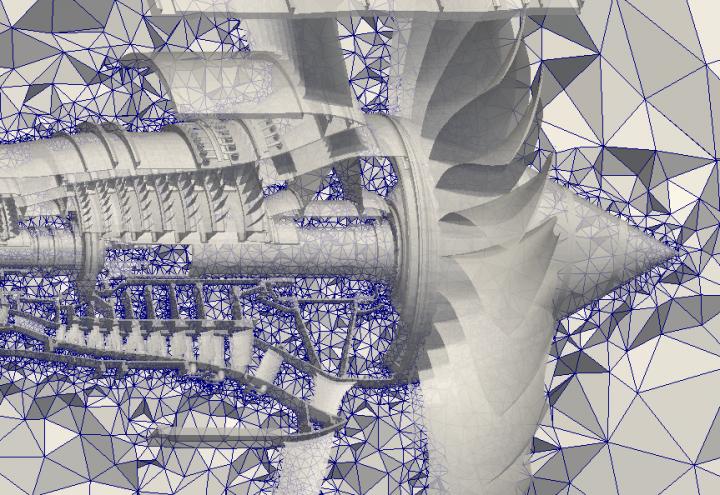
Credit: Weierstrass Institute (WIAS)

Electromagnetic fields in magnetic resonance imaging, groundwater flows, charge carriers in semiconductors and numerous further spatially distributed physical processes have one thing in common: they can be modeled by means of partial differential equations. The solution for such complex mathematical equations can usually not be obtained as a mathematical formula. Therefore, computer-based approximation methods are applied. In order to calculate these, the respective spatial domain must be divided in an intelligent way into a finite number of simple subdomains (e.g. tetrahedra).

The calculation of such partitions with certain necessary specifications regarding size and shape of the tetrahedra is a highly complex algorithmic problem, which is internationally only mastered by a few research groups. Research on these types of problems has been successfully accomplished at the Weierstrass Institute for about 20 years now under the supervision of Dr. Hang Si. In addition to numerous publications in high-ranking scientific journals, the most important result was achieved by developing the software TetGen, which allows a very precise and efficient calculation of these tetrahedral decompositions. TetGen is available to the international research community under an open source license just like the operating system Linux or the web browser Firefox.

Additionally, the Weierstrass Institute concludes license agreements that allow commercial users to integrate TetGen into their programs. As a result, leading international companies such as Wolfram Research, Google and Tera Analysis are benefiting from TetGen. The latest research results in this area are immediately put into practice in a wide variety of application areas such as image processing, animations for films or gaming, and for the calculation of electromagnetic fields and other physical quantities in complex electronic components. Moreover, the revenues generated are used to further intensify research in this area.

With TetGen 1.6, the Weierstrass Institute has now released a new version that allows a significant improvement of the generated grids while reducing the necessary computing time. This quality enhancement was achieved in particular by implementing new core algorithms based on recent research results.

Institute Director Prof. Dr. Michael Hintermüller emphasizes: “The leap in quality of the enhanced grid generator is immediately visible to the user and along with the remarkable speed of the algorithms it pays off right from the start”.

###

Download TetGen v. 1.6:
http://www.wias-berlin.de/software/index.jsp?id=TetGen&lang=1

Media Contact
Dr. Torsten Köhler
[email protected]

Original Source

https://www.fv-berlin.de/en/info-for/the-media-and-public/news/tetgen-16-veroeffentlicht

Tags: Algorithms/ModelsCalculations/Problem-SolvingComputer ScienceMathematics/StatisticsSoftware EngineeringTechnology TransferTechnology/Engineering/Computer Science
Share13Tweet8Share2ShareShareShare2

Related Posts

Asian Working Group Revises Sarcopenia Criteria 2019-2025

June 25, 2026

AI-Powered Platform Advances Structure-Based Drug Discovery

June 25, 2026

BALatrine Reduces Helminth Infections: Central Java Trial

June 24, 2026

Decoding the Secret Code of a Crucial Immune Sensor

June 24, 2026
Please login to join discussion

POPULAR NEWS

  • Saying Goodbye to PGY-6: Pediatric Fellowship Realities

    103 shares
    Share 41 Tweet 26
  • Multi-Hospital Study Reveals Long Covid Burden Is Twice as High as Current Estimates

    92 shares
    Share 36 Tweet 23
  • Detection of EDCs in Breast Milk and Infant Urine Up to Six Months Highlights Early Exposure Risks

    77 shares
    Share 31 Tweet 19
  • New Drug Candidate Developed at McMaster Shows Potential for Treating Brain Cancer

    58 shares
    Share 23 Tweet 15

About

We bring you the latest biotechnology news from best research centers and universities around the world. Check our website.

Follow us

Recent News

Asian Working Group Revises Sarcopenia Criteria 2019-2025

AI-Powered Platform Advances Structure-Based Drug Discovery

BALatrine Reduces Helminth Infections: Central Java Trial

Subscribe to Blog via Email

Enter your email address to subscribe to this blog and receive notifications of new posts by email.

Join 82 other subscribers
  • Contact Us

Bioengineer.org © Copyright 2023 All Rights Reserved.

Welcome Back!

Login to your account below

Forgotten Password?

Retrieve your password

Please enter your username or email address to reset your password.

Log In
No Result
View All Result
  • Homepages
    • Home Page 1
    • Home Page 2
  • News
  • National
  • Business
  • Health
  • Lifestyle
  • Science

Bioengineer.org © Copyright 2023 All Rights Reserved.