Credit: by Lingzhi Li, Yuan Cao, Yanyan Zhi, Jiejun Zhang1, Yuting Zou, Xinhuan Feng, Bai-Ou Guan and Jianping Yao
Parity-time-symmetric photonic and optoelectronic systems is being intensively explored recently, which has been bringing about significant fundamental physics and technological outcomes. One of the main characteristics of a PT symmetric system is its effectiveness in mode selection in a single-mode lasing, in which two cross-coupled and spatially separated resonators with identical geometries are usually employed. A PT-symmetric laser system has a strongly enhanced gain difference between the dominant mode and the side modes, thus making single-mode oscillation possible. However, the strict requirements not only lead to increased structural complexity, high cost, and strong susceptibility to environmental perturbations, but also limit the compactness when on-chip devices are required.
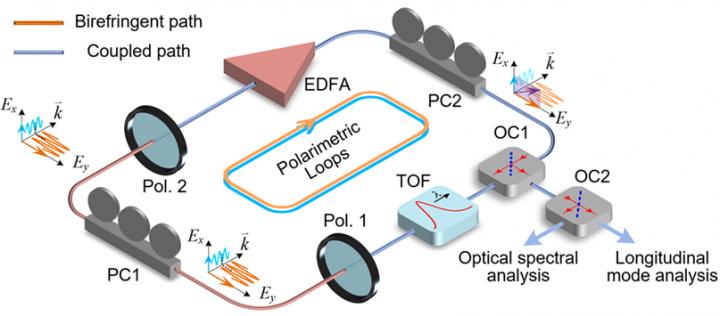
In a new paper published in Light Science & Application, a team of scientists, led by Professor Jiejun Zhang from Guangdong Provincial Key Laboratory of Optical Fiber Sensing and Communications, Institute of Photonics Technology, Jinan University has proposed a new technique to realizing PT symmetry in a single spatial resonator. By the manipulation of the polarization-dependent response of the spatial resonator, localized eigenfrequencies, gain, loss, and coupling coefficients of two polarimetric loops formed by lights of orthogonal polarization states can be tuned to achieve PT symmetry. The proposed polarimetric PT symmetry concept opens new avenues for the implementation of non-Hermitian photonic systems, in which a variety of optical parameters, including polarization, wavelength, transverse mode and optical angular momentum, can be used.
As a demonstration, a fiber ring laser based on this concept supporting stable and single-mode lasing without using a high-Q optical filter is implemented. The PT-symmetric system is implemented in a single fiber loop with polarimetric diversity. In the experiment, the fiber ring laser has a cavity length of 41 m with a mode spacing as small as 4.88 MHz. The employment of polarimetric PT symmetry enables effective suppression of the sidemodes with a suppression ratio greater than 47.9 dB. The linewidth of the light generated by the fiber ring laser is measured to be 129 kHz with a wavelength-tunable range of 35 nm.
“In one single physical fiber loop, the polarimetric diversity is implemented by controlling the polarization states of light via polarization controllers. An erbium-doped fiber amplifier is incorporated to provide an optical gain. By tuning the loss, gain and coupling strength of the two polarimetric modes, PT symmetry is implemented, of which can be observed from the output spectrum. Since only a single physical loop is required, the implementation is significantly simplified, and the stability is highly improved.”
“The measured laser linewidth is 129 kHz, which is broadened due to the high susceptibility of the system to environmental disturbances due to a long fiber in the cavity. By suppressing those noises using active cavity stabilization techniques or isolated laser systems, the linewidth is possible to be reduced to its Lorentzian linewidth of 2.4 kHz.” they added.
“The presented technique provides a new concept of implementing PT symmetry in non-spatial parameter space in photonic systems. Not limited to the polarimetric parameter space, one can adopt this concept by constructing various parameter spaces. With simplified physical structures, this proposed concept is ready to be applied in other fields to promote the application of the PT symmetry mechanism.” the scientists forecast.
###
Media Contact
Jiejun Zhang
[email protected]
Related Journal Article
http://dx.