• HOME
  • NEWS
  • EXPLORE
    • CAREER
      • Companies
      • Jobs
    • EVENTS
    • iGEM
      • News
      • Team
    • PHOTOS
    • VIDEO
    • WIKI
  • BLOG
  • COMMUNITY
    • FACEBOOK
    • INSTAGRAM
    • TWITTER
Monday, October 5, 2026
BIOENGINEER.ORG
No Result
View All Result
  • Login
  • HOME
  • NEWS
  • EXPLORE
    • CAREER
      • Companies
      • Jobs
        • Lecturer
        • PhD Studentship
        • Postdoc
        • Research Assistant
    • EVENTS
    • iGEM
      • News
      • Team
    • PHOTOS
    • VIDEO
    • WIKI
  • BLOG
  • COMMUNITY
    • FACEBOOK
    • INSTAGRAM
    • TWITTER
No Result
View All Result
Bioengineer.org
No Result
View All Result
Home NEWS Science News

Virginia Tech leads a team pursuing more immersive virtual reality

Bioengineer by Bioengineer
October 5, 2020
in Science News
Reading Time: 3 mins read
0
IMAGE
Share on FacebookShare on TwitterShare on LinkedinShare on RedditShare on Telegram

IMAGE

Credit: Virginia Tech

Two Virginia Tech professors are part of a team focused on developing new technology for the virtual world: a full-body experience in a fully electronic environment.

The project is funded by a $1.5 million grant from the National Science Foundation. Virginia Tech contributors are Professor Alex Leonessa from the Department of Mechanical Engineering and Associate Professor Divya Srinivasan from the Grado Department of Industrial and Systems Engineering. They are joining forces with Eric Jing Du, a professor from University of Florida, and industry partner HaptX.

Virtual reality has been a technological pie-in-the-sky development for decades. Movies and television shows have fueled imagination and inspired commercial developments, but the expectation created by fantasy has yet to find its full realization. While science fiction often presents the idea as fully immersive, casting ideas, such as Star Trek’s holodeck and the world of the Matrix, VR has been a heavily visual experience.

The addition of gloves allowed users to interact within virtual environments in ways that expanded the virtual reality world, adapted for video games in developments such as the Nintendo Power Glove and the cyber glove. NASA adapted this approach as well, building its Virtual Interface Environment Workstation in 1990 for an operator to physically move objects from a remote location. In each of these experiences, a user would watch their virtual hands perform virtual tasks in a virtual environment. The feedback to a user remained visual.

In recent years, such developments as HaptX Gloves have added an additional dimension to the experience: a virtual environment that returns a touch response to a user’s hand. Programmed microfluidic pockets within gloves respond based on the actions in a virtual environment, creating a tactile response in addition to a visual one. A user would not just experience the virtual world visually, they would also feel weight, shape, and texture across their hand and fingertips.

The next step

Being able to move around a virtual environment presents its own set of challenges. Video games normally accomplish this by using joysticks or keypads, meaning that a user is essentially pushing buttons with their fingers to achieve virtual reality walking. Other input devices, such as pads and devices that fit like shoes, require some form of walking in place to input the motion.

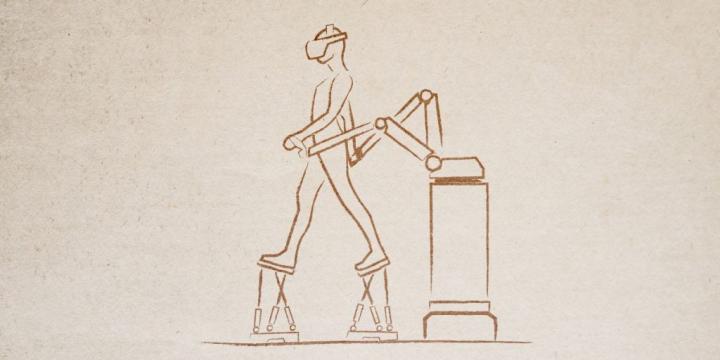
Virginia Tech is working with University of Florida and HaptX to bring together motion, touch response, visual interaction, and more. The hopeful result is a full-body virtual reality rig that allows users to see the environment through a headset, achieve touch via the HaptX gloves, and both walk and interact by using an exoskeleton.

The project is called ForceBot, drawing on the term “force feedback,” the general classification of controls that impact objects in the virtual environment. Responsive robotics working with a user’s feet would allow walking, simulate changes in terrain, and move a user through the electronic world. Additional robotics in a hand and arm rig would provide resistance for pushing and pulling simulated solid objects, while the HaptX gloves complete the experience with touch response. The visual headset would allow a user to see the electronic environment unfold before them.

“We are excited to have the opportunity to develop a fully immersive virtual reality experience, providing realistic full-body interactions,” said Leonessa. “Virtual reality is a familiar technology, but the untapped potential it holds is vast.”

###

Media Contact
Suzanne Irby
[email protected]

Original Source

https://vtnews.vt.edu/articles/2020/09/me-awards-forcebot2020.html

Tags: Computer ScienceTechnology/Engineering/Computer Science
Share12Tweet8Share2ShareShareShare2

Related Posts

AI Reads Students' Faces to Measure Attention in Online Classes

AI Reads Students’ Faces to Measure Attention in Online Classes

October 5, 2026
Blood Clones That Masquerade as Cancer: New Framework Draws Hard Lines in Precision Oncology

Blood Clones That Masquerade as Cancer: New Framework Draws Hard Lines in Precision Oncology

October 5, 2026

A Hidden DNA Insertion Paints Quinoa Leaves in Red and Green

October 5, 2026

Biochar Research Booms as Scientists Map the Race to Rescue the World’s Dying Soils

October 5, 2026
Please login to join discussion

POPULAR NEWS

  • Alloys That Shrink Their Own Grains: New PIX Mechanism Refines Metals With Heat Alone

    Alloys That Shrink Their Own Grains: New PIX Mechanism Refines Metals With Heat Alone

    29 shares
    Share 12 Tweet 7
  • Endurance Exercise Reshapes the Liver in Males and Females Through Distinct Molecular Routes

    29 shares
    Share 12 Tweet 7
  • Single Transcription Factor PU.1 Rapidly Converts Fibroblasts into Macrophage-Lineage Cells

    29 shares
    Share 12 Tweet 7
  • New Scale Measures How Ready Nurse Educators Really Are for the AI Era

    29 shares
    Share 12 Tweet 7

About

We bring you the latest biotechnology news from best research centers and universities around the world. Check our website.

Follow us

Recent News

Alloys That Shrink Their Own Grains: New PIX Mechanism Refines Metals With Heat Alone

Endurance Exercise Reshapes the Liver in Males and Females Through Distinct Molecular Routes

Single Transcription Factor PU.1 Rapidly Converts Fibroblasts into Macrophage-Lineage Cells

Subscribe to Blog via Email

Success! An email was just sent to confirm your subscription. Please find the email now and click 'Confirm' to start subscribing.

Join 85 other subscribers
  • Contact Us

Bioengineer.org © Copyright 2023 All Rights Reserved.

Welcome Back!

Login to your account below

Forgotten Password?

Retrieve your password

Please enter your username or email address to reset your password.

Log In
No Result
View All Result
  • Homepages
    • Home Page 1
    • Home Page 2
  • News
  • National
  • Business
  • Health
  • Lifestyle
  • Science

Bioengineer.org © Copyright 2023 All Rights Reserved.