• HOME
  • NEWS
  • EXPLORE
    • CAREER
      • Companies
      • Jobs
    • EVENTS
    • iGEM
      • News
      • Team
    • PHOTOS
    • VIDEO
    • WIKI
  • BLOG
  • COMMUNITY
    • FACEBOOK
    • INSTAGRAM
    • TWITTER
Saturday, February 7, 2026
BIOENGINEER.ORG
No Result
View All Result
  • Login
  • HOME
  • NEWS
  • EXPLORE
    • CAREER
      • Companies
      • Jobs
        • Lecturer
        • PhD Studentship
        • Postdoc
        • Research Assistant
    • EVENTS
    • iGEM
      • News
      • Team
    • PHOTOS
    • VIDEO
    • WIKI
  • BLOG
  • COMMUNITY
    • FACEBOOK
    • INSTAGRAM
    • TWITTER
  • HOME
  • NEWS
  • EXPLORE
    • CAREER
      • Companies
      • Jobs
        • Lecturer
        • PhD Studentship
        • Postdoc
        • Research Assistant
    • EVENTS
    • iGEM
      • News
      • Team
    • PHOTOS
    • VIDEO
    • WIKI
  • BLOG
  • COMMUNITY
    • FACEBOOK
    • INSTAGRAM
    • TWITTER
No Result
View All Result
Bioengineer.org
No Result
View All Result
Home NEWS Science News Biology

In the arctic, extreme air pollution kills trees, limits growth by reducing sunlight

Bioengineer by Bioengineer
September 29, 2020
in Biology
Reading Time: 2 mins read
0
IMAGE
Share on FacebookShare on TwitterShare on LinkedinShare on RedditShare on Telegram

IMAGE

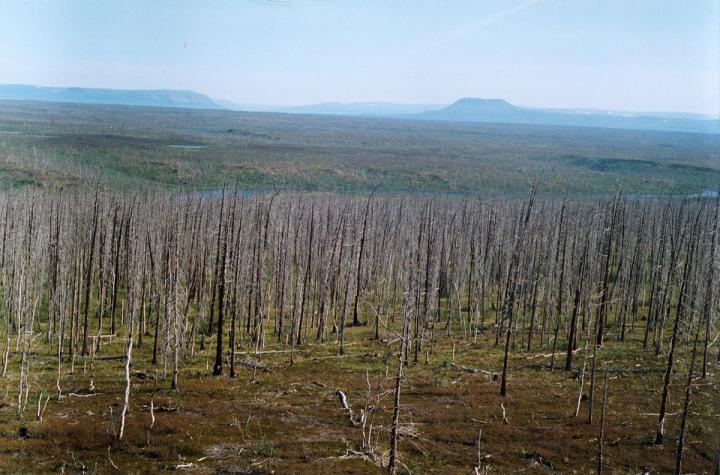
Credit: Photo courtesy of Alexander Kirdyanov

Madison, WI, September 29, 2020 – An international team of scientists that includes a USDA Forest Servicescientist based in New Hampshire used tree rings to document how “Arctic dimming,” the interference with sunlight caused by extreme pollution such as that at an industrial complex in northern Siberia, is killing trees and possibly affecting how trees respond to climate change.

The study, “Arctic Dimming and the Divergence Problem,” was published this week by the journal Ecology Letters. Kevin T. Smith, a supervisory plant physiologist with the Forest Service’s Northern Research Station, is the sole North American co-author of the study; lead author is Alexander V. Kirdyanov of the University of Cambridge in the United Kingdom.

The research team used dendroecology, dendrochemistry, and process-based forward modelling to explore the relationship of tree growth and mortality with industrial pollution at the Norilsk mining complex in northern Siberia; the complex is regarded as the most heavily polluted site on Earth. Their study describes the spatial and temporal dimensions of massive tree mortality associated with development of the industrial complex.

The study also sought to explain “The Divergence Problem,” a phenomenon in which scientists observed a surprising decline in tree growth despite increasing temperatures – normally a positive catalyst for tree growth – in the Arctic. They attribute the breakdown of the correlation between tree growth and climate in northern latitudes to “Arctic dimming,” the loss of direct sunlight available for photosynthesis due to interference by aerosol pollutants from Norilsk and other industrial centers in the Northern Hemisphere.

“Forests encircling the Arctic are important for a number of reasons, including their role in shaping the planet’s carbon cycle and climate system,” Smith said. “This study demonstrates the enormous scale of forest-atmosphere-industrial interactions, and it also demonstrates how much we can learn about trees and future of forests from the ecological and chemical history we find in tree rings.”

###

Media Contact
Jane Hodgins
[email protected]

Original Source

https://www.nrs.fs.fed.us/news/release/Arctic-dimming

Related Journal Article

http://dx.doi.org/10.1111/ele.13611

Tags: Atmospheric ScienceEcology/EnvironmentForestryPollution/Remediation
Share12Tweet8Share2ShareShareShare2

Related Posts

Florida Cane Toad: Complex Spread and Selective Evolution

Florida Cane Toad: Complex Spread and Selective Evolution

February 7, 2026
New Study Uncovers Mechanism Behind Burn Pit Particulate Matter–Induced Lung Inflammation

New Study Uncovers Mechanism Behind Burn Pit Particulate Matter–Induced Lung Inflammation

February 6, 2026

DeepBlastoid: Advancing Automated and Efficient Evaluation of Human Blastoids with Deep Learning

February 6, 2026

Navigating the Gut: The Role of Formic Acid in the Microbiome

February 6, 2026
Please login to join discussion

POPULAR NEWS

  • Robotic Ureteral Reconstruction: A Novel Approach

    Robotic Ureteral Reconstruction: A Novel Approach

    82 shares
    Share 33 Tweet 21
  • Digital Privacy: Health Data Control in Incarceration

    63 shares
    Share 25 Tweet 16
  • Study Reveals Lipid Accumulation in ME/CFS Cells

    57 shares
    Share 23 Tweet 14
  • Breakthrough in RNA Research Accelerates Medical Innovations Timeline

    53 shares
    Share 21 Tweet 13

About

We bring you the latest biotechnology news from best research centers and universities around the world. Check our website.

Follow us

Recent News

Personalized Guide to Understanding and Reducing Chemicals

Inflammasome Protein ASC Drives Pancreatic Cancer Metabolism

Phage-Antibiotic Combo Beats Resistant Peritoneal Infection

Subscribe to Blog via Email

Enter your email address to subscribe to this blog and receive notifications of new posts by email.

Join 73 other subscribers
  • Contact Us

Bioengineer.org © Copyright 2023 All Rights Reserved.

Welcome Back!

Login to your account below

Forgotten Password?

Retrieve your password

Please enter your username or email address to reset your password.

Log In
No Result
View All Result
  • Homepages
    • Home Page 1
    • Home Page 2
  • News
  • National
  • Business
  • Health
  • Lifestyle
  • Science

Bioengineer.org © Copyright 2023 All Rights Reserved.