• HOME
  • NEWS
  • EXPLORE
    • CAREER
      • Companies
      • Jobs
    • EVENTS
    • iGEM
      • News
      • Team
    • PHOTOS
    • VIDEO
    • WIKI
  • BLOG
  • COMMUNITY
    • FACEBOOK
    • INSTAGRAM
    • TWITTER
Sunday, May 10, 2026
BIOENGINEER.ORG
No Result
View All Result
  • Login
  • HOME
  • NEWS
  • EXPLORE
    • CAREER
      • Companies
      • Jobs
        • Lecturer
        • PhD Studentship
        • Postdoc
        • Research Assistant
    • EVENTS
    • iGEM
      • News
      • Team
    • PHOTOS
    • VIDEO
    • WIKI
  • BLOG
  • COMMUNITY
    • FACEBOOK
    • INSTAGRAM
    • TWITTER
  • HOME
  • NEWS
  • EXPLORE
    • CAREER
      • Companies
      • Jobs
        • Lecturer
        • PhD Studentship
        • Postdoc
        • Research Assistant
    • EVENTS
    • iGEM
      • News
      • Team
    • PHOTOS
    • VIDEO
    • WIKI
  • BLOG
  • COMMUNITY
    • FACEBOOK
    • INSTAGRAM
    • TWITTER
No Result
View All Result
Bioengineer.org
No Result
View All Result
Home NEWS Science News Chemistry

Second alignment plane of solar system discovered

Bioengineer by Bioengineer
September 29, 2020
in Chemistry
Reading Time: 3 mins read
0
IMAGE
Share on FacebookShare on TwitterShare on LinkedinShare on RedditShare on Telegram

IMAGE

Credit: NAOJ

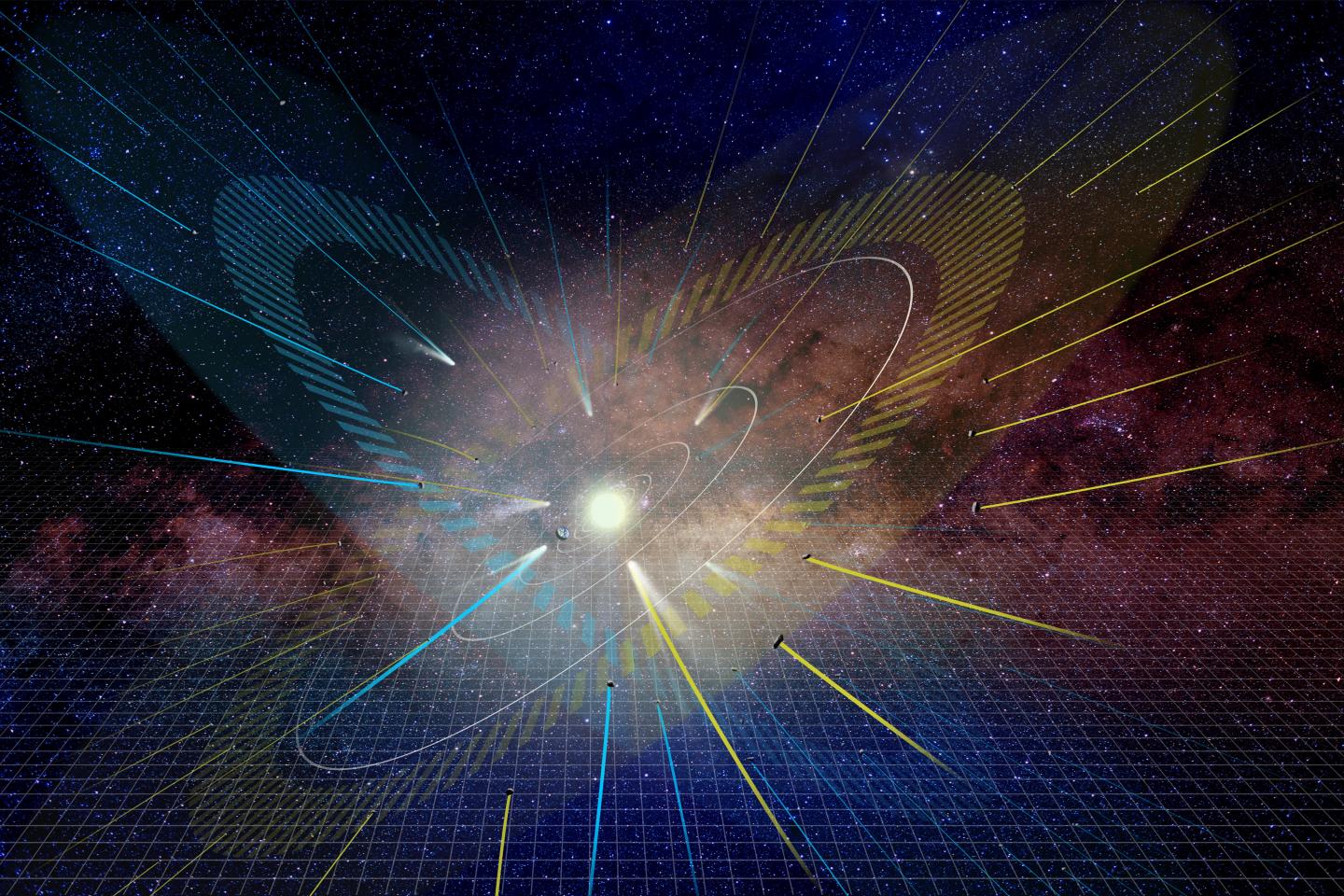
A study of comet motions indicates that the Solar System has a second alignment plane. Analytical investigation of the orbits of long-period comets shows that the aphelia of the comets, the point where they are farthest from the Sun, tend to fall close to either the well-known ecliptic plane where the planets reside or a newly discovered “empty ecliptic.” This has important implications for models of how comets originally formed in the Solar System.

In the Solar System, the planets and most other bodies move in roughly the same orbital plane, known as the ecliptic, but there are exceptions such as comets. Comets, especially long-period comets taking tens-of-thousands of years to complete each orbit, are not confined to the area near the ecliptic; they are seen coming and going in various directions.

Models of Solar System formation suggest that even long-period comets originally formed near the ecliptic and were later scattered into the orbits observed today through gravitational interactions, most notably with the gas giant planets. But even with planetary scattering, the comet’s aphelion, the point where it is farthest from the Sun, should remain near the ecliptic. Other, external forces are needed to explain the observed distribution. The Solar System does not exist in isolation; the gravitational field of the Milky Way Galaxy in which the Solar System resides also exerts a small but non-negligible influence. Arika Higuchi, an assistant professor at the University of Occupational and Environmental Health in Japan and previously a member of the NAOJ RISE Project, studied the effects of the Galactic gravity on long-period comets through analytical investigation of the equations governing orbital motion. She showed that when the Galactic gravity is taken into account, the aphelia of long-period comets tend to collect around two planes. First the well-known ecliptic, but also a second “empty ecliptic.” The ecliptic is inclined with respect to the disk of the Milky Way by about 60 degrees. The empty ecliptic is also inclined by 60 degrees, but in the opposite direction. Higuchi calls this the “empty ecliptic” based on mathematical nomenclature and because initially it contains no objects, only later being populated with scattered comets.

Higuchi confirmed her predictions by cross-checking with numerical computations carried out in part on the PC Cluster at the Center for Computational Astrophysics of NAOJ. Comparing the analytical and computational results to the data for long-period comets listed in NASA’s JPL Small Body Database showed that the distribution has two peaks, near the ecliptic and empty ecliptic as predicted. This is a strong indication that the formation models are correct and long-period comets formed on the ecliptic. However, Higuchi cautions, “The sharp peaks are not exactly at the ecliptic or empty ecliptic planes, but near them. An investigation of the distribution of observed small bodies has to include many factors. Detailed examination of the distribution of long-period comets will be our future work. The all-sky survey project known as the Legacy Survey of Space and Time (LSST) will provide valuable information for this study.”

###

Media Contact
Dr. Hitoshi Yamaoka
[email protected]

Original Source

https://www.nao.ac.jp/en/news/science/2020/20200929-rise.html

Related Journal Article

http://dx.doi.org/10.3847/1538-3881/aba94d

Tags: AstronomyAstrophysicsComets/AsteroidsSpace/Planetary Science
Share12Tweet8Share2ShareShareShare2

Related Posts

Miniature Sensor Uses Light to Detect Touch — Chemistry

Miniature Sensor Uses Light to Detect Touch

May 8, 2026
Iron Minerals Determine Whether Dissolved Organic Matter Fuels Microbes or Becomes Long-Term Carbon Storage — Chemistry

Iron Minerals Determine Whether Dissolved Organic Matter Fuels Microbes or Becomes Long-Term Carbon Storage

May 8, 2026

Kate Evans Appointed Associate Lab Director for Biological and Environmental Systems Science at ORNL

May 8, 2026

Advancing Multiscale Modeling and Overcoming Operational Challenges in Autothermal COâ‚‚-to-Methanol Reactors

May 8, 2026
Please login to join discussion

POPULAR NEWS

  • Research Indicates Potential Connection Between Prenatal Medication Exposure and Elevated Autism Risk

    840 shares
    Share 336 Tweet 210
  • New Study Reveals Plants Can Detect the Sound of Rain

    727 shares
    Share 290 Tweet 181
  • Scientists Investigate Possible Connection Between COVID-19 and Increased Lung Cancer Risk

    68 shares
    Share 27 Tweet 17
  • Salmonella Haem Blocks Macrophages, Boosts Infection

    61 shares
    Share 24 Tweet 15

About

We bring you the latest biotechnology news from best research centers and universities around the world. Check our website.

Follow us

Recent News

Evaluating Digoxin Use in Patients with Symptomatic Rheumatic Heart Disease

Evaluating the Effectiveness and Safety of Digitalis Glycosides in Treating Heart Failure

Urdu Fall Risk Questionnaire Adapted for Elderly

Subscribe to Blog via Email

Enter your email address to subscribe to this blog and receive notifications of new posts by email.

Join 82 other subscribers
  • Contact Us

Bioengineer.org © Copyright 2023 All Rights Reserved.

Welcome Back!

Login to your account below

Forgotten Password?

Retrieve your password

Please enter your username or email address to reset your password.

Log In
No Result
View All Result
  • Homepages
    • Home Page 1
    • Home Page 2
  • News
  • National
  • Business
  • Health
  • Lifestyle
  • Science

Bioengineer.org © Copyright 2023 All Rights Reserved.