Scientists have studied a correlation between the shape of thermal energy storages and their efficiency
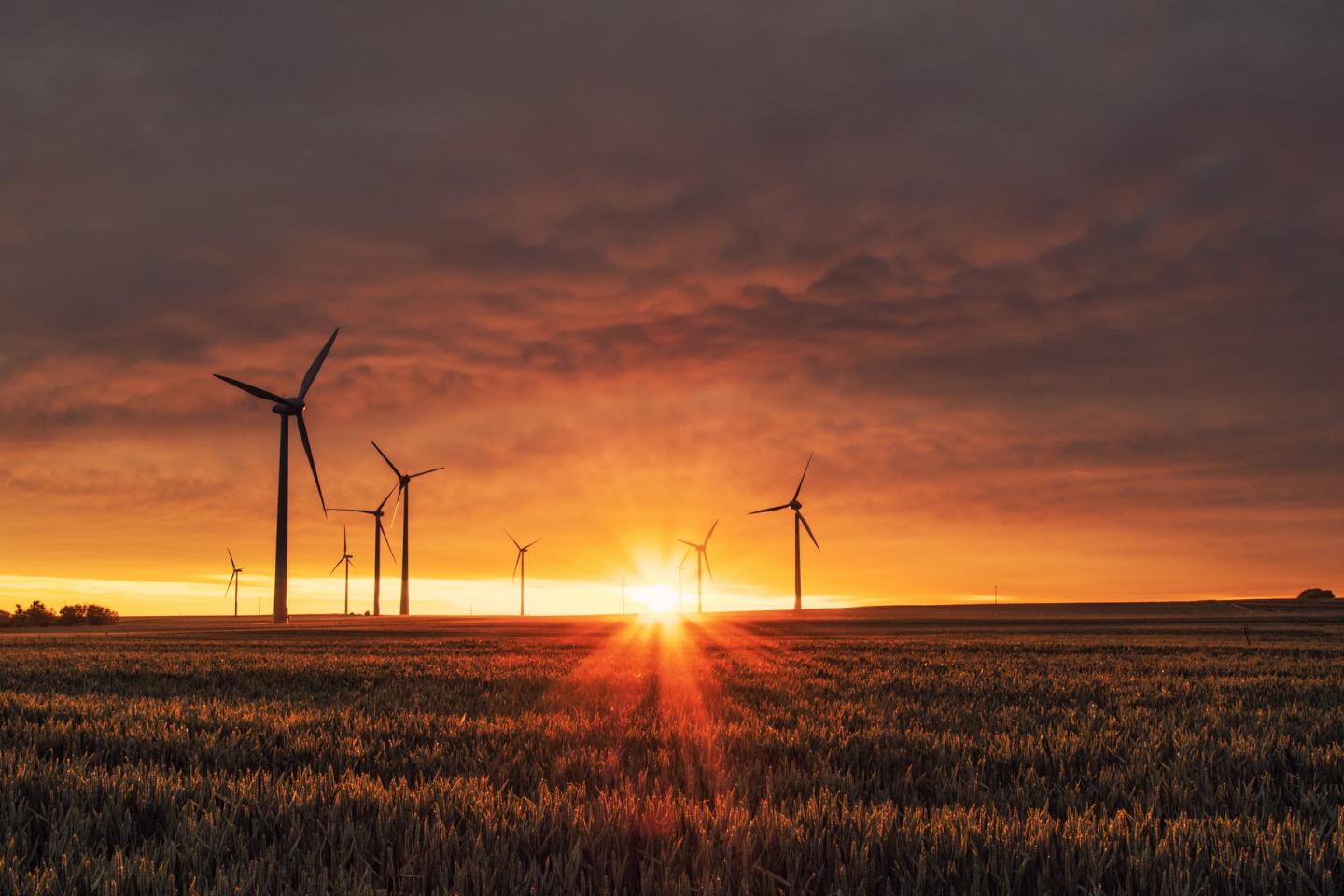
Credit: Karsten Würth, Unsplash
Scientists from Far Eastern Federal University (FEFU), and the Institute of Automation and Control Processes of the Far Eastern Branch of the Russian Academy of Sciences (IACP FEB RAS) have studied a correlation between the shape of Thermal Energy Storages (TES) used in traditional and renewable energy sectors and their efficiency. Using the obtained data, design engineers might be able to improve TES for specific needs. A related article was published in the Renewable Energy.
The scientists studied a correlation between the shape and efficiency of TES based on granular phase change materials. When heated, such materials change their phase from the solid to the liquid state, thus preserving the heat energy. When they solidify again, energy output takes place. Devices based on this principle are used in advanced energy systems.
Using a computational model that had been developed previously, the team found out the effect of narrowing and expansion of cylinder-shaped TES on the process of their charging (energy input), energy storage, and discharging (energy output) depending on various preference criteria.
“To study the charging and discharging of TES with different shapes, we used six efficiency criteria. In some cases, a heat accumulator that stores more energy is the most preferable. In other cases, a unit with the fastest charge time is the most efficient. It is the same for discharge: some need a device with the biggest energy output, and some would prefer one with maximal time of keeping the outlet temperature not lower than a given value,” said Nickolay Lutsenko, a co-author of the work, a Professor at the Engineering Department of the Polytechnic Institute (School), FEFU, and a Laboratory Head at IACP FEB RAS.
According to the scientist’ research, TES with straight walls are often the most preferable. However, the shape of a unit can depend on efficiency criteria and the details of the process, such as boundary conditions, phase transition temperature, and so on. In some scenarios, narrowing or expanding TES can be more beneficial than straight walls ones.
Thermal energy storages can also be parts of other types of energy accumulators, such as adiabatic compressed air energy storages that are used to store cheap energy coming from traditional power plants in the night time or from solar batteries and wind turbines in favorable weather conditions. Energy output from these storage units takes place in peak energy consumption times, such as mornings or evenings.
“These units store the energy of compressed gas that is pumped by compressors into huge containers capable of keeping it for a long time. When there is a shortage of energy, compressed gas is transmitted to turbines that move power plant generators. However, traditional compressed air energy storages have a disadvantage: when gas is compressed and pumped, its temperature increases, but the heat is lost. And when gas is released from containers, its temperature decreases, and it needs to be warmed up again before being transmitted to a turbine. To do so, power plants must consume fuel. Adiabatic compressed air energy storages, that are being developed today, make compressed gas go through a TES after pumping so that it only comes to a container after it releases all its heat. And when gas must be transmitted to a turbine, it passes through the same TES again where it absorbs energy and warms up. The performance factor of such units is much higher, and moreover they are more environmentally friendly, as no fuel needs to be burned and no atmospheric emissions take place,” added Nickolay Lutsenko.
###
Another author of the work, Sergey Fetsov, is a post-graduate student working under the supervision of Prof. N. Lutsenko. He was awarded the medal of the Russian Academy of Sciences for his work “Numerical simulation of gas flow through a layer of a granulated material with phase transition” as the best student in 2019 year.
FEFU and FEB RAS provide a site for scientists, postgraduates, and students to conduct studies in different fields of multicomponent continuum mechanics under the supervision of Prof. N. Lutsenko. Besides modeling the innovative energy systems based on composite phase change materials, the teams study filtration combustion of natural and manmade porous systems and develop prototypes of low-temperature gas generators for advanced hypersonic aircrafts.
Media Contact
Alex Zverev
[email protected]
Related Journal Article
http://dx.