Credit: Universidad de Córdoba
Consumers always look for good quality products, above all in fresh food like vegetables. But how do we measure the quality of fresh spinach before it gets on the market nowadays? The most commonly used methods to analyze vegetable quality are slow, costly and destructive. They require choosing several samples from the same batch, to be analyzed later at a laboratory. In order to carry out different kinds of analyses, the product must be destroyed, so an entire harvest cannot be used.
A University of Cordoba team sought to find a solution to this issue by proposing the use of a non-invasive kind of technology: near infrared spectroscopy, abbreviated to NIRS. Though its use is widespread in many fields, such as in the food sector, it is also used in the fields of chemistry, pharmaceutics and even biomedicine.
“This technique is based on light interacting with a product in order to gather information about its physical-chemical make-up, its structure and even parameters related to its sensorial characteristics”, explains researcher Dolores Pérez Marín who, along with María Teresa Sánchez, leads a line of research studying the use of NIRS sensors as applied to fruit and vegetables. Research groups PAIDI AGR-128 and AGR-193 have been working together on this line of research for years. In particular, this study was performed within the framework of Irina Torres Rodríguez’s doctoral thesis research, in partnership with the industrial sector.
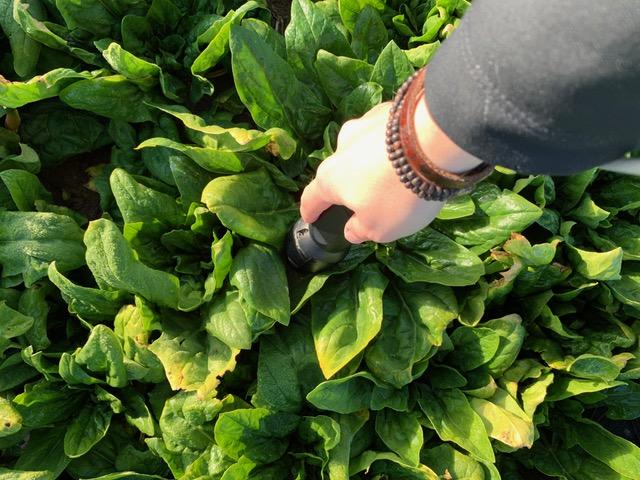
The aim of this study was to develop prediction models for parameters linked to food quality and safety of spinach, by means of using a portable NIRS micro instrument, which is very small in size, that allows researchers to analyze the product directly in the field, as well as at reception and processing points the product passes through. “The results are very positive”, says Dolores Pérez Marín. “They show this technology’s ability to directly analyze vegetables in the farm field or within the industry, in order to determine the characteristics related to quality as well as food safety”.
As far as quality is concerned, the product’s soluble solid content was studied, which helps plan the best harvest date at the point when a suitable level has been reached. Also, nitrate content was analyzed as well, which allows farmers to set appropriate fertilizer amounts for each crop. This is of utmost interest for the product’s food safety, given that European regulations have established a maximum level of nitrates that can be present in vegetables depending on if they will be used for baby food, consumed fresh or will be processed.
The study concludes, therefore, that NIRS spectroscopy offers ideal features in order to provide answers to current needs in quality control in the food sector. It is fast, accurate, environmentally friendly, affordable and non-destructive. “In fact, this knowledge is receiving quite a lot of interest within the sector. There is already a company that is using this technology provided by UCO”, the researcher comments.
This research team continues to make progress in the use of new instruments and applications on other food products. The use of NIRS technology within the food industry is a very new topic that could revolutionize quality control systems. Specifically, its use as a non-directed method, an approach that does not look for a particular component, as traditional lab analyses do, but rather tries to find out if the product is different from set standards, will undoubtedly enable us to stay one step ahead of future food crises.
###
Irina Torres, María Teresa Sánchez, Dolores Pérez Marín. Integrated soluble solid and nitrate content assessment of spinach plants using portable NIRS sensors along the supply chain. Postharvest Biology and Technology. https:/
Media Contact
Elena Lázaro
[email protected]
Original Source
https:/
Related Journal Article
http://dx.