Individual Pt atoms participate in catalytic reaction to faciitate the electrode process by up to 10 times. Single-atom Pt catalysts are stable at 700 degrees Celsius and expected to stimulate the commercialization of next-gen reversible fuel cells.
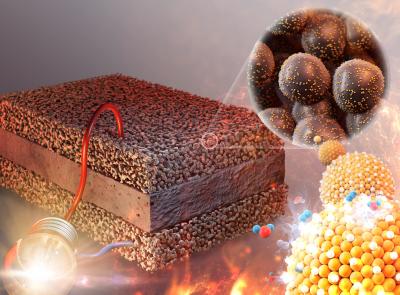
Credit: Korea Institue of Science and Technology(KIST)
Unlike secondary batteries that need to be recharged, fuel cells are a type of eco-friendly power generation systems that produce electricity directly from electrochemical reactions using hydrogen as fuel and oxygen as oxidant. There are various types of fuel cells, differing in operating temperatures and electrolyte materials. Among them, the solid oxide fuel cell (SOFC), which uses a ceramic electrolyte, are receiving increasing attention. Because it operates at high temperatures aroung 700 degrees Celsius, it offers the highest efficiency among various fuel cells, and it can also be used to produce hydrogen by steam decomposition. For the commercialization of this technology, further improvement of cell performance is necessary, and novel high-temperature catalyst materials are highly anticipated.
Platinum (Pt)-based catalysts demonstrate such excellent performance in fuel cell electrode reactions. Particularly, single-atom Pt catalysts are actively investigated due to their unique functionality. However, at high temperatures, the Pt atoms are not stable and easily agglomerate. Therefore, Pt single-atom catalysts have been used only in low-temperature fuel cells, like polymer-electrolyte membrane fuel cells, which is used for hydrogen electric vehicles.
Under these circumstances, a domestic research team have developed a catalyst that requires only a small amount of platinum for the significant improvement of performance and can operate stably at high temperatures. The Korea Institute of Science and Technology (KIST) announced that Dr. Kyung-Joong Yoon and Researcher Ji-Su Shin from the Center for Energy Materials Research, together with Professor Yun -Jung Lee from Hanyang University (Hanyang University, President Woo-Seung Kim), developed a single-atom Pt catalyst that can be used for SOFCs.
In their research, entire platinum atoms are evenly distributed and function individually without agglomeration even at high temperatures. It has been experimentally shown to increase the electrode reaction rate by more than 10 times. It can also operate for more than 500 hours even at high temperatures up to 700 degrees Celsius and improves the electric power generation and hydrogen production performance by 3-4 times. It is expected to accelerate the commercialization of solid oxide fuel cells (SOFCs), the next-generation eco-friendly fuel cells.
The single-atom catalyst jointly developed by KIST-Hanyang University research team is made by combining platinum atoms and cerium (Ce) oxide nanoparticles. Each platinum atom is individually dispersed on the surface of the cerium oxide nanoparticles, and the strong bond maintains the dispersed state of the atoms for a long duration of time even at high temperatures, which allows all platinum atoms to be involved in the reaction. This in turn makes it possible to substantially improve the rate of the electrode reaction while minimizing the amount of platinum used.
For the fabrication, a solution containing platinum and cerium ions is injected into the electrode of the SOFC, and the catalysts are synthesized while the fuel cell is operating at a high temperature. Because the injection into the electrode can be performed easily without any special equipment, it expected that the newly developed catalyst can readily be applied to existing fuel cell fabrication processes.
Dr. Kyung-Joong Yoon from KIST stated, “The catalyst developed in this study can be applied to a wide variety of solid oxide fuel cells and high-temperature electrochemical devices using an easy and simple low-cost process, so it is expected to accelerate the development of next-generation eco-friendly power generation and energy storage devices.” “Based on the fact that the single-atom catalyst can operate stably even at 700 degrees Celsius or higher, its application fields will be greatly expanded, including high-temperature thermochemical reactions and high-temperature electrochemical reactions.”
###
This study was carried out with a grant from the Ministry of Science and ICT (MSIT), as part of the Institutional R&D Program of KIST and the Korea Research Foundation’s Program on Development of Technology in Response to Climate Change. This paper was published in the latest edition of Energy & Environmental Science (IF: 30.289, top 0.189% in the field of JCR).
Media Contact
Do-Hyun Kim
[email protected]
Related Journal Article
http://dx.