Credit: Stefan Eisebitt/Max Born Institute
In 1921, Albert Einstein received the Nobel Prize in physics for the discovery that light is quantized, interacting with matter as a stream of particles called photons. Since these early days of quantum mechanics, it is known that photons also possess momentum. The photon’s ability to transfer momentum was used in a novel approach by scientists of the Max Born Institute, Uppsala University, and the European X-Ray Free-Electron Laser Facility to observe a fundamental process in the interaction of x-rays with atoms. The detailed experimental and theoretical results are reported in the journal Science.
Absorption as well as emission of a photon by an atom are fundamental processes of the interaction of light with matter. Much rarer are processes in which several photons simultaneously interact with one atom. The availability of intense laser beams since the 1960s has led to the development of “nonlinear optics”, which observes and utilizes such processes.
Entirely new possibilities emerge if it is possible to use nonlinear optics with x-rays instead of visible light. The use of ultrashort flashes of x-rays allows for detailed insight into the motion of electrons and atomic nuclei in molecules and solids. This perspective was one of the drivers leading to the construction of x-ray lasers based on particle accelerators in several countries. When the European x-ray free-electron laser, the European XFEL, started operation in 2017, the scientific community made an important step in that direction. Nevertheless, progress in the use of nonlinear x-ray processes to study fundamental interaction with matter has been slower than expected. “Typically, the much stronger linear processes occlude the interesting nonlinear processes”, says Prof. Ulli Eichmann from Max Born Institute for nonlinear optics and short pulse spectroscopy in Berlin.
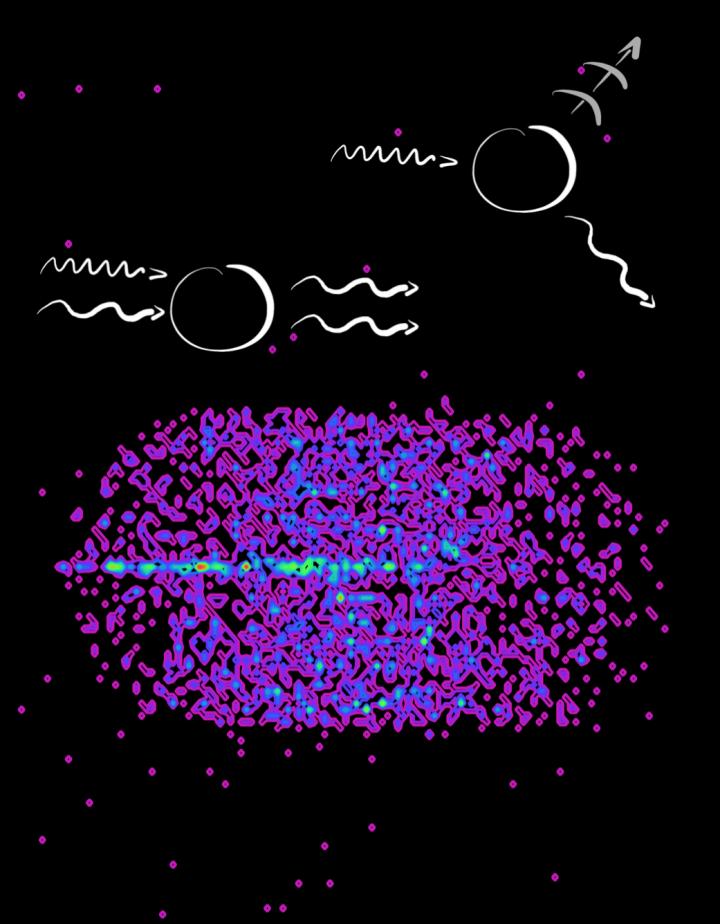
The German-Swedish research team has now demonstrated a new method allowing to observe the nonlinear processes without being disturbed by the linear processes. To this end, the team made use of the momentum that is transferred between x-rays and atoms. When crossing a supersonic atomic beam with the x-ray beam, they can identify those atoms which have undergone the so-called stimulated Raman scattering process – a fundamental nonlinear process, where two photons of different wavelength hit an atom and two photons of the longer wavelength leave the atom. The results were reported in the journal Science.
“Photons transfer momentum to an atom – completely analogous to a billiard ball hitting another one”, explains Eichmann. In the stimulated Raman process, both photons leave the atom in the exact same direction as the two incident photons, hence the momentum of the atom and its direction of flight remain essentially unchanged. The much more frequent linear processes, where one photon is absorbed followed by the emission of another photon, have a different signature: as the emitted photon is typically emitted in a different direction, the atom will be deflected. Observing the direction of the atoms the scientists could thus clearly discriminate the stimulated Raman process from other processes.
“The new method opens unique possibilities when combined in the future with two time-delayed x-ray pulses of different wavelength. Such pulse patterns have recently become available at x-ray lasers, like the European XFEL”, explains Dr. Michael Meyer, researcher at the European XFEL. As x-ray pulses with different wavelength allow to specifically address particular atoms in a molecule, it is possible to observe in detail how the wavefunctions of electrons in molecules evolve over time. In the long run, the scientists hope to not only observe this evolution, but to influence it via tailored laser pulses. “Our approach allows for a better understanding of chemical reactions on the atomic scale and may help to steer the reactions in a desired direction. As the movement of electrons is the essential step in chemical and photochemical reactions occurring e.g. in batteries and solar cells, our approach may give new insight in such processes as well”, says Jan-Erik Rubensson, professor at Uppsala University.
###
Media Contact
Prof. Dr. Ulrich Eichmann
[email protected]
Original Source
https:/
Related Journal Article
http://dx.