Engineers develop Hyperspectral Stripe Projector to quickly merge depth, spectral data
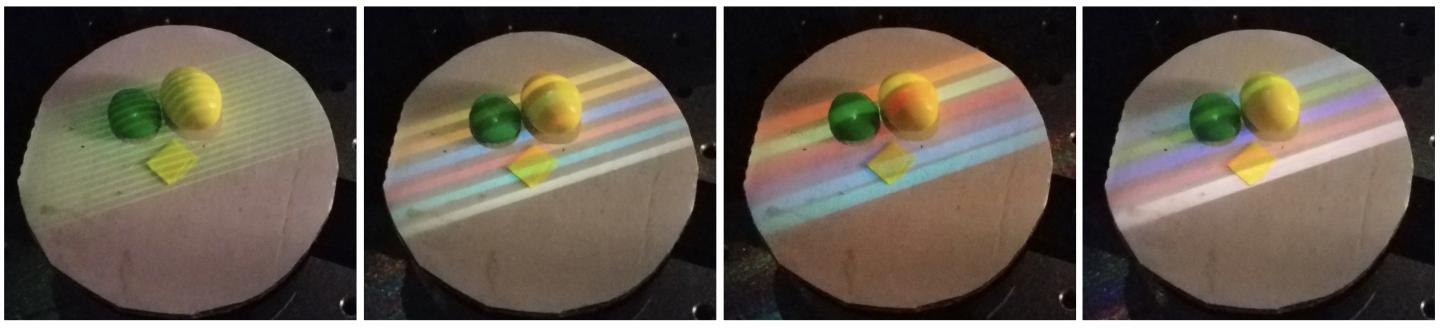
Credit: Kelly Lab/Rice University
HOUSTON – (Sept. 24, 2020) – Stripes are in fashion this season at a Rice University lab, where researchers use them to make images that plain cameras could never capture.
Their compact Hyperspectral Stripe Projector (HSP) is a step toward a new method to collect the spatial and spectral information required for self-driving cars, machine vision, crop monitoring, surface wear and corrosion detection and other applications.
“I can envision this technology in the hands of a farmer, or on a drone, to look at a field and see not only the nutrients and water content of plants but also, because of the 3D aspect, the height of the crops,” said Kevin Kelly, an associate professor of electrical and computer engineering at Rice’s Brown School of Engineering. “Or perhaps it can look at a painting and see the surface colors and texture in detail, but with near-infrared also see underneath to the canvas.”
Kelly’s lab could enable 3D spectroscopy on the fly with a system that combines the HSP, a monochrome sensor array and sophisticated programming to give users a more complete picture of an object’s shape and composition.
“We’re getting four-dimensional information from an image, three spatial and one spectral, in real time,” Kelly said. “Other people use multiple modulators and thus require bright light sources to accomplish this, but we found we could do it with a light source of normal brightness and some clever optics.”
The work by Kelly, lead author and Rice alumna Yibo Xu and graduate student Anthony Giljum is detailed in an open-access paper in Optics Express.
HSP takes a cue from portable 3D imaging techniques that are already in consumers’ hands — think of face ID systems in smartphones and body trackers in gaming systems — and adds a way to pull broad spectral data from every pixel captured. This compressed data is reconstructed into a 3D map with spectral information that can incorporate hundreds of colors and be used to reveal not only the shape of an object but also its material composition.
“Regular RGB (red, green, blue) cameras basically give you only three spectral channels,” Xu said. “But a hyperspectral camera gives us spectra in many, many channels. We can capture red at around 700 nanometers and blue at around 400 nanometers, but we can also have bandwidths at every few nanometers or less between. That gives us fine spectral resolution and a fuller understanding of the scene.
“HSP simultaneously encodes the depth and hyperspectral measurements in a very simple and efficient way, allowing the use of a monochrome camera instead of an expensive hyperspectral camera as typically used in similar systems,” said Xu, who earned her doctorate at Rice in 2019 and is now a machine learning and computer vision research engineer at Samsung Research America Inc. She developed both the hardware and reconstruction software as part of her thesis in Kelly’s lab.
HSP uses an off-the-shelf digital micromirror device (DMD) to project patterned stripes that look something like colorful bar codes onto a surface. Sending the white-light projection through a diffraction grating separates the overlapping patterns into colors.
Each color is reflected back to the monochrome camera, which assigns a numerical grey level to that pixel.
Each pixel can have multiple levels, one for every color stripe it reflects. These are recombined into an overall spectral value for that part of the object.
“We use a single DMD and a single grating in HSP,” Xu said. “The novel optical design of folding the light path back to the same diffraction grating and lens is what makes it really compact. The single DMD allows us to keep the light we want and throw away the rest.”
These finely tuned spectra can reach beyond visible light. What they reflect back to the sensor as multiplexed fine-band spectra can be used to identify the material’s chemical composition.
At the same time, distortions in the pattern are reconstructed into 3D point clouds, essentially a picture of the target, but with a lot more data than a plain snapshot could provide.
Kelly envisions HSP built into car headlights that can see the difference between an object and a person. “It could never get confused between a green dress and a green plant, because everything has its own spectral signature,” he said.
Kelly believes the lab will eventually incorporate ideas from Rice’s groundbreaking single-pixel camera to further reduce the size of the device and adapt it for compressive video capture as well.
The National Science Foundation funded the research.
###
Read the paper at https:/
This news release can be found online at https:/
Follow Rice News and Media Relations via Twitter @RiceUNews
Related materials:
Single-pixel camera has multiple futures: http://news.
Kevin Kelly: https:/
Department of Electrical and Computer Engineering: https:/
George R. Brown School of Engineering: https:/
Video:
https:/
CAPTION: Rice University engineers turned a set of monochrome camera captures from a 3D hyperspectral imaging system based on the Hyperspectral Stripe Projector into 4D data of spatial and spectral information. This video demonstrates the spatial reconstruction of the targets. (Credit: Kelly Lab/Rice University)
Images for download:
https:/
Patterns adorns a static model used to test Rice University’s Hyperspectral Stripe Projector, which combines spectroscopic and 3D imaging. Barcode-like black and white patterns are displayed on the DMD to generate the hyperspectral stripes. (Credit: Kelly Lab/Rice University)
https:/
A 3D point cloud of objects reconstructed by Rice University’s Hyperspectral Stripe Projector- based imaging system. The monochrome camera also captures spectral data for each point to provide not only the target’s form but also its material composition. (Credit: Kelly Lab/Rice University)
https:/
A target and its point cloud image show one capability of Rice University’s Hyperspectral Stripe Projector, which acquires 3D data and spectral data for each point to provide not only the target’s form but also its material composition. (Credit: Kelly Lab/Rice University)
https:/
Rice University engineers Kevin Kelly and Yibo Xu lead the development of the Hyperspectral Stripe Projector, which combines the capture of spectroscopic data of an object with 3D imaging into a single system that uses a monochrome camera as the sensor instead of a hyperspectral camera. (Credit: Kelly Lab/Rice University)
Located on a 300-acre forested campus in Houston, Rice University is consistently ranked among the nation’s top 20 universities by U.S. News & World Report. Rice has highly respected schools of Architecture, Business, Continuing Studies, Engineering, Humanities, Music, Natural Sciences and Social Sciences and is home to the Baker Institute for Public Policy. With 3,978 undergraduates and 3,192 graduate students, Rice’s undergraduate student-to-faculty ratio is just under 6-to-1. Its residential college system builds close-knit communities and lifelong friendships, just one reason why Rice is ranked No. 1 for lots of race/class interaction and No. 1 for quality of life by the Princeton Review. Rice is also rated as a best value among private universities by Kiplinger’s Personal Finance.
Jeff Falk
713-348-6775
jfalk@rice.edu
Mike Williams
713-348-6728
mikewilliams@rice.edu
Media Contact
Jeff Falk
jfalk@rice.edu
Original Source
https:/
Related Journal Article
http://dx.