• HOME
  • NEWS
  • EXPLORE
    • CAREER
      • Companies
      • Jobs
    • EVENTS
    • iGEM
      • News
      • Team
    • PHOTOS
    • VIDEO
    • WIKI
  • BLOG
  • COMMUNITY
    • FACEBOOK
    • INSTAGRAM
    • TWITTER
Saturday, February 7, 2026
BIOENGINEER.ORG
No Result
View All Result
  • Login
  • HOME
  • NEWS
  • EXPLORE
    • CAREER
      • Companies
      • Jobs
        • Lecturer
        • PhD Studentship
        • Postdoc
        • Research Assistant
    • EVENTS
    • iGEM
      • News
      • Team
    • PHOTOS
    • VIDEO
    • WIKI
  • BLOG
  • COMMUNITY
    • FACEBOOK
    • INSTAGRAM
    • TWITTER
  • HOME
  • NEWS
  • EXPLORE
    • CAREER
      • Companies
      • Jobs
        • Lecturer
        • PhD Studentship
        • Postdoc
        • Research Assistant
    • EVENTS
    • iGEM
      • News
      • Team
    • PHOTOS
    • VIDEO
    • WIKI
  • BLOG
  • COMMUNITY
    • FACEBOOK
    • INSTAGRAM
    • TWITTER
No Result
View All Result
Bioengineer.org
No Result
View All Result
Home NEWS Science News

ANU invention to inspire new night-vision specs

Bioengineer by Bioengineer
December 7, 2016
in Science News
Reading Time: 2 mins read
0
Share on FacebookShare on TwitterShare on LinkedinShare on RedditShare on Telegram
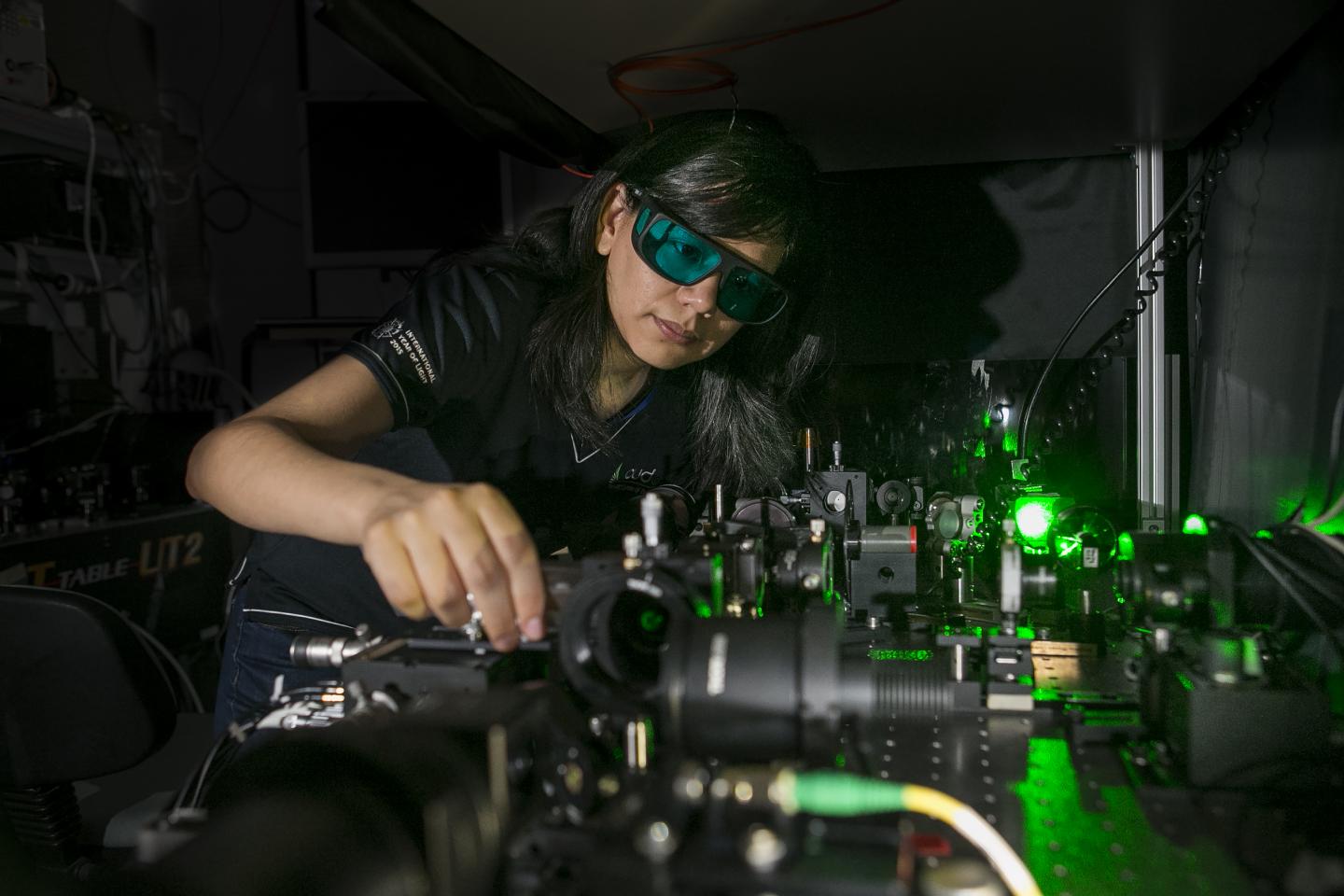
IMAGE

Credit: Stuart Hay, ANU

Scientists at The Australian National University (ANU) have designed a nano crystal around 500 times smaller than a human hair that turns darkness into visible light and can be used to create light-weight night-vision glasses.

Professor Dragomir Neshev from ANU said the new night-vision glasses could replace the cumbersome and bulky night-vision binoculars currently in use.

"The nano crystals are so small they could be fitted as an ultra-thin film to normal eye glasses to enable night vision," said Professor Neshev from the Nonlinear Physics Centre within the ANU Research School of Physics and Engineering.

"This tiny device could have other exciting uses including in anti-counterfeit devices in bank notes, imaging cells for medical applications and holograms."

Co-researcher Dr Mohsen Rahmani said the ANU team's achievement was a big milestone in the field of nanophotonics, which involves the study of behaviour of light and interaction of objects with light at the nano-scale.

"These semi-conductor nano-crystals can transfer the highest intensity of light and engineer complex light beams that could be used with a laser to project a holographic image in modern displays," said Dr Rahmani, a recipient of the Australian Research Council (ARC) Discovery Early Career Researcher Award based at the ANU Research School of Physics and Engineering.

PhD student Maria del Rocio Camacho-Morales said the team built the device on glass so that light can pass through, which was critical for optical displays.

"This is the first time anyone has been able to achieve this feat, because growing a nano semi-conductor on a transparent material is very difficult," said Ms Camacho-Morales from the Nonlinear Physics Centre at ANU.

###

The innovation builds on more than 15 years of research supported by the ARC through CUDOS, a Centre of Excellence, and the Australian National Fabrication Facility.

The research is published in Nano Letters and is being presented by Dr Rahmani at the Australian Institute of Physics Congress in Brisbane this week: http://pubs.acs.org/doi/abs/10.1021/acs.nanolett.6b03525

The paper and related images are available via this Dropbox link: https://www.dropbox.com/sh/0b3d8ofo2tyscuz/AABNkmUbySCXhdEby5dmT0-Ia?dl=0

Watch a video interview with the researchers on the ANU YouTube channel: https://youtu.be/Y0TDZb7U_l8

Media Contact

Dragomir Neshev
[email protected]
61-405-019-061
@ANUmedia

http://www.anu.edu.au/media

############

Story Source: Materials provided by Scienmag
Share14Tweet9Share2ShareShareShare2

Related Posts

Evaluating Pediatric Emergency Care Quality in Ethiopia

February 7, 2026

TPMT Expression Predictions Linked to Azathioprine Side Effects

February 7, 2026

Improving Dementia Care with Enhanced Activity Kits

February 7, 2026

Decoding Prostate Cancer Origins via snFLARE-seq, mxFRIZNGRND

February 7, 2026
Please login to join discussion

POPULAR NEWS

  • Robotic Ureteral Reconstruction: A Novel Approach

    Robotic Ureteral Reconstruction: A Novel Approach

    82 shares
    Share 33 Tweet 21
  • Digital Privacy: Health Data Control in Incarceration

    63 shares
    Share 25 Tweet 16
  • Study Reveals Lipid Accumulation in ME/CFS Cells

    57 shares
    Share 23 Tweet 14
  • Breakthrough in RNA Research Accelerates Medical Innovations Timeline

    53 shares
    Share 21 Tweet 13

About

We bring you the latest biotechnology news from best research centers and universities around the world. Check our website.

Follow us

Recent News

Evaluating Pediatric Emergency Care Quality in Ethiopia

TPMT Expression Predictions Linked to Azathioprine Side Effects

Improving Dementia Care with Enhanced Activity Kits

Subscribe to Blog via Email

Success! An email was just sent to confirm your subscription. Please find the email now and click 'Confirm' to start subscribing.

Join 73 other subscribers
  • Contact Us

Bioengineer.org © Copyright 2023 All Rights Reserved.

Welcome Back!

Login to your account below

Forgotten Password?

Retrieve your password

Please enter your username or email address to reset your password.

Log In
No Result
View All Result
  • Homepages
    • Home Page 1
    • Home Page 2
  • News
  • National
  • Business
  • Health
  • Lifestyle
  • Science

Bioengineer.org © Copyright 2023 All Rights Reserved.