UC San Diego engineer Boris Kramer is part of a team that will develop software to forecast space storms.
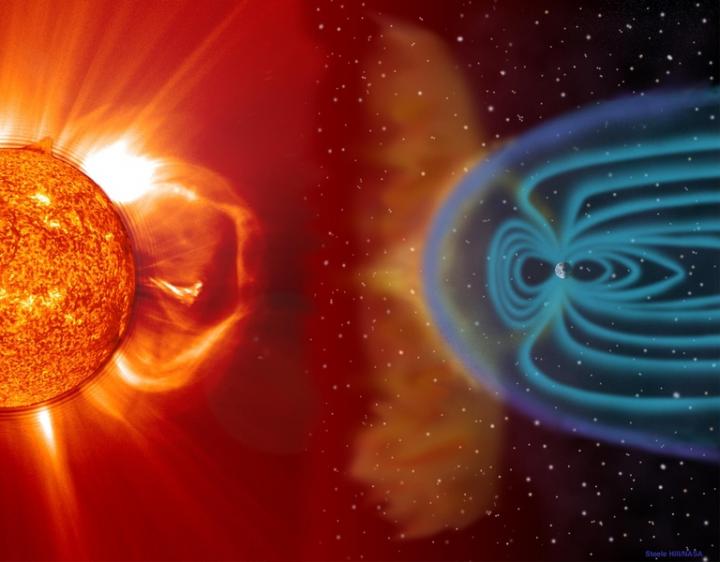
Credit: NASA
In August 1859, a massive solar storm knocked out the global telegraph system. Some telegraph operators were hit by electric shocks; others saw sparks flying from cable pylons. Telegraph transmissions were halted for days.
The damage was due to a geomagnetic storm caused by a series of coronal mass ejections–giant bursts from the sun’s surface–that raced across the solar system and saturated Earth’s atmosphere with magnetic solar energy.
If a solar storm of similar scale occurred today, it would cause worldwide blackouts, massive network failures and widespread damage to the satellites that enable GPS and telecommunication. Worse still, it would threaten human health due to increased levels of radiation.
The arrival and intensity of these solar storms can be difficult to predict. To improve the ability to forecast space weather, a multidisciplinary team of researchers, including Professor Boris Kramer at the University of California San Diego, received $3.1 million from the National Science Foundation. The researchers, led by Professor Richard Linares at the Massachusetts Institute of Technology, will also work on speeding up the forecasting abilities that are currently available.
Speeding up forecasts
“Space weather models often need to be evaluated rather quickly, for example when they are used for control of satellites, so I am excited to contribute with new data-driven reduced-order modeling approaches to this overall goal, and make space weather models not only better, but also faster,” said Kramer, who is part of the Department of Mechanical and Aerospace Engineering at the UC San Diego Jacobs School of Engineering.
The algorithms for complex space weather models that Kramer will develop will speed up the time it takes to execute the models’ simulations and lead to real-time estimations. As a result, decision makers will have real-time information to make sure satellites avoid collisions. The project will also improve satellite navigation overall.
Making forecasts more accurate
“A second big issue are the massive uncertainties that weather, and here specifically space weather, is subject to,” he added. “There are so many parameters we don’t know well, or can’t measure in outer space. Our work here at UC San Diego will help tell us what uncertainties are present in our computed, predicted weather simulations, given that there are so many inputs that are uncertain. I am excited to work with the MIT Haystack Observatory to get high-quality data of the ionosphere that we can use to calibrate our predictions.”
Kramer will develop theory and multifidelity algorithms to quantify the uncertainty in space weather models. The goal is to at least match the accuracy of the models that predict hurricanes, which include a likely path and an estimate of other areas where hurricanes could be headed. Researchers want to be able to predict a likely path for a solar storm, for example, and also draw a cone around that path, showing the other areas it might be headed to instead.
Powerful software platform
The team, which also includes researchers at the University of Michigan, will create a powerful, flexible software platform using cutting-edge computational tools to collect and analyze huge sets of observational data that can be easily shared and reproduced among researchers. The platform will also be designed to work even as computer technology rapidly advances and new researchers contribute to the project from new places, using new machines. Using Julia, a high-performance programming language developed by Professor Alan Edelman at MIT, researchers from all over the world will be able to tailor the software for their own purposes to contribute their data without having to rewrite the program from scratch.
The grant is part of a $17 million, three-year effort by NSF and NASA to expand the nation’s space weather prediction capabilities.
“Space weather involves intricate interactions between the sun, the solar wind, Earth’s magnetic field and Earth’s atmosphere,” said Jim Spann, the space weather lead for NASA’s heliophysics division at NASA headquarters in Washington, D.C. “Our ability to understand the sun-Earth system is of growing importance to economies, national security, and our society as it increasingly depends on technology. NASA and NSF through this program enable the operational organizations, NOAA and the Department of Defense, to incorporate that understanding into operational models and space weather predictions to better prepare us for potential impacts.”
###
Media Contact
Ioana Patringenaru
[email protected]
Original Source
https:/