UD’s Shuo Wei gets $1.8 million in NIH support to study birth defects caused by genetic mutations
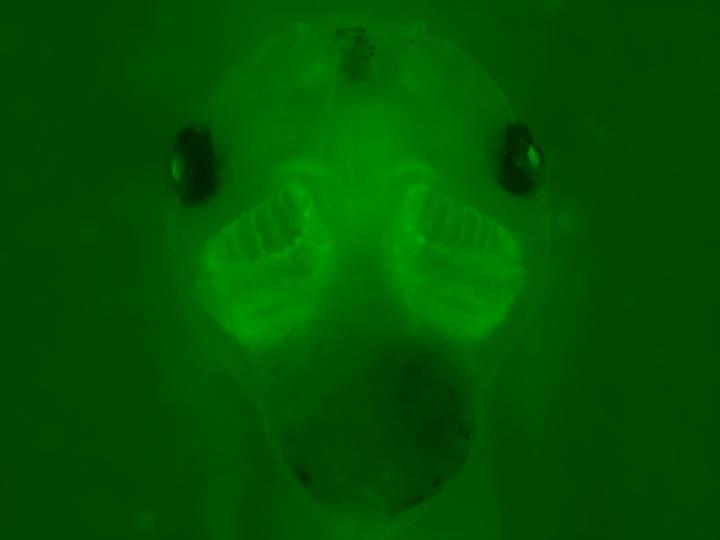
Credit: Photo courtesy of Yu Shi of the Wei Lab
Long before you were aware of anything or anyone even realized you were under construction, things were happening that determined critical features of your life.
In the earliest hours of your embryonic status, cells were developing and multiplying, critical processes were starting up, networks were connecting and genetic codes — for better or worse — were directing the whole project.
That early development is the focus of the research University of Delaware biologist Shuo Wei pursues. Wei, associate professor of biological sciences, looks specifically at how problems in cellular signal relays affect these processes and cause birth defects.
Now Wei’s research has won more than $1.8 million in support from the National Institutes of Health for his study of genetic mutations that can disrupt proper development of neural crest stem cells in embryos.
Neural crest stem cells are “multipotent” stem cells, which means several kinds of tissues develop from these cells, including skull and facial structures, heart tissue, pigment cells and the peripheral nervous system.
When something goes wrong with the neural crest, birth defects are the result, including some of the most common known in humans.
Wei’s lab is focusing on the DDX3X gene and related genes and the roles they play in neural crest development.
The significance of the DDX3X gene in developmental disorders is relatively new science, Wei said. One of his former doctoral students, Mark Perfetto, brought the gene to Wei’s attention about seven years ago when he saw a report in Science Magazine. He urged Wei to look into it because the authors described the influence of DDX3X on a cell signaling pathway known as “Wnt signaling,” a focus of Wei’s research. Many researchers are investigating Wnt (pronounced “wint”) signaling because of its critical role in embryonic development.
“Because Wnt signaling is critical for neural crest development, we hypothesized that mutating the DDX3X gene may cause neural crest defects,” Wei said.
They studied this mutation in frogs and found that all tadpoles that had this genetic mutation had severe neural crest defects, such as underdeveloped facial structures.
Two years after their discovery, other labs found that DDX3X mutations cause multiple human birth defects — including intellectual disabilities, craniofacial disorders such as cleft lip and cleft palate, and the most common birth defect of all, congenital heart disease. This means mutations in the DDX3X gene also cause neural crest defects in humans.
As their work continued, Wei and his students realized they were seeing a different process than the Science article described. They started looking beyond the DDX3X gene to the “downstream” genes controlled by it. Mutations of each of those genes produced symptoms in both tadpoles and humans that were similar to those produced by DDX3X deficits.
“Our hypothesis is that these genes, including DDX3X all function along one pathway,” Wei said. “If one of these genes is mutated, you get these birth defects.
“We want to apply our discoveries to diagnosis and prevention. This is personalized medicine. If you know the genetic mutations in your patients, when they have kids you can make a prediction on the risks and the kinds of medicines the pregnant mother can take or not take. If you identify the mutation, you may be able to do something to prevent birth defects.”
Wei joined UD’s faculty in 2016, responding to recruitment efforts by Provost Robin Morgan, a longtime member of UD’s faculty who chaired the department then. He has found promising new opportunities in the department, now chaired by Prof. Velia Fowler, as well as those in chemistry and other disciplines.
“I love the research environment here,” he said. “We have a great department and a group of researchers working on similar problems with all kinds of animal models. What attracted me most was the research environment of the department and the collaborations with other departments.”
###
Wei earned his bachelor’s degree in biology at the University of Science and Technology of China, his doctorate in biochemistry and molecular biology at the University of Miami and did postdoctoral research in cell and developmental biology at the University of Virginia.
Media Contact
Peter Kerwin
[email protected]
Original Source
https:/