New light on sunfleck research
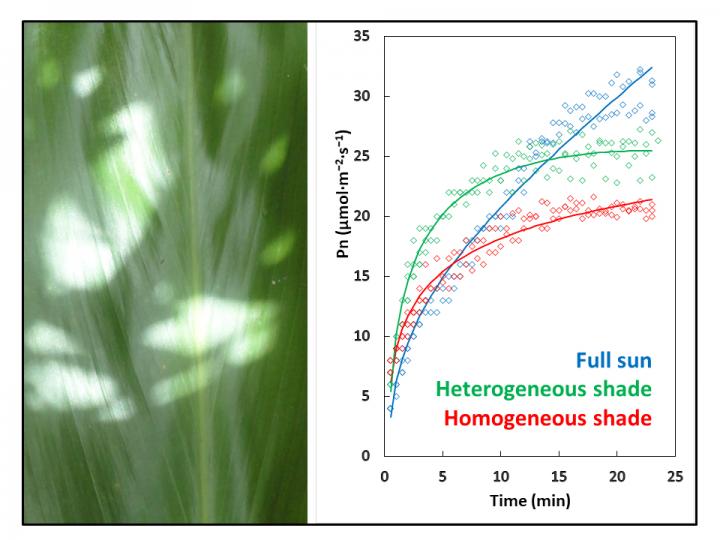
Credit: Thomas E, Marler
“All the roads of learning begin in the darkness and go out into the light.”
This quote is often attributed to Hippocrates and exhibits a double level of relevance in photosynthesis research. The use of light by plant leaves to drive photosynthesis is often studied in steady state environments, but most plant leaves are required to adjust to fluctuations in incident light every day. The research into use of fluctuating light by plant leaves has expanded in recent decades. A study from the Western Pacific Tropical Research Center at the University of Guam has shown that accurate results in this subdiscipline of plant physiology can only be obtained when methods employ leaves that were grown in fluctuating light prior to experimental methods. The results have been published in a recent issue of the journal Plants (doi: 10.3390/plants9070905).
The experimental results confirmed that leaves which were constructed under homogeneous shade such as commercial shade fabric did not respond to fluctuating light in a manner that was similar to leaves which were constructed under fluctuating light. To expand the applicability of the results, three model species were employed for this study. Soybean represented eudicot angiosperms, corn represented monocot angiosperms, and the native cycad species in Guam represented gymnosperms.
The experimental approach called on traditional response variables to ensure applicability of the results to the established literature. One response variable was the speed of increase in photosynthesis when a leaf that is acclimated to deep shade is suddenly challenged with saturating incident light, a response that physiologists call induction. A second response variable was the influence of a short sunfleck on photosynthetic induction during a subsequent sunfleck, a response that physiologists call priming.
“As expected, the leaves that developed under fluctuating light exhibited more rapid photosynthetic induction and more successful priming than the leaves that developed in homogeneous shade,” said Thomas Marler, author of the paper. This new knowledge indicates a substantial percentage of the established leaf physiology literature concerning use of sunflecks includes results that are dubious because the sunfleck methods used experimental leaves that were grown under shadecloth.
The study also reveals the value of off-site conservation germplasm collections. “Ubiquitous invasive insect herbivores in Guam create difficulties for research on the native cycad species,” said Marler. “The ex situ germplasm collections in several countries allow scientists to sustain relevant research on this important cycad species.” This study, for example, was conducted in one of these managed gardens in the Philippines where the plants are not threatened by the insects.
When new knowledge illuminates a fallacy in established experimental methods, a search for an empirical approach for salvaging the published information is appropriate. If a universal conversion factor could be identified, for example, then the published data could be corrected with that conversion. Unfortunately, there were quantitative differences among the three model species with regard to how the homogeneous shade leaves behaved compared to the heterogeneous shade leaves. Therefore, the published sunfleck use literature based on methods that employed homogeneous shade-grown leaves should be interpreted with caution.
###
Further reading: Marler, T.E. 2020. Artifleck: the study of artifactual responses to light-flecks with inappropriate leaves. Plants 9: 905; doi:10.3390/plants9070905.
Media Contact
Olympia Terral
[email protected]
Related Journal Article
http://dx.