Credit: ©Science China Press
The growing demands for ultrahigh energy density batteries used in electronic devices, electrical vehicles, and large-scale energy storage have inspired wide search on novel electrode materials, especially high-capacity cathode materials for Li-ion batteries (LIBs). The traditional design paradigm for the transition-metal oxide (TMO) based cathodes, e.g., LiCoO2, LiMn2O4, LiFePO4 are to use TM as the sole source of electrochemical activity, and their theoretical capacity is limited by the number of electrons that TM can exchange per unit mass. Moreover, the usage of transition metals is also confronted with the pressure of raw material cost and environmental contamination. Although Li-rich cathodes exhibit enhanced capacity to some extent by activating the redox reactions at oxygen sites, they inevitably suffer from poor structural stability and potential safety issues.
Replacing the TMO cathodes with a high capacity and light-weighted carbonaceous analog can deliver huge advantages in cathode designing. However, their low electrochemical potential (3.0 V)?
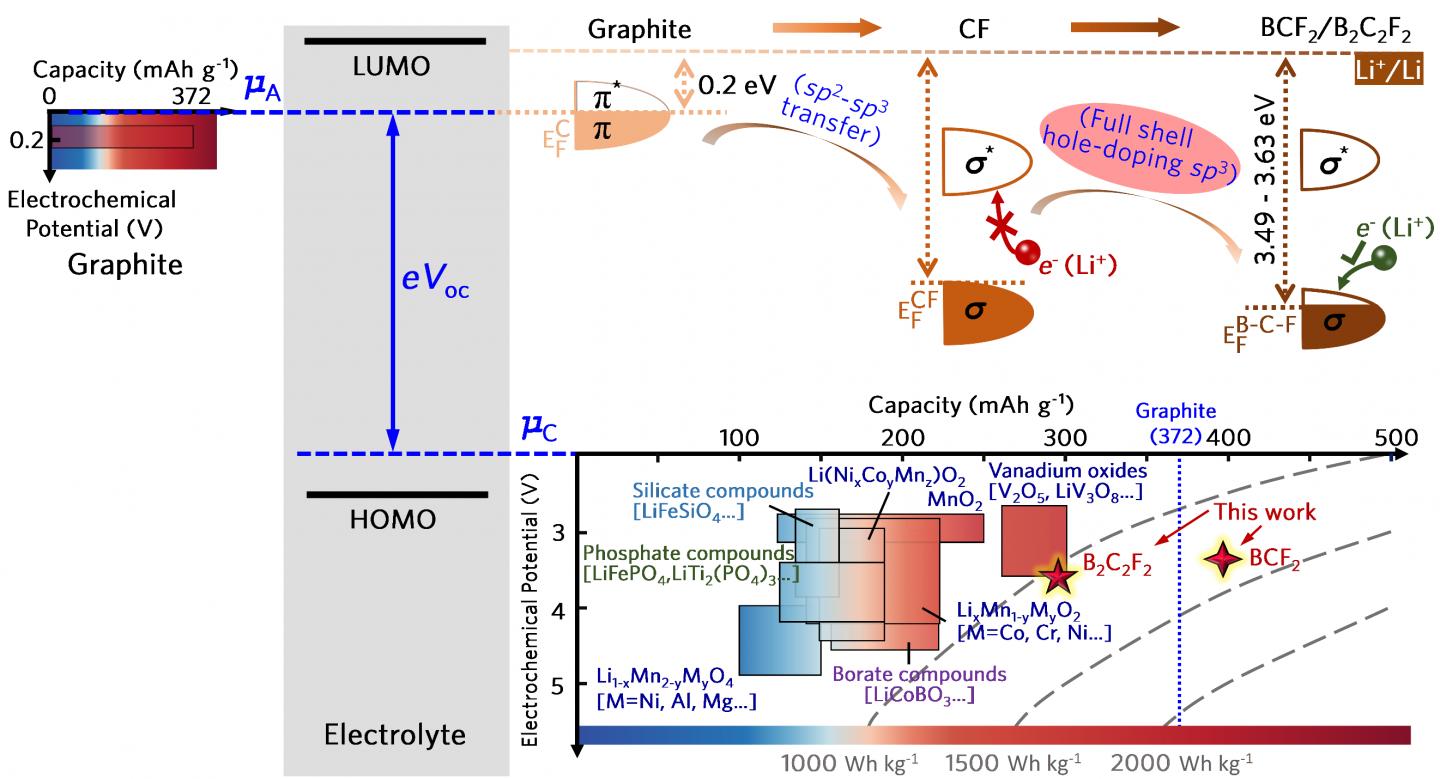
Recently, Prof. Chuying Ouyang from Jiangxi Normal University and Prof. Siqi Shi from Shanghai University proposed an effective strategy to achieve a breakthrough in the design of carbonaceous materials as cathodes for rechargeable LIBs/SIBs. By using the p-type doping strategy, they showed that the new transition-metal-free Li(Na)BCF2/Li(Na)B2C2F2 cathodes have the high potential of 2.7-3.7 V that would lead to a record-breaking high energy density (> 1000 Wh kg?1). Meanwhile, they also demonstrate great potentials in Na-ion storage.
In this work, the researchers uncover the tuning effect of the p-type doping strategy on the Li+ intercalation potentials of carbonaceous electrodes. It is emphasized that the high Fermi level (?4.31 eV) of graphite material results in a low Li+ intercalation potential of ~0.2 V, while for fluorinated graphite (CF), the hybridization of carbon atoms changes from sp2 to sp3, which leads to the increasing of the potential to 2.29 V. However, the electronic saturation nature of CF at Fermi level causes irreversible structural change during lithiation. To address this issue, the authors proposed that some carbon atoms could be substituted with boron atoms to create unoccupied states close to the valence bands (p-type doping), which efficiently shift-down the Fermi level of BCF2 to ?8.36 eV and consequently increases the Li+ intercalation potential to 3.49 V, comparable to those of common TMO cathodes for LIBs. Besides, the p-type doped B-C-F can achieve not only good electronic structural stability during lithiation, but also improved structural stability due to the strong Coulomb interactions between boron and fluorine. Amazingly, they for the first time transform the carbonaceous anode material into cathode material for rechargeable battery application through the p-type doping strategy.
This p-type doping strategy realizes great enhancement of Li+/Na+ intercalation potentials and structural stability for carbonaceous materials, by building visual links between electrochemical potential and band-structure properties. And it can be further applied to other charge transfer-dominated ion intercalation/deintercalation systems, to provide an avenue for developing next-generation cathode materials with ultrahigh energy density. More importantly, this work presents a new paradigm for systematically evaluating performance of electrochemical energy storage materials from multiple perspectives including crystal structure searching, phase diagram calculation, phonon spectrum, electronic structure tuning, voltage platform prediction, ions diffusion barrier, etc.
This work has been published on National Science Review (2020, DOI: 10.1093/nsr/nwaa174), entitled “Efficient potential-tuning strategy through p-type doping for designing cathodes with ultrahigh energy-density”. Subsequently, Prof. Michel Armand, one of the founders of Li ion battery field has published corresponding research highlight on National Science Review (2020, DOI: 10.1093/nsr/nwaa185) and highly rated this work: “…achieved a breakthrough in the design of carbonaceous materials as cathodes for rechargeable LIBs/SIBs. This is a new paradigm for battery design, which is helpful in addressing issues related to the battery energy-density limit as well as the transition-metal cost and shortages…In a broader sense…can help guide a rational design of these compounds in the future and inform prospective theoretical and experimental researches in this field.”.
###
See the article:
Zhiqiang Wang, Da Wang, Zheyi Zou, Tao Song, Dixing Ni, Zhenzhu Li, Xuecheng Shao, Wanjian Yin, Yanchao Wang, Wenwei Luo, Musheng Wu, Maxim Avdeev, Bo Xu, Siqi Shi, Chuying Ouyang, Liquan Chen
Efficient potential-tuning strategy through p-type doping for designing cathodes with ultrahigh energy-density
National Science Review, https:/
Research Highlight from Prof. Michel Armand
Michel Armand
A new family of carbonaceous cathodes for rechargeable batteries through electronic structure tuning engineering
National Science Review, https:/
Media Contact
Siqi Shi
[email protected]
Related Journal Article
http://dx.