Credit: ©Science China Press
Since Lehn’s famous definition of supramolecular chemistry, supramolecular synthesis as a rapidly growing field is still in its formative stage, which is an important method to construct new multifunctional material systems. Compared with the traditional and complex synthetic method of covalent bond, organic co-crystal strategy based on noncovalent bond will be more characteristic and advantageous in the construction of multicomponent supramolecular functional materials. Co-crystal not only retains the inherent property of every component, but also shows more novel physicochemical properties through synergistic effects between different components, which is helpful to realize the multifunction of materials. The co-crystallization process is greatly related to molecular recognition and supramolecular self-assembly between components, which are driven by non-covalent interactions, for example, halogen bonds, hydrogen bonds, π-π stacking, van der Waals forces and so forth. Thereinto, halogen-bonding strength spans over a wide range from 5 to 180 kJ/mol, which allows them to prevail over analogous hydrogen bond in recognition processes. It has become a research hotspot to construct new multifunctional material systems based on halogen bond in the field of supramolecular chemistry and materials.
One common synthetic approach to achieve halogen-bonding co-crystallization systems is to utilize halogen-bonding donors and acceptors with complementary functional groups. As far as halogen-bonding donors are concerned, the halogen-bonding strength increases in the order of Cl?Br?I depending on their electronegativity, and can be further enhanced by introducing electron-withdrawing groups such as the fluorine atom. For this reason, 1,4-DITFB was envisaged as an ideal halogen-bonding donor and has a great potential in the design and synthesis of new multicomponent supramolecular co-crystalline materials.
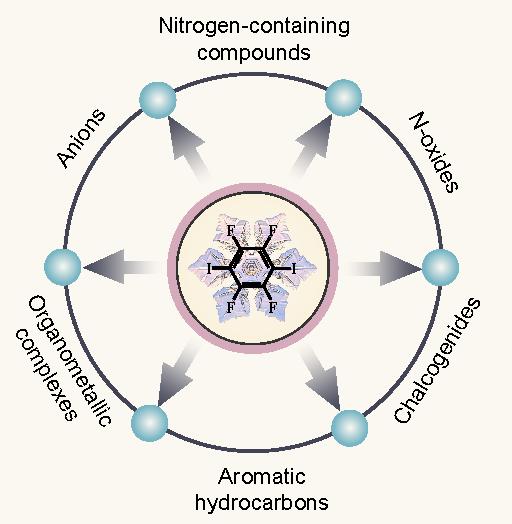
Recently, Huang’s group (Xue-Hua Ding, Yong-Zheng Chang, Chang-Jin Ou, Jin-Yi Lin, Ling-Hai Xie and Wei Huang) have summarized the wide use of 1,4-DITFB in the construction of halogen-bonding multicomponent supramolecular assemblies through co-crystallizing with a variety of halogen-bonding acceptors in the range from neutral Lewis bases (nitrogen-containing compounds, N-oxides, chalcogenides, aromatic hydrocarbons and organometallic complexes) to anions (halide ions, thio/selenocyanate ions and tetrahedral oxyanions). The examples reviewed here illustrate halogen bonds have a vital role in the co-crystallizing processes, exhibiting a wide diversity of impressive supramolecular architectures (for instance, dimers, trimers, tetramers, pentamers, heptamers, thirteen-molecule finite chains, 1D infinite chains, highly undulated infinite ribbons, 2D 3D networks). Many interesting physicochemical properties are found in these co-crystals, such as fluorescence, phosphorescence, magnetism, dielectric and nonlinear optical property, as well as liquid crystal and supramolecular gel. In addition, some co-crystals are able to be applied in different photoelectric devices, e.g. optical waveguide, laser, optical logic gate and memory.
In this review, the authors give an overview of the research progress on 1,4-DITFB, concentrate on the structures of multicomponent supramolecular complexes and their related physicochemical properties, explore the “structure-assembly-property” relationship, highlight typical examples, and point out the main possible directions that remain to be developed in this field. From the perspectives of supramolecular chemistry and crystal engineering, the complexes presented here should provide important information for further design and investigation on this fascinating class of halogen-bonding multicomponent supramolecular materials, and offer useful references for expanding the application of organic co-crystals in the field of optoelectronics.
###
See the article:
Xue-Hua Ding, Yong-Zheng Chang, Chang-Jin Ou, Jin-Yi Lin, Ling-Hai Xie and Wei Huang
Halogen Bonding in Co-crystallization of Potentially Ditopic Diiodotetrafluorobenzene: A Powerful Tool for Constructing Multicomponent Supramolecular Assemblies
National Science Review
https:/
Media Contact
Jin-Yi Lin
[email protected]
Related Journal Article
http://dx.