Credit: ©Science China Press
For anisotropic crystals, it has been known for many years that the birefringence effect rising from anisotropic refractive index should be considered for angle-resolved polarized Raman (ARPR) intensity. For opaque anisotropic crystals (OAC), not only the birefringence effect but also the dichroism effect from anisotropic absorption is responsible for ARPR intensity. With boomed emergence of in-plane anisotropic layered materials (ALMs), e.g., black phosphorus (BP), the investigations of their ARPR intensity have received great attention, which are commonly fitted by its Raman tensor and polarization of incident laser and scattered signal outside the crystals with a fitted complex Raman tensor due to dichroism or a fitted birefringence-induced phase delay. However, these approaches cannot be applicable to the case of ARPR intensity at oblique laser incidence because of the complex depth-dependent polarization and intensity of incident laser and scattered signal inside ALMs, and additional angle-dependent reflection and refraction at the interface between ALM lakes and air. Fundamentally, only real Raman tensor is generally involved if no magnetic perturbation occurs. Thus, this leaves an open question whether it is possible to reproduce ARPR intensity of OAC by only the real Raman tensor, especially for emergent ALMs.
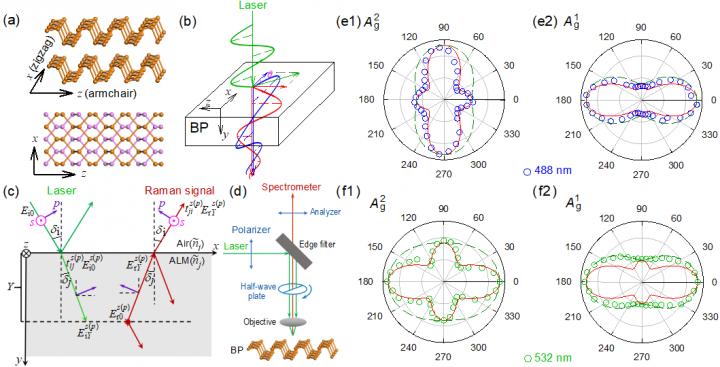
Recently, a research team led by Prof. Ping-Heng Tan from Institute of Semiconductors, Chinese Academy of Sciences proposed a so-called birefringence-linear-dichroism (BLD) model to quantitively understand the ARPR intensity at both normal and oblique laser incidences on in-plane ALMs, by taking the bulk black phosphorus (BP) as an example. The depth-dependent polarization and intensity of incident laser and scattered signal induced by birefringence and linear dichroism are considered by complex refractive indexes along three principle axes, which is experimentally determined by the incident-angle resolved reflectivity. The experimental ARPR intensity can be well reproduced by the same set of real Raman tensors for a certain laser excitation, which are obtained from the relative Raman intensity along its principle axes. No fitting parameter is needed.
Fig.1 shows the setup for ARPR measurements at laser normal incidence and the corresponding ARPR intensity excited by 488 nm and 532 nm lasers. The good agreement between the calculated results (solid lines) experimental data (open circles) indicates that the ARPR intensity in ALMs can be quantitatively understand by the real Raman tensor once the birefringence and linear dichroism effects are considered based on the BLD model. In Fig.2, the ARPR intensity at oblique laser incidence can also be well reproduced by the same set of Raman tensors without any fitting parameters, which implies that the BLD model is possible to quantitatively reproduce the ARPR intensity of all ALMs for a given excitation wavelength under any scattering and polarization configurations.
The results suggest that the previously reported ARPR intensity of ultrathin ALM flakes deposited on a multilayered substrate at normal laser incidence can be also understood based on the BLD model by considering the depth-dependent polarization and intensity of incident laser and scattered Raman signal induced by both birefringence and linear dichroism effects within ALM flakes and the interference effects in the multilayered structures, which are dependent on the excitation wavelength, thickness of ALM flakes and dielectric layers of the substrate. This work can be generally applicable to any OAC, offering a promising route to predict and manipulate the polarized behaviors of related phonons.
###
This work was supported by the National Key Research and Development Program of China (2016YFA0301204), the National Natural Science Foundation of China (11874350 and 51702352), the CAS Key Research Program of Frontier Sciences (ZDBS-LYSLH004), China Postdoctoral Science Foundation (2019TQ0317), Youth Innovation Promotion Association Chinese Academy of Sciences (2020354).
See the article for more details:
Miao-Ling Lin, Yu-Chen Leng, Xin Cong, Da Meng, Jiahong Wang, Xiao-Li Li, Binlu Yu, Xue-Lu Liu, Xue-Feng Yu, Ping-Heng Tan. Understanding angle-resolved polarized Raman scattering from black phosphorus at normal and oblique laser incidences, Science Bulletin, 2020. DOI: 10.1016/j.scib.2020.08.008
https:/
Media Contact
Ping-Heng Tan
[email protected]
Related Journal Article
http://dx.