• HOME
  • NEWS
  • EXPLORE
    • CAREER
      • Companies
      • Jobs
    • EVENTS
    • iGEM
      • News
      • Team
    • PHOTOS
    • VIDEO
    • WIKI
  • BLOG
  • COMMUNITY
    • FACEBOOK
    • INSTAGRAM
    • TWITTER
Saturday, February 7, 2026
BIOENGINEER.ORG
No Result
View All Result
  • Login
  • HOME
  • NEWS
  • EXPLORE
    • CAREER
      • Companies
      • Jobs
        • Lecturer
        • PhD Studentship
        • Postdoc
        • Research Assistant
    • EVENTS
    • iGEM
      • News
      • Team
    • PHOTOS
    • VIDEO
    • WIKI
  • BLOG
  • COMMUNITY
    • FACEBOOK
    • INSTAGRAM
    • TWITTER
  • HOME
  • NEWS
  • EXPLORE
    • CAREER
      • Companies
      • Jobs
        • Lecturer
        • PhD Studentship
        • Postdoc
        • Research Assistant
    • EVENTS
    • iGEM
      • News
      • Team
    • PHOTOS
    • VIDEO
    • WIKI
  • BLOG
  • COMMUNITY
    • FACEBOOK
    • INSTAGRAM
    • TWITTER
No Result
View All Result
Bioengineer.org
No Result
View All Result
Home NEWS Science News Chemistry

Establishment of a rapid synthesis method for useful organic fluorine compounds

Bioengineer by Bioengineer
September 9, 2020
in Chemistry
Reading Time: 2 mins read
0
IMAGE
Share on FacebookShare on TwitterShare on LinkedinShare on RedditShare on Telegram

IMAGE

Credit: Issey Takahashi

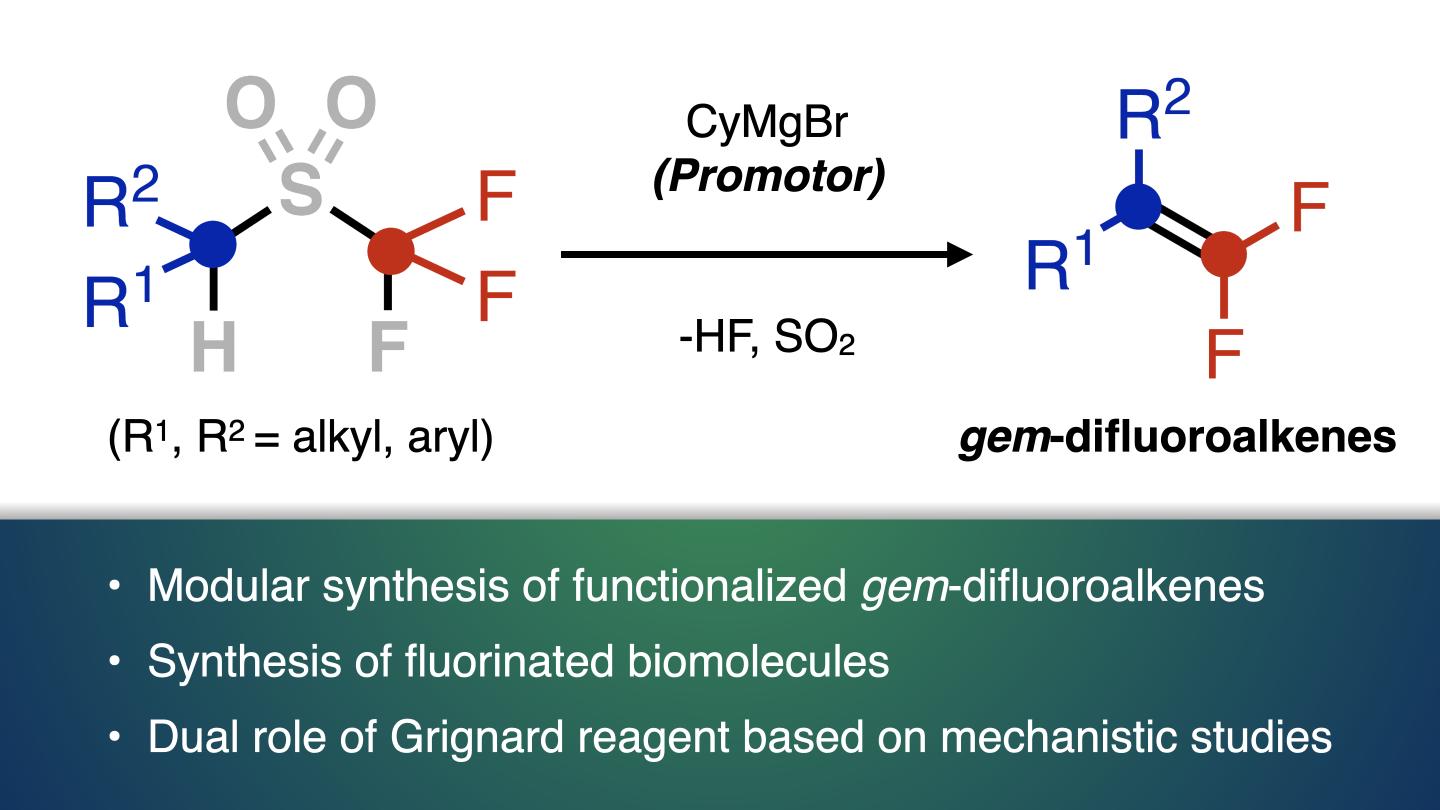
The Nagoya University Institute of Transformative Bio-Molecules (WPI-ITbM) research team of Professor Cathleen Crudden, Designated Lecturer Masakazu Nambo, JSPS Postdoctoral Fellow Yuki Maekawa and Associate Professor Daisuke Yokogawa have developed a new synthesis method for the efficient production of fluorinated alkenes. This method offers a practical solution for the shortening of the synthesis process of existing bioactive compounds through the simple addition of an organic magnesium reagent, or Grignard reagent.

As bonds between carbon and fluorine are comparatively stronger than those between carbon and hydrogen, the addition of fluorine is known to increase stability in metabolism and oxidation. Thus, organic fluorine compounds are found in the majority of agrochemicals and organic materials, with their importance in this field only growing. ‘Difluoroalkene’ is the generic name for a compound with a structure into which two fluorine atoms have been introduced. Although a number of synthesis methods for difluoroalkenes have previously been developed, these often require the use of dangerously toxic and highly reactive fluoride reagents and are complex and multi-staged. Although some methods not requiring hazardous reagents have been reported in recent years, generic synthesis methods for particularly useful gem-difluoroalkenes have remained severely limited.

The research group aimed to develop a new synthesis method for fluorinated compounds using triflones, a variety of a group of organosulfur compounds called sulfones. They succeeded in carrying out a Ramberg-Bäcklund reaction to produce gem-difluoroalkenes, reacting triflones with an organic magnesium (Grignard) reagent. As a variety of carbon substituents can be introduced to the raw material of the triflone, this method greatly speeds up the previously very challenging gem-difluoroalkene synthesis process.

This method represents a great step forward for synthesis strategies in organic synthetic chemistry. Its ability to use easy to obtain and prepare reagents means that it is expected to find widespread use and contribute to the discovery of new agrochemicals and organic materials.

###

Media Contact
Masakazu Nambo
[email protected]

Original Source

https://pubs.acs.org/doi/10.1021/jacs.0c07924

Related Journal Article

http://dx.doi.org/10.1021/jacs.0c07924

Tags: Atomic/Molecular/Particle PhysicsBiochemistryChemistry/Physics/Materials Sciences
Share12Tweet8Share2ShareShareShare2

Related Posts

blank

Breakthrough in Environmental Cleanup: Scientists Develop Solar-Activated Biochar for Faster Remediation

February 7, 2026
blank

Cutting Costs: Making Hydrogen Fuel Cells More Affordable

February 6, 2026

Scientists Develop Hand-Held “Levitating” Time Crystals

February 6, 2026

Observing a Key Green-Energy Catalyst Dissolve Atom by Atom

February 6, 2026
Please login to join discussion

POPULAR NEWS

  • Robotic Ureteral Reconstruction: A Novel Approach

    Robotic Ureteral Reconstruction: A Novel Approach

    82 shares
    Share 33 Tweet 21
  • Digital Privacy: Health Data Control in Incarceration

    63 shares
    Share 25 Tweet 16
  • Study Reveals Lipid Accumulation in ME/CFS Cells

    57 shares
    Share 23 Tweet 14
  • Breakthrough in RNA Research Accelerates Medical Innovations Timeline

    53 shares
    Share 21 Tweet 13

About

We bring you the latest biotechnology news from best research centers and universities around the world. Check our website.

Follow us

Recent News

Evaluating Pediatric Emergency Care Quality in Ethiopia

TPMT Expression Predictions Linked to Azathioprine Side Effects

Improving Dementia Care with Enhanced Activity Kits

Subscribe to Blog via Email

Success! An email was just sent to confirm your subscription. Please find the email now and click 'Confirm' to start subscribing.

Join 73 other subscribers
  • Contact Us

Bioengineer.org © Copyright 2023 All Rights Reserved.

Welcome Back!

Login to your account below

Forgotten Password?

Retrieve your password

Please enter your username or email address to reset your password.

Log In
No Result
View All Result
  • Homepages
    • Home Page 1
    • Home Page 2
  • News
  • National
  • Business
  • Health
  • Lifestyle
  • Science

Bioengineer.org © Copyright 2023 All Rights Reserved.