Credit: ©Science China Press
Hall effect plays an important role in the development of condensed matter physics. The classical Hall effect was discovered by American physicist E. H. Hall in 1879. When an electric current passes through a conductor under an out-of-plane magnetic field, a transverse Hall voltage appears in the direction perpendicular to both the magnetic field and the current. In condensed matter systems, apart from the dynamical phase of a Bloch electron, geometrical phase (Berry phase) must also be considered. The Berry curvature corresponding to Berry phase will generate an anomalous velocity that is perpendicular to the applied electric field, leading to transverse Hall signals. Recent studies have shown that in topological materials, when the magnetic field and current are coplanar, Berry curvature will induce planar Hall effect (PHE). On one hand, different from classical Hall effect, planar Hall resistivity ρyx is an even function of magnetic field (namely, symmetric to magnetic field, ρyx (-B)=ρyx(B)). On the other hand, PHE will vanish when in-plane magnetic field is perpendicular (B?I) or parallel (B?I) to the current, same as the classical Hall effect.
Recently, Professor Jian Wang in collaborated with Professor Xincheng Xie at Peking University, Professor Haiwen Liu at Beijing Normal University, Dr. Jiaqiang Yan and Professor David Mandrus at Oak Ridge National Laboratory etc discovered unconventional Hall effect in non-magnetic topological material ZrTe5 devices. Nonzero Hall effect was observed when in-plane magnetic field is perpendicular (B?I) or parallel (B?I) to the current. The paper entitled “Unconventional Hall Effect induced by Berry Curvature” was published online in National Science Review. Professor Jian Wang and Professor Xincheng Xie at Peking University are corresponding authors of this paper. PhD candidate Jun Ge and Dr. Da Ma at Peking University contribute equally to this work.
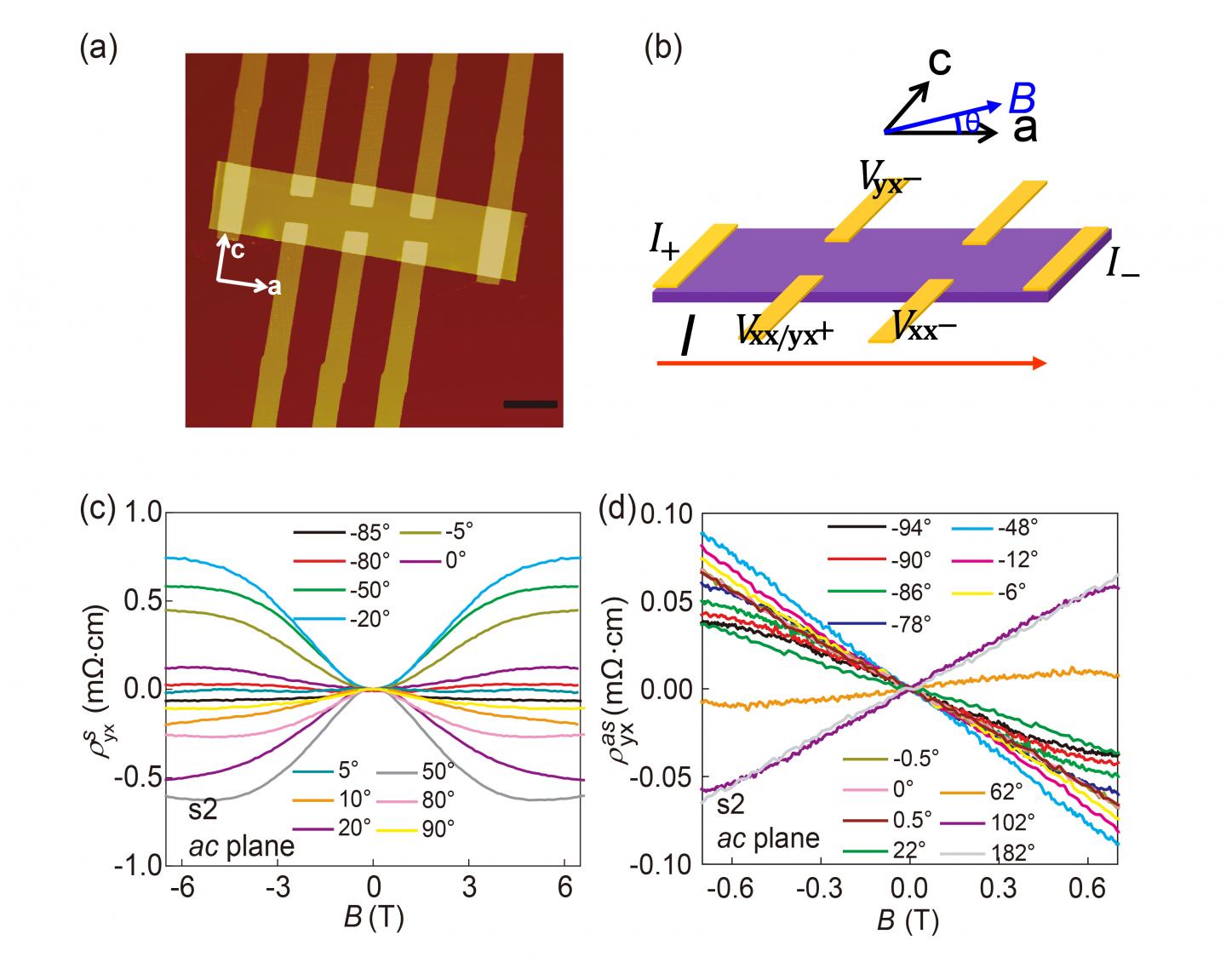
The research team performed systematic transport measurements on ZrTe5 devices (Fig. 1(a)) in both Physical Property Measurement System and a dilution refrigerator with triple axes vector magnet. With well-controlled angular-dependent transport measurements (Fig. 1(b)), the research team excluded the extrinsic influence of longitudinal resistance and classical Hall effect, and detected intrinsic in-plane Hall response of ZrTe5 devices. The observed in-plane Hall signal of ZrTe5 devices contains both symmetric (Fig. 1(c)) and asymmetric (Fig. 1(d)) components with respect to the magnetic field. More interestingly, nonzero in-plane Hall signal is detected for B?I (Fig. 2(a-c)) and B?I (Fig. 2(d-f)) situations. These discoveries are beyond the expectations of classical Hall effect and previously suggested PHE in topological materials.
The origin of the observed unconventional Hall effect is revealed by theoretical calculations. The researchers find that ZrTe5 can be considered as a Weyl semimetal with tiled Weyl cones under external magnetic field. The tilt of Weyl cones, the anomalous velocity induced by Berry curvature, the chiral chemical potential, and phase volume effect together give rise to the observed unconventional Hall effect. A new formula for in-plane Hall signal is proposed, which can well fit the experimental observation (Fig. 3).
The nonzero in-plane Hall signals when magnetic field is parallel or perpendicular to the current adds a new member to the Hall effect family. This work provides a new platform to investigate Berry curvature related physics in condensed matter systems.
###
See the article:
Jun Ge, Da Ma, Yanzhao Liu, Huichao Wang, Yanan Li, Jiawei Luo, Tianchuang Luo, Ying Xing, Jiaqiang Yan, David Mandrus, Haiwen Liu, X.C. Xie, Jian Wang
Unconventional Hall Effect induced by Berry Curvature
https:/
Media Contact
Jian Wang
[email protected]
Related Journal Article
http://dx.