• HOME
  • NEWS
  • EXPLORE
    • CAREER
      • Companies
      • Jobs
    • EVENTS
    • iGEM
      • News
      • Team
    • PHOTOS
    • VIDEO
    • WIKI
  • BLOG
  • COMMUNITY
    • FACEBOOK
    • INSTAGRAM
    • TWITTER
Saturday, February 7, 2026
BIOENGINEER.ORG
No Result
View All Result
  • Login
  • HOME
  • NEWS
  • EXPLORE
    • CAREER
      • Companies
      • Jobs
        • Lecturer
        • PhD Studentship
        • Postdoc
        • Research Assistant
    • EVENTS
    • iGEM
      • News
      • Team
    • PHOTOS
    • VIDEO
    • WIKI
  • BLOG
  • COMMUNITY
    • FACEBOOK
    • INSTAGRAM
    • TWITTER
  • HOME
  • NEWS
  • EXPLORE
    • CAREER
      • Companies
      • Jobs
        • Lecturer
        • PhD Studentship
        • Postdoc
        • Research Assistant
    • EVENTS
    • iGEM
      • News
      • Team
    • PHOTOS
    • VIDEO
    • WIKI
  • BLOG
  • COMMUNITY
    • FACEBOOK
    • INSTAGRAM
    • TWITTER
No Result
View All Result
Bioengineer.org
No Result
View All Result
Home NEWS Science News

Humans’ construction ‘footprint’ on ocean quantified for first time

Bioengineer by Bioengineer
August 31, 2020
in Science News
Reading Time: 2 mins read
0
IMAGE
Share on FacebookShare on TwitterShare on LinkedinShare on RedditShare on Telegram

Scale of marine intrusion comparable to that on land
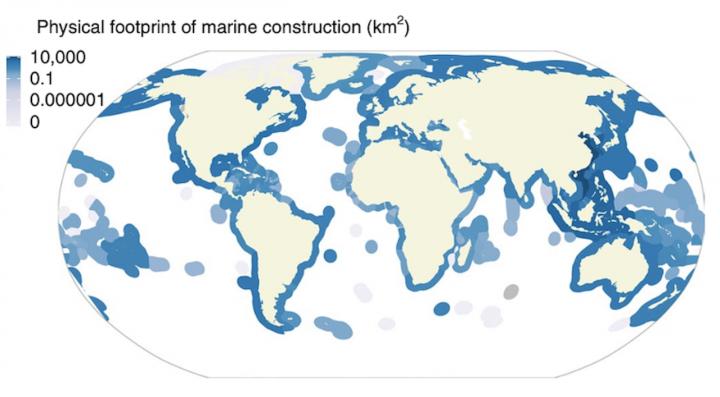
IMAGE

Credit: Bugnot et al., ‘Current and projected global extent of marine built structures’, Nature Sustainability.

In a world-first, the extent of human development in oceans has been mapped. An area totalling approximately 30,000 square kilometres – the equivalent of 0.008 percent of the ocean – has been modified by human construction, a study led by Dr Ana Bugnot from the University of Sydney School of Life and Environmental Sciences and the Sydney Institute of Marine Science has found.

The extent of ocean modified by human construction is, proportion-wise, comparable to the extent of urbanised land, and greater than the global area of some natural marine habitats, such as mangrove forests and seagrass beds.

When calculated as the area modified inclusive of flow-on effects to surrounding areas, for example, due to changes in water flow and pollution, the footprint is actually two million square kilometres, or over 0.5 percent of the ocean.

The oceanic modification includes areas affected by tunnels and bridges; infrastructure for energy extraction (for example, oil and gas rigs, wind farms); shipping (ports and marinas); aquaculture infrastructure; and artificial reefs.

Dr Bugnot said that ocean development is nothing new, yet, in recent times, it has rapidly changed. “It has been ongoing since before 2000 BC,” she said. “Then, it supported maritime traffic through the construction of commercial ports and protected low-lying coasts with the creation of structures similar to breakwaters.

“Since the mid-20th century, however, ocean development has ramped up, and produced both positive and negative results.

“For example, while artificial reefs have been used as ‘sacrificial habitat’ to drive tourism and deter fishing, this infrastructure can also impact sensitive natural habitats like seagrasses, mudflats and saltmarshes, consequently affecting water quality.

“Marine development mostly occurs in coastal areas – the most biodiverse and biologically productive ocean environments.”

Future expansion ‘alarming’

Dr Bugnot, joined by co-researchers from multiple local and international universities, also projected the rate of future ocean footprint expansion.

“The numbers are alarming,” Dr Bugnot said. “For example, infrastructure for power and aquaculture, including cables and tunnels, is projected to increase by 50 to 70 percent by 2028.

“Yet this is an underestimate: there is a dearth of information on ocean development, due to poor regulation of this in many parts of the world.

“There is an urgent need for improved management of marine environments. We hope our study spurs national and international initiatives, such as the EU Marine Strategy Framework Directive, to greater action.”

The researchers attributed the projected expansion on people’s increasing need for defences against coastal erosion and inundation due to sea level rise and climate change, as well as their transportation, energy extraction, and recreation needs.

###

Journal Nature Sustainability published their research. It was undertaken in 2018, when Dr Bugnot was employed by UNSW.

Media Contact
Loren Smith
[email protected]

Related Journal Article

http://dx.doi.org/10.1038/s41893-020-00595-1

Tags: AgricultureClimate ChangeEarth ScienceHydrology/Water ResourcesOceanographyPolicy/EthicsTechnology/Engineering/Computer Science
Share12Tweet8Share2ShareShareShare2

Related Posts

Phage-Antibiotic Combo Beats Resistant Peritoneal Infection

February 7, 2026

Boosting Remote Healthcare: Stepped-Wedge Trial Insights

February 7, 2026

Barriers and Boosters of Seniors’ Physical Activity in Karachi

February 7, 2026

Evaluating Pediatric Emergency Care Quality in Ethiopia

February 7, 2026
Please login to join discussion

POPULAR NEWS

  • Robotic Ureteral Reconstruction: A Novel Approach

    Robotic Ureteral Reconstruction: A Novel Approach

    82 shares
    Share 33 Tweet 21
  • Digital Privacy: Health Data Control in Incarceration

    63 shares
    Share 25 Tweet 16
  • Study Reveals Lipid Accumulation in ME/CFS Cells

    57 shares
    Share 23 Tweet 14
  • Breakthrough in RNA Research Accelerates Medical Innovations Timeline

    53 shares
    Share 21 Tweet 13

About

We bring you the latest biotechnology news from best research centers and universities around the world. Check our website.

Follow us

Recent News

Phage-Antibiotic Combo Beats Resistant Peritoneal Infection

Boosting Remote Healthcare: Stepped-Wedge Trial Insights

Barriers and Boosters of Seniors’ Physical Activity in Karachi

Subscribe to Blog via Email

Enter your email address to subscribe to this blog and receive notifications of new posts by email.

Join 73 other subscribers
  • Contact Us

Bioengineer.org © Copyright 2023 All Rights Reserved.

Welcome Back!

Login to your account below

Forgotten Password?

Retrieve your password

Please enter your username or email address to reset your password.

Log In
No Result
View All Result
  • Homepages
    • Home Page 1
    • Home Page 2
  • News
  • National
  • Business
  • Health
  • Lifestyle
  • Science

Bioengineer.org © Copyright 2023 All Rights Reserved.