• HOME
  • NEWS
  • EXPLORE
    • CAREER
      • Companies
      • Jobs
    • EVENTS
    • iGEM
      • News
      • Team
    • PHOTOS
    • VIDEO
    • WIKI
  • BLOG
  • COMMUNITY
    • FACEBOOK
    • INSTAGRAM
    • TWITTER
Saturday, February 7, 2026
BIOENGINEER.ORG
No Result
View All Result
  • Login
  • HOME
  • NEWS
  • EXPLORE
    • CAREER
      • Companies
      • Jobs
        • Lecturer
        • PhD Studentship
        • Postdoc
        • Research Assistant
    • EVENTS
    • iGEM
      • News
      • Team
    • PHOTOS
    • VIDEO
    • WIKI
  • BLOG
  • COMMUNITY
    • FACEBOOK
    • INSTAGRAM
    • TWITTER
  • HOME
  • NEWS
  • EXPLORE
    • CAREER
      • Companies
      • Jobs
        • Lecturer
        • PhD Studentship
        • Postdoc
        • Research Assistant
    • EVENTS
    • iGEM
      • News
      • Team
    • PHOTOS
    • VIDEO
    • WIKI
  • BLOG
  • COMMUNITY
    • FACEBOOK
    • INSTAGRAM
    • TWITTER
No Result
View All Result
Bioengineer.org
No Result
View All Result
Home NEWS Science News Biology

Citizen scientists bring surprising insights into cowslip mating system

Bioengineer by Bioengineer
August 31, 2020
in Biology
Reading Time: 3 mins read
0
IMAGE
Share on FacebookShare on TwitterShare on LinkedinShare on RedditShare on Telegram

IMAGE

Credit: Photos: Tsipe Aavik

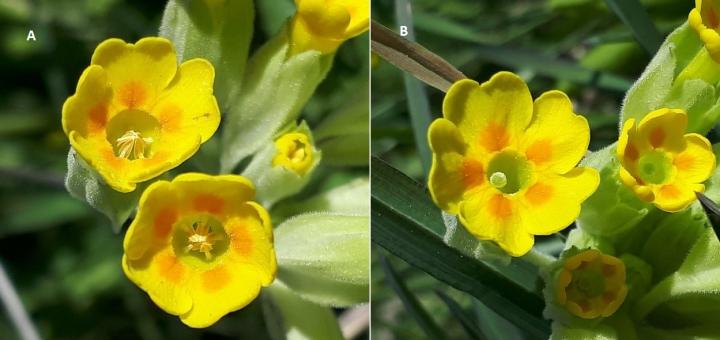
About half of the individuals of cowslip (Primula veris) have flowers with a short style, while the other half of individuals produce flowers with a long style. Recent discoveries have suggested that the loss and fragmentation of habitats may shake this optimal balance of morphologically different plants. This, in turn, decreases the reproductive success of plants and jeopardizes their future viability.

As the primary habitat, cowslips prefer semi-natural grasslands, which have experienced a dramatic area loss over the last hundred years throughout Europe. The study coordinated by the ecologists of the University of Tartu and the Estonian Fund for Nature aimed to examine whether this drastic landscape change has led to deviations in morph balance. To collect data across Estonia, they decided to implement a citizen science approach. A specifically designed web platform http://www.cowslips.eu facilitated an easy upload of data. “In addition, the task and importance of the cowslip observation campaign were explained in detailed guidelines, numerous videos, social media, and other communication platforms,” commented Tsipe Aavik, the lead researcher of the heterostyly project.

Novel insight into fundamental research

Nearly 1,700 observations obtained during the campaign led to unexpected discoveries, is now published in the Journal of Ecology. First, data revealed a systematic dominance of short-styled morphs over long-styled morphs. Second, morph frequencies were more likely to deviate in smaller populations and deviations increased in landscapes with higher human population density.

“We are very thankful to all participants who helped to collect heterostyly data at such an unprecedented scale,” commented Tsipe Aavik. “Although the first discoveries on heterostyly were made already by Darwin more than 150 years ago, data obtained in the citizen science campaign has helped us to add novel aspects into this fascinating topic with a long history of research.”

The findings brought novel insights into fundamental research: the systematic dominance of the short-styled morphs is an intriguing but previously undescribed aspect in this otherwise well-studied plant mating system. However, perhaps even more important are the implications of these findings for conservation because deviating morph frequencies are likely to jeopardize the viability of heterostylous plants. The findings thus describe another threat in the list of negative consequences of habitat loss.

Perhaps Europe could be looking for cowslips one day

The surprising findings of the study have seeded an idea to widen the geographic scope of the study to examine whether the observed patterns are confirmed in other European countries. Furthermore, the discovery about the role of human population density altering morph balance encourages to look at the patterns of heterostyly in landscapes with more intense human impact than Estonia with its relatively low human population density. “In the spring of 2020, when we repeated the campaign, Latvian citizen scientists warmly welcomed the opportunity to contribute to heterostyly observations. But perhaps one day we all can participate in a project ‘Europe is looking for cowslips’,” adds Aavik with a hope that there still are places in Europe where one can find this beautiful and intriguing plant, cowslip.

###

Media Contact
Tsipe Aavik
[email protected]

Related Journal Article

http://dx.doi.org/10.1111/1365-2745.13488

Tags: BiodiversityBiologyEcology/EnvironmentPlant Sciences
Share12Tweet8Share2ShareShareShare2

Related Posts

Florida Cane Toad: Complex Spread and Selective Evolution

Florida Cane Toad: Complex Spread and Selective Evolution

February 7, 2026
New Study Uncovers Mechanism Behind Burn Pit Particulate Matter–Induced Lung Inflammation

New Study Uncovers Mechanism Behind Burn Pit Particulate Matter–Induced Lung Inflammation

February 6, 2026

DeepBlastoid: Advancing Automated and Efficient Evaluation of Human Blastoids with Deep Learning

February 6, 2026

Navigating the Gut: The Role of Formic Acid in the Microbiome

February 6, 2026
Please login to join discussion

POPULAR NEWS

  • Robotic Ureteral Reconstruction: A Novel Approach

    Robotic Ureteral Reconstruction: A Novel Approach

    82 shares
    Share 33 Tweet 21
  • Digital Privacy: Health Data Control in Incarceration

    63 shares
    Share 25 Tweet 16
  • Study Reveals Lipid Accumulation in ME/CFS Cells

    57 shares
    Share 23 Tweet 14
  • Breakthrough in RNA Research Accelerates Medical Innovations Timeline

    53 shares
    Share 21 Tweet 13

About

We bring you the latest biotechnology news from best research centers and universities around the world. Check our website.

Follow us

Recent News

Boosting Remote Healthcare: Stepped-Wedge Trial Insights

Barriers and Boosters of Seniors’ Physical Activity in Karachi

Evaluating Pediatric Emergency Care Quality in Ethiopia

Subscribe to Blog via Email

Enter your email address to subscribe to this blog and receive notifications of new posts by email.

Join 73 other subscribers
  • Contact Us

Bioengineer.org © Copyright 2023 All Rights Reserved.

Welcome Back!

Login to your account below

Forgotten Password?

Retrieve your password

Please enter your username or email address to reset your password.

Log In
No Result
View All Result
  • Homepages
    • Home Page 1
    • Home Page 2
  • News
  • National
  • Business
  • Health
  • Lifestyle
  • Science

Bioengineer.org © Copyright 2023 All Rights Reserved.