• HOME
  • NEWS
  • EXPLORE
    • CAREER
      • Companies
      • Jobs
    • EVENTS
    • iGEM
      • News
      • Team
    • PHOTOS
    • VIDEO
    • WIKI
  • BLOG
  • COMMUNITY
    • FACEBOOK
    • INSTAGRAM
    • TWITTER
Saturday, February 7, 2026
BIOENGINEER.ORG
No Result
View All Result
  • Login
  • HOME
  • NEWS
  • EXPLORE
    • CAREER
      • Companies
      • Jobs
        • Lecturer
        • PhD Studentship
        • Postdoc
        • Research Assistant
    • EVENTS
    • iGEM
      • News
      • Team
    • PHOTOS
    • VIDEO
    • WIKI
  • BLOG
  • COMMUNITY
    • FACEBOOK
    • INSTAGRAM
    • TWITTER
  • HOME
  • NEWS
  • EXPLORE
    • CAREER
      • Companies
      • Jobs
        • Lecturer
        • PhD Studentship
        • Postdoc
        • Research Assistant
    • EVENTS
    • iGEM
      • News
      • Team
    • PHOTOS
    • VIDEO
    • WIKI
  • BLOG
  • COMMUNITY
    • FACEBOOK
    • INSTAGRAM
    • TWITTER
No Result
View All Result
Bioengineer.org
No Result
View All Result
Home NEWS Science News Chemistry

An improved wearable, stretchable gas sensor using nanocomposites

Bioengineer by Bioengineer
August 27, 2020
in Chemistry
Reading Time: 2 mins read
0
IMAGE
Share on FacebookShare on TwitterShare on LinkedinShare on RedditShare on Telegram

IMAGE

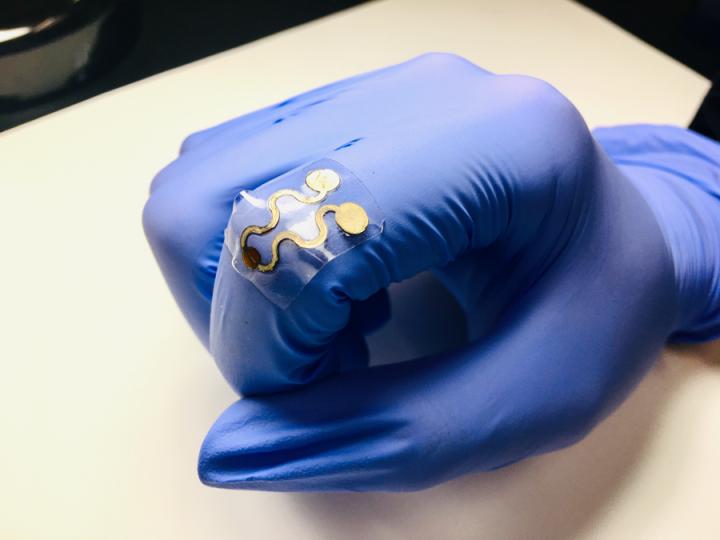
Credit: Cheng Lab, Penn State

A stretchable, wearable gas sensor for environmental sensing has been developed and tested by researchers at Penn State, Northeastern University and five universities in China.

The sensor combines a newly developed laser-induced graphene foam material with a unique form of molybdenum disulfide and reduced-graphene oxide nanocomposites. The researchers were interested in seeing how different morphologies, or shapes, of the gas-sensitive nanocomposites affect the sensitivity of the material to detecting nitrogen dioxide molecules at very low concentration. To change the morphology, they packed a container with very finely ground salt crystals.

Nitrogen dioxide is a noxious gas emitted by vehicles that can irritate the lungs at low concentrations and lead to disease and death at high concentrations.

When the researchers added molybdenum disulfide and reduced graphene oxide precursors to the canister, the nanocomposites formed structures in the small spaces between the salt crystals. They tried this with a variety of different salt sizes and tested the sensitivity on conventional interdigitated electrodes, as well as the newly developed laser-induced graphene platform. When the salt was removed by dissolving in water, the researchers determined that the smallest salt crystals enabled the most sensitive sensor.

“We have done the testing to 1 part per million and lower concentrations, which could be 10 times better than conventional design,” says Huanyu Larry Cheng, assistant professor of engineering science and mechanics and materials science and engineering. “This is a rather modest complexity compared to the best conventional technology which requires high-resolution lithography in a cleanroom.”

Ning Yi and Han Li, doctoral students at Penn State and co-authors on the paper in Materials Today Physics, added, “The paper investigated the sensing performance of the reduced graphene oxide/moly disulfide composite. More importantly, we find a way to enhance the sensitivity and signal-to-noise ratio of the gas sensor by controlling the morphology of the composite material and the configuration of the sensor-testing platform. We think the stretchable nitrogen dioxide gas sensor may find applications in real-time environmental monitoring or the healthcare industry.”

###

Other Penn State authors on the paper, titled “Stretchable, Ultrasensitive, and Low-Temperature NO2 Sensors Based on MoS2@rGO Nanocomposites,” are Li Yang, Jia Zhu, Xiaoqi Zheng and Zhendong Liu.

National Science Foundation and American Chemical Society Petroleum Research Fund funded this research with additional funding from Penn State and Northeastern.

Media Contact
A’ndrea Elyse Messer
[email protected]

Related Journal Article

http://dx.doi.org/10.1016/j.mtphys.2020.100265

Tags: Biomedical/Environmental/Chemical EngineeringChemistry/Physics/Materials Sciences
Share12Tweet8Share2ShareShareShare2

Related Posts

blank

Breakthrough in Environmental Cleanup: Scientists Develop Solar-Activated Biochar for Faster Remediation

February 7, 2026
blank

Cutting Costs: Making Hydrogen Fuel Cells More Affordable

February 6, 2026

Scientists Develop Hand-Held “Levitating” Time Crystals

February 6, 2026

Observing a Key Green-Energy Catalyst Dissolve Atom by Atom

February 6, 2026
Please login to join discussion

POPULAR NEWS

  • Robotic Ureteral Reconstruction: A Novel Approach

    Robotic Ureteral Reconstruction: A Novel Approach

    82 shares
    Share 33 Tweet 21
  • Digital Privacy: Health Data Control in Incarceration

    63 shares
    Share 25 Tweet 16
  • Study Reveals Lipid Accumulation in ME/CFS Cells

    57 shares
    Share 23 Tweet 14
  • Breakthrough in RNA Research Accelerates Medical Innovations Timeline

    53 shares
    Share 21 Tweet 13

About

We bring you the latest biotechnology news from best research centers and universities around the world. Check our website.

Follow us

Recent News

Personalized Guide to Understanding and Reducing Chemicals

Inflammasome Protein ASC Drives Pancreatic Cancer Metabolism

Phage-Antibiotic Combo Beats Resistant Peritoneal Infection

Subscribe to Blog via Email

Enter your email address to subscribe to this blog and receive notifications of new posts by email.

Join 73 other subscribers
  • Contact Us

Bioengineer.org © Copyright 2023 All Rights Reserved.

Welcome Back!

Login to your account below

Forgotten Password?

Retrieve your password

Please enter your username or email address to reset your password.

Log In
No Result
View All Result
  • Homepages
    • Home Page 1
    • Home Page 2
  • News
  • National
  • Business
  • Health
  • Lifestyle
  • Science

Bioengineer.org © Copyright 2023 All Rights Reserved.