Credit: Gregory Schill
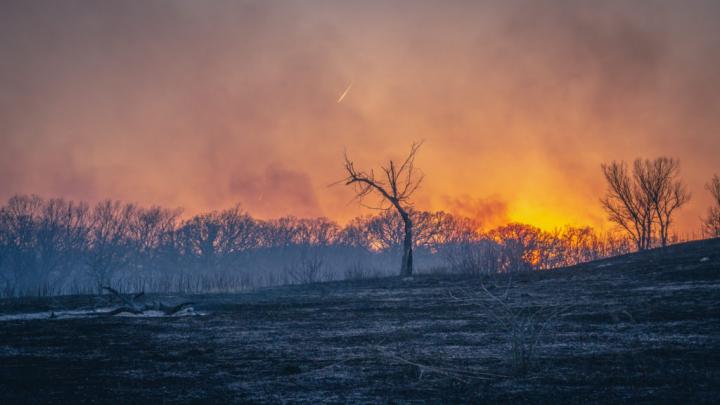
When fossil fuel or biomass burns, soot – also known as black carbon – fills the air. Black carbon is an important short-term climate driver because it absorbs solar energy and can affect the formation and composition of clouds.
The extent of black carbon’s impact on clouds has been the subject of debate for 30 years. A study recently published by Colorado State University atmospheric scientists aims to settle the debate and improve climate models.
Previous studies done in the laboratory conflicted on whether black carbon was effective at ice nucleation, a process important to cloud formation. Soot particles, like other types of aerosol particles in the air, can act as the foundation for ice crystal growth. Lab results on soot ranged wildly from no ice nucleation activity to efficient ice formation.
“One reason these results could span such a range is that combustion processes that form black carbon are extremely complicated and differ depending on fuels burned, and on whether combustion is carefully controlled, as in a diesel engine, or uncontrolled, as in wildfires,” said Gregory Schill, first author on the study and a former NSF postdoctoral research fellow in the Department of Atmospheric Science.
Schill and his colleagues sampled smoke from wildfires and prescribed burns, then filtered out soot particles using a technique he developed with other members of Professor Sonia Kreidenweis and Paul DeMott’s research group. This work builds on Schill’s previous investigation of black carbon particles from diesel engine exhaust, conducted at the CSU Engines and Energy Conversion Laboratory.
Combining the knowledge gained through these experiments, Schill and his colleagues simulated the contributions of black carbon ice-nucleating particles versus other natural sources in a global model. They found black carbon is not as important as previously thought for ice particle formation in mid-level clouds, the clouds most responsible for precipitation over continents.
Natural sources, such as dust and sea spray, have more influence on mid-level cloud properties. These cloud attributes variously affect climate by reflecting sunlight, releasing precipitation and determining how long the cloud persists.
“Our results suggest that black carbon, regardless of fuel types or combustion conditions, have similar ice formation properties in mid-level clouds, and these are less efficient at forming ice compared to other non-anthropogenic sources,” Schill said.
Atmospheric models have overestimated the role of black carbon as an ice-nucleating particle, and these findings correct that misunderstanding.
“This provides a clearer picture of the factors, both natural and anthropogenic, that might impact clouds and precipitation in a future climate,” Schill said.
The study eliminates black carbon as the primary suspect for ice formation from smoke particles but leaves many unanswered questions about how biomass burning affects clouds.
“Black carbon is only one component of a complex soup that makes up smoke,” Schill said. “We know that something in smoke can form ice particles, but we do not fully understand what these cloud seeds are.”
CSU atmospheric scientists are working on that problem, including a study by the Kreidenweis/DeMott group that addresses biomass burning’s contribution of such seeds to cloud levels. This nascent work is based on samples taken during the WE-CAN campaign, in which scientists in research aircraft flew into wildfire smoke. The new study’s findings confirm that lofted plumes have the same characteristics Schill found in his ground-based studies.
###
Schill now works for the National Oceanic and Atmospheric Administration. The black carbon study’s authors include atmospheric scientists Paul DeMott, Tom Hill, Ezra Levin and Associate Professor Jeff Pierce; CSU atmospheric science graduate John Kodros; former postdoctoral fellow Kaitlyn Suski; CSU chemistry graduates Ethan Emerson and Anne Marie Rauker; Chemistry Associate Professor Delphine Farmer; and University Distinguished Professor Sonia Kreidenweis.
Media Contact
Jennifer Dimas
[email protected]
Original Source
https:/
Related Journal Article
http://dx.