• HOME
  • NEWS
  • EXPLORE
    • CAREER
      • Companies
      • Jobs
    • EVENTS
    • iGEM
      • News
      • Team
    • PHOTOS
    • VIDEO
    • WIKI
  • BLOG
  • COMMUNITY
    • FACEBOOK
    • INSTAGRAM
    • TWITTER
Saturday, February 7, 2026
BIOENGINEER.ORG
No Result
View All Result
  • Login
  • HOME
  • NEWS
  • EXPLORE
    • CAREER
      • Companies
      • Jobs
        • Lecturer
        • PhD Studentship
        • Postdoc
        • Research Assistant
    • EVENTS
    • iGEM
      • News
      • Team
    • PHOTOS
    • VIDEO
    • WIKI
  • BLOG
  • COMMUNITY
    • FACEBOOK
    • INSTAGRAM
    • TWITTER
  • HOME
  • NEWS
  • EXPLORE
    • CAREER
      • Companies
      • Jobs
        • Lecturer
        • PhD Studentship
        • Postdoc
        • Research Assistant
    • EVENTS
    • iGEM
      • News
      • Team
    • PHOTOS
    • VIDEO
    • WIKI
  • BLOG
  • COMMUNITY
    • FACEBOOK
    • INSTAGRAM
    • TWITTER
No Result
View All Result
Bioengineer.org
No Result
View All Result
Home NEWS Science News Chemistry

Electron movements in liquid measured in super-slow motion

Bioengineer by Bioengineer
August 21, 2020
in Chemistry
Reading Time: 3 mins read
0
IMAGE
Share on FacebookShare on TwitterShare on LinkedinShare on RedditShare on Telegram

IMAGE

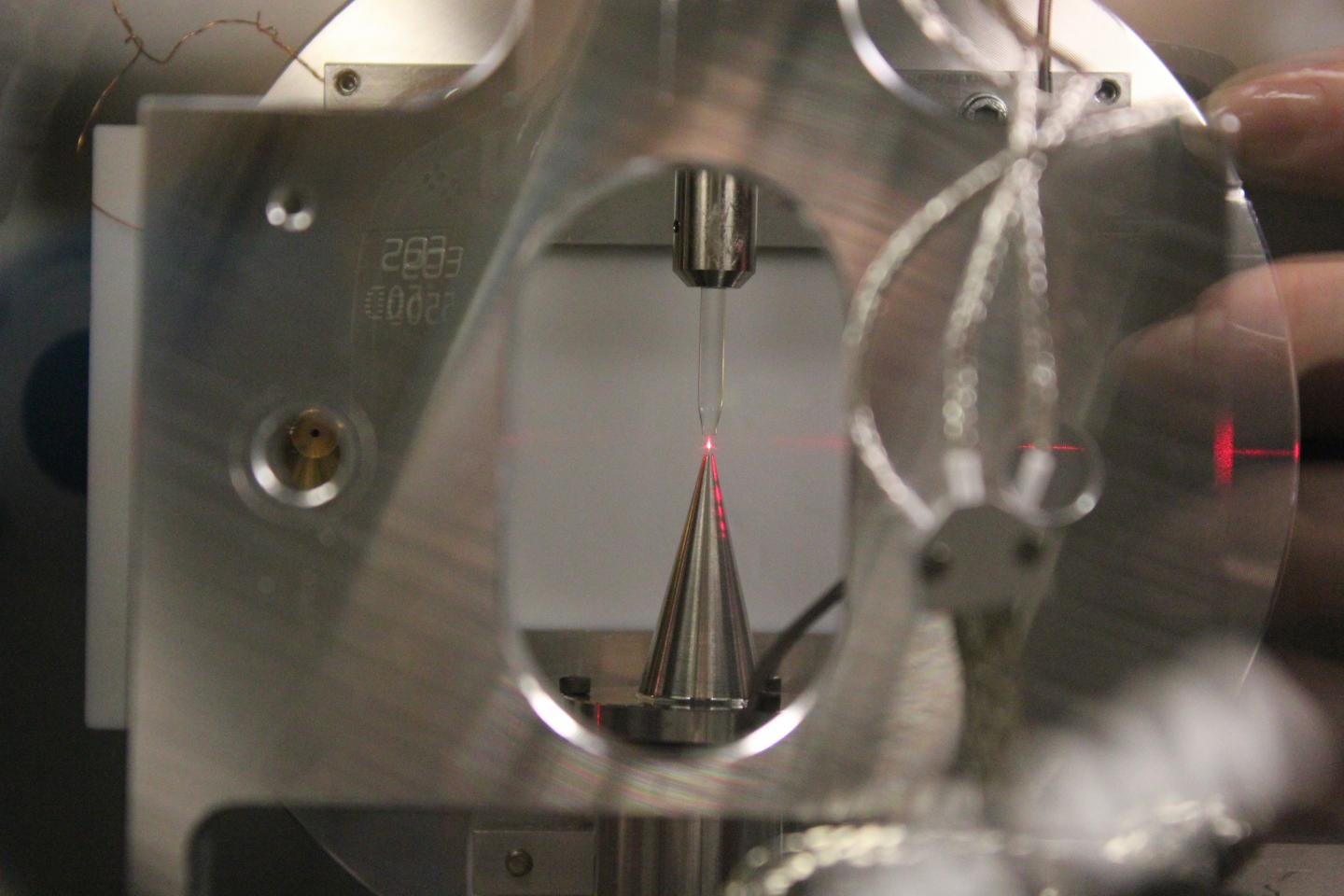
Credit: ETH Zurich / Inga Jordan

To understand how chemical reactions begin, chemists have been using super-slow motion experiments for years to study the very first moments of a reaction. These days, measurements with a resolution of a few dozen attoseconds are possible. An attosecond is 1×10^-18 of a second, i.e. a millionth of a millionth of a millionth of a second.

“In these first few dozen attoseconds of a reaction, you can already observe how electrons shift within molecules,” explains Hans Jakob Wörner, Professor at the Laboratory of Physical Chemistry at ETH Zurich. “Later, in the course of about 10,000 attoseconds or 10 femtoseconds, chemical reactions result in movements of atoms up to and including the breaking of chemical bonds.”

Five years ago, the ETH professor was one of the first scientists to be able to detect electron movements in molecules on the attosecond scale. However, up to now such measurements could be carried out only on molecules in gaseous form because they take place in a high-vacuum chamber.

Delayed transport of electrons from the liquid

After building novel measuring equipment, Wörner and his colleagues have now succeeded in detecting such movements in liquids. To this end, the researchers made use of photoemission in water: they irradiated water molecules with light, causing them to emit electrons that the scientists could then measure. “We chose to use this process for our investigation because it is possible to start it with high temporal precision using laser pulses,” Wörner says.

The new measurements also took place in high vacuum. Wörner and his team injected a 25-micrometre-thin water microjet into the measuring chamber. This allowed them to discover that electrons are emitted from water molecules in liquid form 50-70 attoseconds later than from water molecules in vapour form. The time difference is due to the fact that the molecules in liquid form are surrounded by other water molecules, which has a measurable delay effect on individual molecules.

Important step

“Electron movements are the key events in chemical reactions. That’s why it’s so important to measure them on a high-resolution time scale,” Wörner says. “The step from measurements in gases to measurements in liquids is of particular importance, because most chemical reactions – especially the ones that are biochemically interesting – take place in liquids.”

Among those, there are numerous processes that, like photoemission in water, are also triggered by light radiation. These include photosynthesis in plants, the biochemical processes on our retina that enable us to see, and damage to DNA caused by X-rays or other ionising radiation. With the help of attosecond measurements, scientists should gain new insights into these processes in the coming years.

###

Reference

Jordan I, Huppert M, Rattenbacher D, Peper M, Jelovina D, Perry C, from Conta A, sign A, Wörner HJ: Attosecond spectroscopy of liquid water. Science 2020, 369: 974, doi: 10.1126/science.abb0979 [http://dx.doi.org/10.1126/science.abb0979]

Media Contact
Hans Jakob Wörner
[email protected]

Original Source

https://ethz.ch/en/news-and-events/eth-news/news/2020/08/electron-movements-in-liquid-measured-in-super-slow-motion.html

Related Journal Article

http://dx.doi.org/10.1126/science.abb0979

Tags: Chemistry/Physics/Materials Sciences
Share12Tweet8Share2ShareShareShare2

Related Posts

blank

Breakthrough in Environmental Cleanup: Scientists Develop Solar-Activated Biochar for Faster Remediation

February 7, 2026
blank

Cutting Costs: Making Hydrogen Fuel Cells More Affordable

February 6, 2026

Scientists Develop Hand-Held “Levitating” Time Crystals

February 6, 2026

Observing a Key Green-Energy Catalyst Dissolve Atom by Atom

February 6, 2026
Please login to join discussion

POPULAR NEWS

  • Robotic Ureteral Reconstruction: A Novel Approach

    Robotic Ureteral Reconstruction: A Novel Approach

    82 shares
    Share 33 Tweet 21
  • Digital Privacy: Health Data Control in Incarceration

    63 shares
    Share 25 Tweet 16
  • Study Reveals Lipid Accumulation in ME/CFS Cells

    57 shares
    Share 23 Tweet 14
  • Breakthrough in RNA Research Accelerates Medical Innovations Timeline

    53 shares
    Share 21 Tweet 13

About

We bring you the latest biotechnology news from best research centers and universities around the world. Check our website.

Follow us

Recent News

Digital Health Perspectives from Baltic Sea Experts

Florida Cane Toad: Complex Spread and Selective Evolution

Exploring Decision-Making in Dementia Caregivers’ Mobility

Subscribe to Blog via Email

Enter your email address to subscribe to this blog and receive notifications of new posts by email.

Join 73 other subscribers
  • Contact Us

Bioengineer.org © Copyright 2023 All Rights Reserved.

Welcome Back!

Login to your account below

Forgotten Password?

Retrieve your password

Please enter your username or email address to reset your password.

Log In
No Result
View All Result
  • Homepages
    • Home Page 1
    • Home Page 2
  • News
  • National
  • Business
  • Health
  • Lifestyle
  • Science

Bioengineer.org © Copyright 2023 All Rights Reserved.