• HOME
  • NEWS
  • EXPLORE
    • CAREER
      • Companies
      • Jobs
    • EVENTS
    • iGEM
      • News
      • Team
    • PHOTOS
    • VIDEO
    • WIKI
  • BLOG
  • COMMUNITY
    • FACEBOOK
    • INSTAGRAM
    • TWITTER
Wednesday, October 7, 2026
BIOENGINEER.ORG
No Result
View All Result
  • Login
  • HOME
  • NEWS
  • EXPLORE
    • CAREER
      • Companies
      • Jobs
        • Lecturer
        • PhD Studentship
        • Postdoc
        • Research Assistant
    • EVENTS
    • iGEM
      • News
      • Team
    • PHOTOS
    • VIDEO
    • WIKI
  • BLOG
  • COMMUNITY
    • FACEBOOK
    • INSTAGRAM
    • TWITTER
  • HOME
  • NEWS
  • EXPLORE
    • CAREER
      • Companies
      • Jobs
        • Lecturer
        • PhD Studentship
        • Postdoc
        • Research Assistant
    • EVENTS
    • iGEM
      • News
      • Team
    • PHOTOS
    • VIDEO
    • WIKI
  • BLOG
  • COMMUNITY
    • FACEBOOK
    • INSTAGRAM
    • TWITTER
No Result
View All Result
Bioengineer.org
No Result
View All Result
Home NEWS Science News Biology

Unbalanced microtubule networks launch establishment of neuronal polarity

Bioengineer by Bioengineer
August 21, 2020
in Biology
Reading Time: 2 mins read
0
IMAGE
Share on FacebookShare on TwitterShare on LinkedinShare on RedditShare on Telegram

IMAGE

Credit: IGDB

Prof. MENG Wenxiang’s group from the Institute of Genetics and Developmental Biology of the Chinese Academy of Sciences recently reported a new mechanism by which microtubule networks instruct neuronal polarity.

The study, published in PNAS, deepens the understanding of the fundamental question of neuroscience, “What microtubular factor is decisive in the establishment of neuronal polarity?”

A typical mature neuron has one axon and multiple dendrites, forming the physical basis of neuronal function. In neurons, the establishment of axon/dendrite polarity is regulated by a variety of factors, including the polarization of signaling regulators and cytoskeletons. Microtubules are the final performer in this process. However, how microtubules instruct axon/dendrite differentiation has been unclear.

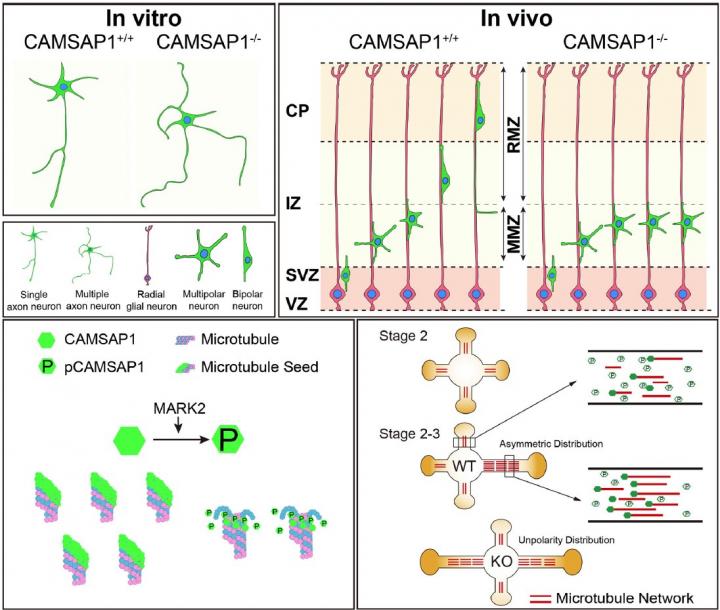
In this study, the researchers found that CAMSAP1, a microtubule minus-end binding protein, is an indispensable factor in neuronal multipolar-bipolar transition and radial migration.

Collaborating with WANG Yingchun’s group, the researchers demonstrated that the polarity regulatory factor MARK2 kinase phosphorylated the serine at amino acid 1485 of CAMSAP1 and thereby regulated the ability of CAMSAP1 to bind and protect microtubule minus-ends.

This finding shows that the asymmetric distribution of microtubule-associated CAMSAP1 is a trigger in neurons and controls neuronal polarization by creating an unbalanced distribution of microtubules among neuronal processes.

“In fact, in the early stage of neuronal polarization, it was the unbalanced stability of the noncentrosomal microtubule minus-ends that caused the asymmetric distribution of microtubules, which in turn promoted the changes of stability or modification of microtubules,” said Dr. ZHOU Zhengrong, the first author of the study. “Our research answers a question that has long plagued neuroscientists, that is, whether the stability and acetylated modification of microtubules are the decisive factors in establishing neuronal polarity.”

###

This work was supported by the National Natural Science Foundation of China and the National Basic Research Program of China.

Media Contact
MENG Wenxiang
[email protected]

Related Journal Article

http://dx.doi.org/10.1073/pnas.1913177117

Tags: BiologyGeneticsneurobiology
Share12Tweet8Share2ShareShareShare2

Related Posts

Synthetic Nanobody Library Yields New Resin for Purifying Clotting Factor VII

Synthetic Nanobody Library Yields New Resin for Purifying Clotting Factor VII

October 7, 2026
Brain Cells Have a Fat Sensor That Keeps Their Recycling Plants Running

Brain Cells Have a Fat Sensor That Keeps Their Recycling Plants Running

October 7, 2026

Behind every restored prairie lies a web of people, values and seed networks

October 7, 2026

RNA-Binding Protein PTBP3 Drives Kidney Scarring in Diabetes, Study Finds

October 7, 2026
Please login to join discussion

POPULAR NEWS

  • Alloys That Shrink Their Own Grains: New PIX Mechanism Refines Metals With Heat Alone

    Alloys That Shrink Their Own Grains: New PIX Mechanism Refines Metals With Heat Alone

    29 shares
    Share 12 Tweet 7
  • Endurance Exercise Reshapes the Liver in Males and Females Through Distinct Molecular Routes

    29 shares
    Share 12 Tweet 7
  • Single Transcription Factor PU.1 Rapidly Converts Fibroblasts into Macrophage-Lineage Cells

    29 shares
    Share 12 Tweet 7
  • New Scale Measures How Ready Nurse Educators Really Are for the AI Era

    29 shares
    Share 12 Tweet 7

About

We bring you the latest biotechnology news from best research centers and universities around the world. Check our website.

Follow us

Recent News

Alloys That Shrink Their Own Grains: New PIX Mechanism Refines Metals With Heat Alone

Endurance Exercise Reshapes the Liver in Males and Females Through Distinct Molecular Routes

Single Transcription Factor PU.1 Rapidly Converts Fibroblasts into Macrophage-Lineage Cells

Subscribe to Blog via Email

Success! An email was just sent to confirm your subscription. Please find the email now and click 'Confirm' to start subscribing.

Join 85 other subscribers
  • Contact Us

Bioengineer.org © Copyright 2023 All Rights Reserved.

Welcome Back!

Login to your account below

Forgotten Password?

Retrieve your password

Please enter your username or email address to reset your password.

Log In
No Result
View All Result
  • Homepages
    • Home Page 1
    • Home Page 2
  • News
  • National
  • Business
  • Health
  • Lifestyle
  • Science

Bioengineer.org © Copyright 2023 All Rights Reserved.