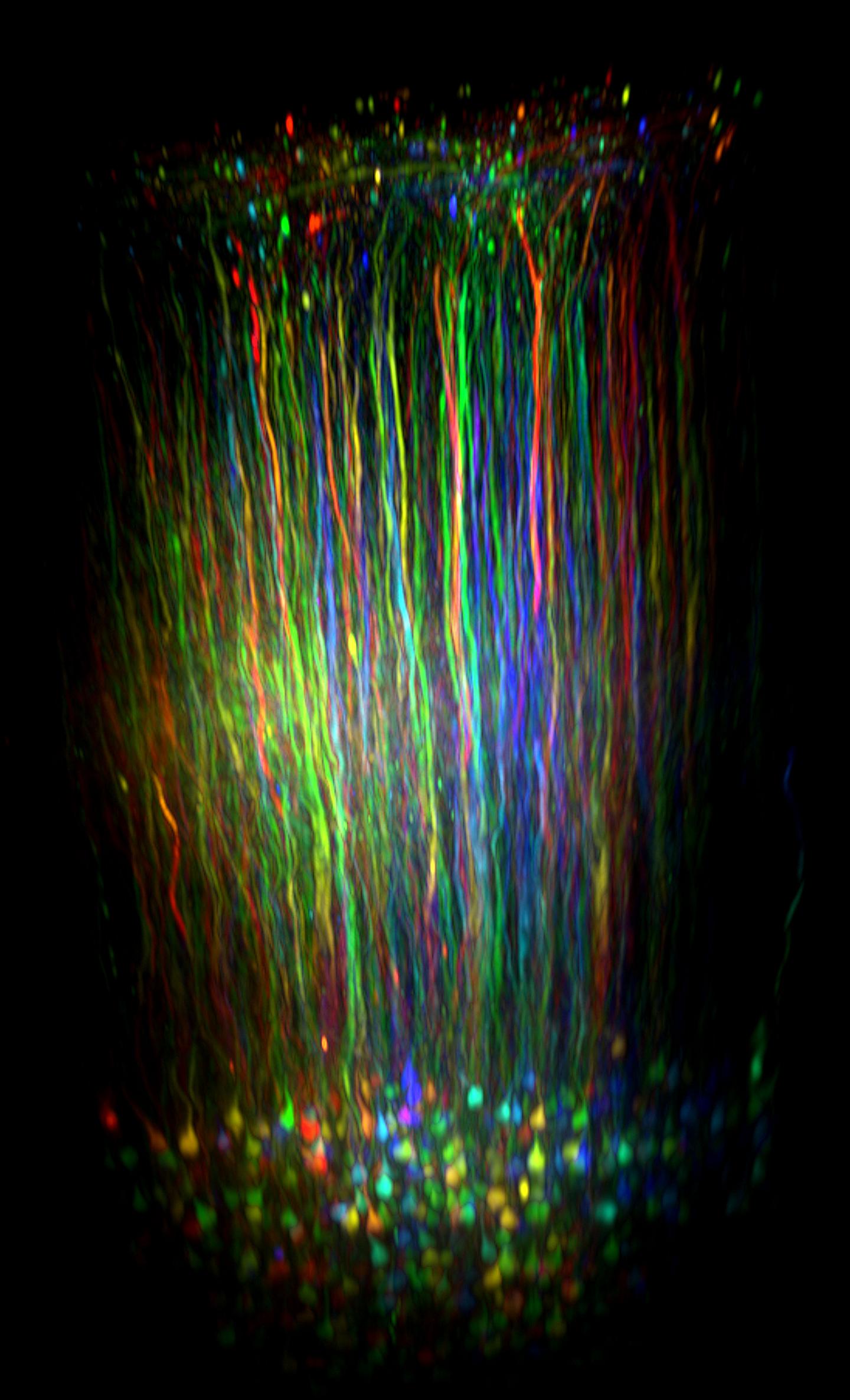
Credit: OIST
It’s probably quite easy to relate to. You’re in a lecture or meeting, avidly taking notes and engaged in the topic. You’re alert and aware of what’s being discussed, keen to absorb as much as you can. And then, suddenly, your thoughts drift away. You stop hearing what’s being said or seeing what’s being shown. You become drowsy, your eyelids start to droop, and your mind switches off.
Although this scenario is familiar to many people, the reason behind why our brains do this is not properly understood. This is mainly because many different brain structures regulate our attention span and one of them is in layer 6 – the deepest layer in the cortex. The cortex, or cerebral cortex, is the outermost part of the brain in humans and other mammals. It is composed of functionally specialized and highly interconnected sensory, motor and association areas. Abstract thinking, an internal model of the outside world, and conscious perception all arise from this part of the brain.
“We know layer 6 of the cortex regulates how we are connected to the external world in a behavior state-related manner. It’s involved in why we are fully aware in some situations and why our attention suddenly goes when we become drowsy,” explained Dr. Sigita Augustinaite, from the Optical Neuroimaging Unit at the Okinawa Institute of Science and Technology Graduate University (OIST). “But it’s a very difficult area of the brain to study.”
For this research, which was published in Current Biology, Dr. Augustinaite worked with Professor Bernd Kuhn, who leads the Unit. They used a powerful microscopy technique – two-photon imaging – to examine the neuronal activity of visual cortex layer 6 in mice. This was the first time that layer 6 neurons had been studied with subjects that were awake and behaving.
Neurons are specialized cells, which transmit information to other nerve cells and muscles around the body. Within the brain, they form networks and communicate with each other via electrochemical signals. Given their importance, finding out more about their activity is vital for understanding how our brains work.
In each experiment, the mouse was placed in a fixed yet comfortable position and periodically shown different kinds of visual stimuli. It had the freedom to run, sit, groom itself and even sleep, all while hours of recordings were being taken from deep within its brain with cellular resolution. To determine its alertness, the researchers also recorded the electrical activity – or electroencephalogram – in the brain of the mouse, as well as its running speed and pupil size. The result was the ability to observe the activity of hundreds of individual neurons at once in response to different sensory conditions whilst the mouse was in different behavioral states.
The researchers found three distinct populations of neurons that reacted differently to the visual stimulation. Around one-third of the neurons were classed as visual stimulus activated (VSA) neurons. These were inactive when there were no visual stimuli but were activated when the mouse was shown a stimulus. Other neurons had the opposite reaction. They were spontaneously active without a visual stimulus but, once a stimulus was shown, the activity dropped away. These were classed as visual stimulus suppressed (VSS) neurons.
There was also a population of quiet neurons. These were neurons that didn’t show any activity during this experiment. But, as Dr. Augustinaite explained, they might simply have shown no activity because the right kind of stimuli wasn’t being presented to activate them. “There’s a possibility that if the right stimuli were shown, then these so-called quiet neurons would have started acting as VSA neurons.”
The majority of VSA and VSS neurons were most active when the mouse was most alert, and their activity gradually decreased as the mouse became sleepier. However, this was not always the case. Some neurons, especially among the VSS population, were most active during low alertness – when the mouse was drowsy or asleep. And interestingly, while many neurons did not discriminate between locomotion and stationary states, others did. Some neurons were only active during locomotion, whilst others were only active during stationary periods. In fact, if there’s one thing this research has shown, it’s that there’s no constant. Rather, the neurons in layer 6 are diverse and dynamic.
“This is how we think layer 6 regulates what’s happening,” Dr. Augustinaite said. “The activity of these different populations of neurons complements each other.”
For example, if there’s a flow of visual information, VSA neurons send information outside of the cortex to other parts of the brain. But if it’s dark, these sub-cortical areas still need to know what’s happening in the cortex. So, the VSS neurons take over. This activity of layer 6 neurons regulates the information flow from the sensory organs to the cortex and is therefore one of the key factors that makes one pay attention or lose focus.
There’s still a lot of research to be done in layer 6 to determine exactly how this circuit contributes to our attention spans and to different disorders, such as attention deficit, autism or schizophrenia, but Dr. Augustinaite emphasized that if we want to understand what’s happening in our mind, then we must work with awake and behaving subjects. “This is the first-time layer 6 was investigated with this method.”
###
Media Contact
Tomomi Okubo
[email protected]
Original Source
https:/
Related Journal Article
http://dx.