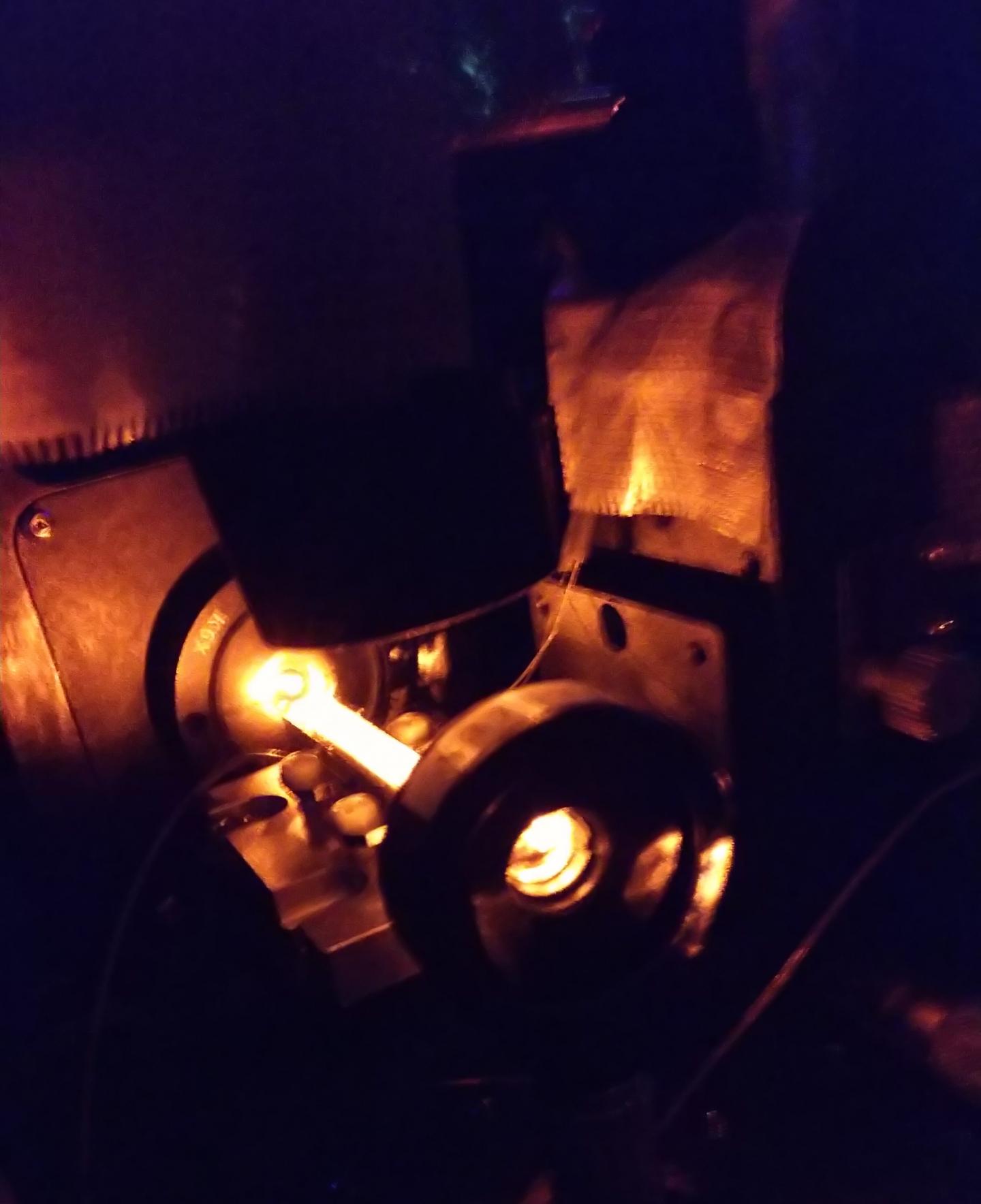
Credit: Tomoyuki Horikiri, Yokohama National University
Traditional ways of producing entanglements, necessary for the development of any “quantum internet” linking quantum computers, are not very well suited for fiber optic telecoms networks used by today’s non-quantum internet. However, researchers have come up with a new way to produce such particles that is much more compatible.
In today’s telecoms network, connected by fiber-optic cable, the photons that are transmitted tend to be absorbed within a few kilometers by the material the cable is made out of. In order to avoid deterioration of the signal, repeaters are established at regular intervals to amplify it.
Similar problems will bedevil efforts towards quantum communications — and ultimately a quantum internet. Tomoyuki Horikiri and colleagues at Yokohama National University are tackling this issue by developing a new source of entangled photons.
Their findings were published on August 12 in Communications Physics.
A pair of particles, or qubits, becomes entangled when the quantum state of each of them is inescapably connected to the quantum state of the other particle. Therefore, a measurement performed on one qubit will always be correlated to a measurement on the other qubit, regardless of the distance.
This entanglement, famously described in pop-science explanations as “spooky action at a distance,” is key to any quantum communication infrastructure of the future.
Exploiting this spooky phenomenon, researchers can use entangled photons to transfer information between two locations. The sender has half the entangled photons and the receiver has the other half. The two users, for example, can establish a random secret bit string for encryption by the shared entanglement.
But long-distance quantum communication also suffers from optical fiber losses, with entangled photons becoming disentangled due to interaction with their surroundings, and quantum repeaters, where quantum memories are loaded, would be necessary for prolonging the distance of quantum communication. The repeater stores quantum state of photon sent by users. . An entanglement “swapping,” performed by a measurement on the photons, effectively propagates the entanglement over much longer distances – like runners handing off batons in a relay race.
A quantum repeater works via a repeated exchange of quantum states between light and matter. This requires a source of entangled particles that is compatible with quantum memory. Unfortunately, quantum memory generally absorbs a narrow width of a light beam’s spectrum (known as linewidth), but traditional sources of a quantum-entangled pair of photons have a wide spectrum. This results in very poor coupling between an entangled photon pair and the quantum memory.
So far, efforts to develop sources of entangled photons have struggled to meet all the requirements for repeater-quantum memory compatibility and real-world application: a high number of photons (for large amounts of traffic), narrow linewidth, and high entanglement fidelity.
For decades, the most common way to produce entangled particles has been a technique called spontaneous parametric down-conversion, or SPDC. It uses crystals to convert single high-energy photons into pairs of entangled photons with half the original energy.
“This has been great for quantum information experiments,” said Horikiri. “But for broadband quantum communications, SPDC is not very compatible with the very narrow energy transitions involved in production of the quantum memory needed for quantum repeaters.”
The researchers improved upon this technique in effect by placing the crystal in a bowtie shaped optical cavity, and were able to successfully propagate entangled photons over ten kilometers through optical fiber, repeated once for a total overall distance of 20 kilometers.
Following on from this proof of concept for a new source of quantum-memory-compatible entangled photons that can be deployed through fiber-optic cable with low losses, the researchers now want to deploy their technique via multiple repeater nodes for much longer distances.
###
Yokohama National University (YNU or Yokokoku) is a Japanese national university founded in 1949. YNU provides students with a practical education utilizing the wide expertise of its faculty and facilitates engagement with the global community. YNU’s strength in the academic research of practical application sciences leads to high-impact publications and contributes to international scientific research and the global society. For more information, please see: https:/
Media Contact
Akiko Tsumura
[email protected]
Related Journal Article
http://dx.