• HOME
  • NEWS
  • EXPLORE
    • CAREER
      • Companies
      • Jobs
    • EVENTS
    • iGEM
      • News
      • Team
    • PHOTOS
    • VIDEO
    • WIKI
  • BLOG
  • COMMUNITY
    • FACEBOOK
    • INSTAGRAM
    • TWITTER
Saturday, February 7, 2026
BIOENGINEER.ORG
No Result
View All Result
  • Login
  • HOME
  • NEWS
  • EXPLORE
    • CAREER
      • Companies
      • Jobs
        • Lecturer
        • PhD Studentship
        • Postdoc
        • Research Assistant
    • EVENTS
    • iGEM
      • News
      • Team
    • PHOTOS
    • VIDEO
    • WIKI
  • BLOG
  • COMMUNITY
    • FACEBOOK
    • INSTAGRAM
    • TWITTER
  • HOME
  • NEWS
  • EXPLORE
    • CAREER
      • Companies
      • Jobs
        • Lecturer
        • PhD Studentship
        • Postdoc
        • Research Assistant
    • EVENTS
    • iGEM
      • News
      • Team
    • PHOTOS
    • VIDEO
    • WIKI
  • BLOG
  • COMMUNITY
    • FACEBOOK
    • INSTAGRAM
    • TWITTER
No Result
View All Result
Bioengineer.org
No Result
View All Result
Home NEWS Science News

Further details revealed about a highly-efficient anticancer drug delivery system

Bioengineer by Bioengineer
August 18, 2020
in Science News
Reading Time: 2 mins read
0
IMAGE
Share on FacebookShare on TwitterShare on LinkedinShare on RedditShare on Telegram

IMAGE

Credit: Tohoku University

The majority of drug delivery systems use nano carriers to transport drugs due to their small size and ability to distribute drugs to otherwise inaccessible sites of the body. The downside to this small size, however, is that large quantities are needed to match the required dosage.

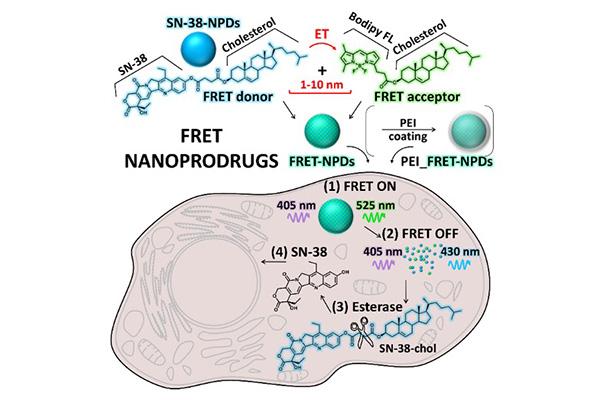
Alternative carrier-free systems, known as nanoprodrugs (NPD), show immense promise for cancer treatment. For example, a SN-38 NPD has about 10 times higher anticancer efficiency than commercially available drugs. Now, researchers have, for the first time, developed a comprehensive study on the dynamics of SN-38 NPDs inside cancer cells, including their internalization rate, intracellular localization, and degradation, as well as their therapeutic efficiency.

“These innovative systems show high anticancer activity, but the knowledge fundamental for clinical translation, such as their interaction with cancer cells, was still lacking,” said Professor Hitoshi Kasai, co-author of the study.

The research team evaluated the state of NPDs inside cancer cells using the Förster Resonance Energy Transfer (FRET) based microscopy technique. FRET relies on the energy transfer between two light-sensitive molecules. Taking advantage of the fluorescent property of the SN-38 along with the Bodipy FL fluorescence probe in the NPDs specifically designed for this study, FRET allowed the researchers to observe the state of NPDs from intact particle to the dissolved prodrug.

Confocal laser microscopy observation confirmed significant NPD degradation from intact state to a dissolved prodrug inside the cells over time. This means that NPDs were consistently absorbed by cells as intact particles before being transported into the lysosomes – a membrane bound organelle containing digestive enzymes. Once inside the lysosomes, the SN-38 prodrug dissolved from an intact particle (Figure 2) and performed its therapeutic effects on the cancer cells.

Kasai adds that “Our works provides a comprehensive overview of the dynamics of prodrug nanoparticles inside cancer cells, allowing for further progress towards their application as next-generation anticancer drug delivery devices.”

###

Media Contact
Hitoshi Kasai
[email protected]

Original Source

https://www.tohoku.ac.jp/en/press/sn38npd_further_details_revealed.html

Related Journal Article

http://dx.doi.org/10.1039/D0NR04910G

Tags: Technology/Engineering/Computer Science
Share12Tweet8Share2ShareShareShare2

Related Posts

Decoding Prostate Cancer Origins via snFLARE-seq, mxFRIZNGRND

February 7, 2026

Digital Health Perspectives from Baltic Sea Experts

February 7, 2026

Florida Cane Toad: Complex Spread and Selective Evolution

February 7, 2026

Exploring Decision-Making in Dementia Caregivers’ Mobility

February 7, 2026
Please login to join discussion

POPULAR NEWS

  • Robotic Ureteral Reconstruction: A Novel Approach

    Robotic Ureteral Reconstruction: A Novel Approach

    82 shares
    Share 33 Tweet 21
  • Digital Privacy: Health Data Control in Incarceration

    63 shares
    Share 25 Tweet 16
  • Study Reveals Lipid Accumulation in ME/CFS Cells

    57 shares
    Share 23 Tweet 14
  • Breakthrough in RNA Research Accelerates Medical Innovations Timeline

    53 shares
    Share 21 Tweet 13

About

We bring you the latest biotechnology news from best research centers and universities around the world. Check our website.

Follow us

Recent News

Decoding Prostate Cancer Origins via snFLARE-seq, mxFRIZNGRND

Digital Health Perspectives from Baltic Sea Experts

Florida Cane Toad: Complex Spread and Selective Evolution

Subscribe to Blog via Email

Enter your email address to subscribe to this blog and receive notifications of new posts by email.

Join 73 other subscribers
  • Contact Us

Bioengineer.org © Copyright 2023 All Rights Reserved.

Welcome Back!

Login to your account below

Forgotten Password?

Retrieve your password

Please enter your username or email address to reset your password.

Log In
No Result
View All Result
  • Homepages
    • Home Page 1
    • Home Page 2
  • News
  • National
  • Business
  • Health
  • Lifestyle
  • Science

Bioengineer.org © Copyright 2023 All Rights Reserved.