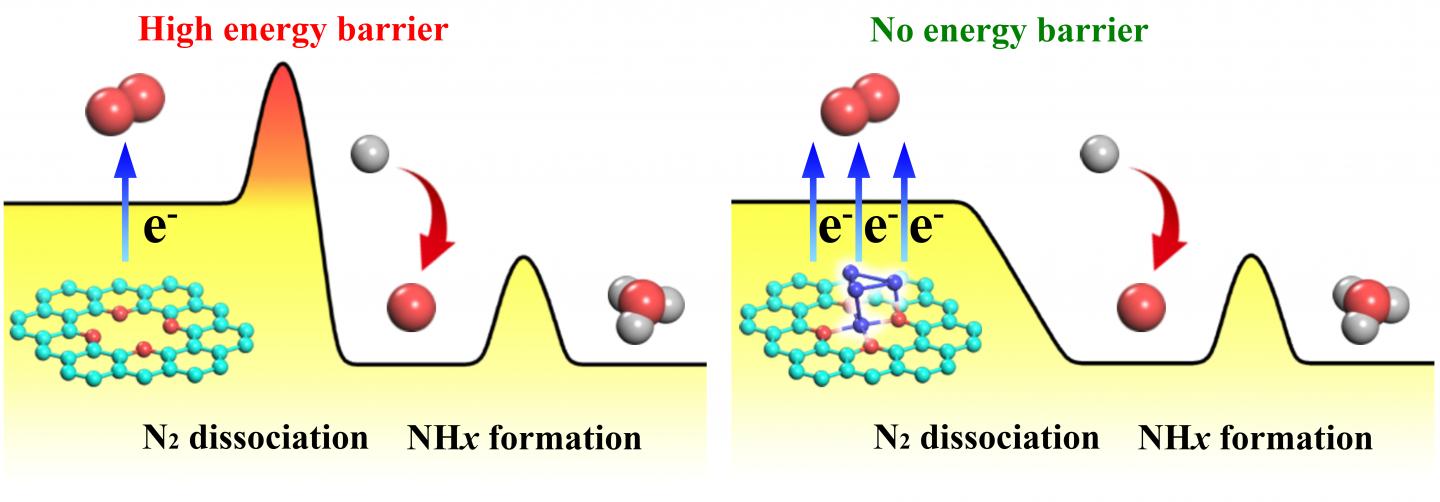
Credit: ©Science China Press
Ammonia is a generic precursor for the manufacture of essential fertilizer and most nitrogen-containing organic chemicals. To date, industrial ammonia production is predominantly conducted by the Haber-Bosch process, in which nitrogen is fixed using the chemical reductant hydrogen. However, despite the development for more than one hundred years, this process still requires harsh conditions including high temperatures (673-873 K) and pressures (20-40 MPa), accounting for 1.5% of worldwide energy consumption. In this context, it is urgently demanded to seek a sustainable and less energy-intensive technology to produce ammonia.
The electrocatalytic N2 reduction reaction (NRR), using proton from water as the hydrogen source and powered by renewable electricity sources, is an alternative method to achieve N2 fixation under ambient conditions. However, in practice, it is still difficult to achieve desirable NRR performance, which causes great energy loss of the process, and the key challenge lies in the activation of the inert nitrogen-nitrogen triple bond, which is generally considered as the rate-determining step. In this context, highly active catalysts that could alter the rate-determining step of electrochemical ammonia synthesis is expected to be an ideal candidate for ammonia synthesis.
In a new research article published in the Beijing-based National Science Review, scientists at the Soochow University in Suzhou, China present the latest advances in overcoming the bottleneck of ambient ammonia synthesis. Co-authors Sisi Liu, Mengfan Wang, Haoqing Ji, Xiaowei Shen, Chenglin Yan, and Tao Qian successfully alter the rate-determining step of ambient ammonia synthesis by deliberate introduction of cobalt single clusters as electron-donating promoter in nitrogen-doped carbon, and achieve outstanding ammonia yield rate of 76.2 μg h-1 mg-1 and superior Faradaic efficiency of 52.9%. With such strategy, the superior performance would greatly reduce the energy loss of the system and cut down the fundamental cost, thus contributing to future practical applications.
These scientists likewise outline the potential development directions of future electrocatalysts for sustainable NRR systems. “When chemically adsorbed on Co cluster, N2 is spontaneously activated and experiences a significant weakening of the nitrogen-nitrogen triple bond due to the strong electron backdonation from the metal to the N2 antibonding orbitals, and the N2 dissociation becomes an exothermic process over the cobalt single cluster.” Prof. Tao Qian said, “Thus, the rate-determining step has been successfully shifted from the usual N2 activation to the subsequent hydrogenation with only a small energy barrier of 0.85 eV.”
###
This research received funding from the National Natural Science Foundation of China and the Natural Science Foundation of Jiangsu Province.
See the article:
Sisi Liu, Mengfan Wang, Haoqing Ji, Xiaowei Shen, Chenglin Yan and Tao Qian
Altering the rate-determining step over cobalt single clusters leading to highly efficient ammonia synthesis
Natl Sci Rev nwaa136
https:/
The National Science Review is the first comprehensive scholarly journal released in English in China that is aimed at linking the country’s rapidly advancing community of scientists with the global frontiers of science and technology. The journal also aims to shine a worldwide spotlight on scientific research advances across China.
Media Contact
Tao Qian
[email protected]
Related Journal Article
http://dx.