New Springer book tackles questions around the mystery of the origin of life
Credit: Springer
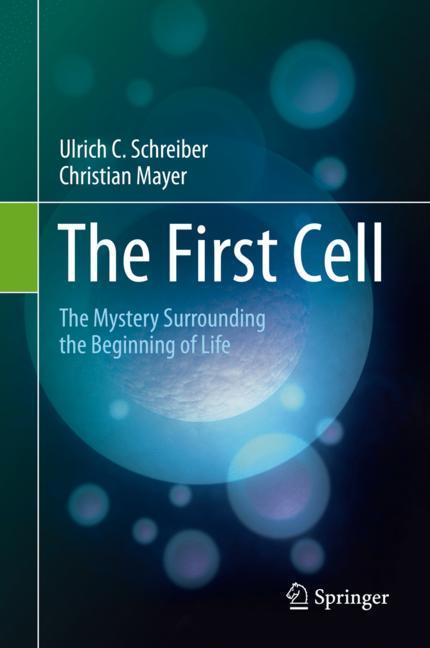
How did life on earth begin, and what does LUCA have to do with it? In their book The First Cell: The Mystery Surrounding the Beginning of Life, the geologist Ulrich C. Schreiber together with the physical chemist Christian Mayer trace the origin of life on earth and describe what it took for the first cell LUCA, the Last Universal Common Ancestor, to form.
The question of how life on earth originated has moved humanity and driven scientists for centuries. The book illustrates the process of chemical evolution under real-world conditions and takes the reader on a journey to solve the mystery surrounding the beginning of life. “On the basis of biochemical data, we have good reason to assume that all living beings on earth descend from just one ancestor”, the authors state and support their hypothesis with several astonishing findings from laboratory experiments. They explain that for LUCA to form, there must have taken place a continuous production of molecules, which provided the necessary basic building blocks for life.
The First Cell is enriched with personal notes and experiences of the authors and includes many coloured illustrations and graphics that help readers to understand better this complex topic. The quest to find an answer to the question of the origin of life shows “that life, which in our view is so natural in its existence for us, is surprisingly difficult to define.”
While the book offers a holistic theory of how life originated on earth, it requires some knowledge of biology, as the reader should be familiar with terms such as translation, nucleic acids or ribosome. The book is particularly suitable for readers who are fascinated by molecular scenarios of the evolution of life and constitutes an interesting contribution to the debate about the origin of life on earth.
###
About the authors
Both authors have been professors at the University of Duisburg-Essen since 1996. As a professor for Geology, Ulrich Schreiber did research on volcanism and tectonics, studies on gas permeable fault zones and hydrothermal systems. In 2003, he identified a connection between the locations of forest ant nests and gas permeable faults. The investigations of these faults ultimately led to a new model for the origin of life. The starting point here is supercritical CO2, which occurs in tectonic faults of the continental crust at depths of around 1000 m. Together with Christian Mayer, professor for Physical Chemistry, he conducted laboratory experiments that simulated the conditions of the continental crust. In the course of these experiments, Christian Mayer, for the first time, successfully demonstrated a chemical evolution of peptides in association with vesicles under real-world conditions. This in connection with the author’s discoveries of organic chemical molecules in archaic hydrothermal quartz from Western Australia can be seen as evidence of complex prebiotic chemistry in the upper crust.
Ulrich C. Schreiber, Christian Mayer
The First Cell: The Mystery Surrounding the Beginning of Life
2020, 193 p. 48 illus., 47 illus. in colour
Hardcover 29,99 € | £24.99 | $37.99
ISBN 978-3-030-45380-0
eISBN 978-3-030-45381-7
Media Contact
Stefanie Schulmeyer
[email protected]
Original Source
https:/