• HOME
  • NEWS
  • EXPLORE
    • CAREER
      • Companies
      • Jobs
    • EVENTS
    • iGEM
      • News
      • Team
    • PHOTOS
    • VIDEO
    • WIKI
  • BLOG
  • COMMUNITY
    • FACEBOOK
    • INSTAGRAM
    • TWITTER
Monday, May 11, 2026
BIOENGINEER.ORG
No Result
View All Result
  • Login
  • HOME
  • NEWS
  • EXPLORE
    • CAREER
      • Companies
      • Jobs
        • Lecturer
        • PhD Studentship
        • Postdoc
        • Research Assistant
    • EVENTS
    • iGEM
      • News
      • Team
    • PHOTOS
    • VIDEO
    • WIKI
  • BLOG
  • COMMUNITY
    • FACEBOOK
    • INSTAGRAM
    • TWITTER
  • HOME
  • NEWS
  • EXPLORE
    • CAREER
      • Companies
      • Jobs
        • Lecturer
        • PhD Studentship
        • Postdoc
        • Research Assistant
    • EVENTS
    • iGEM
      • News
      • Team
    • PHOTOS
    • VIDEO
    • WIKI
  • BLOG
  • COMMUNITY
    • FACEBOOK
    • INSTAGRAM
    • TWITTER
No Result
View All Result
Bioengineer.org
No Result
View All Result
Home NEWS Science News Chemistry

Using physics to improve root canal efficiency

Bioengineer by Bioengineer
August 11, 2020
in Chemistry
Reading Time: 3 mins read
0
IMAGE
Share on FacebookShare on TwitterShare on LinkedinShare on RedditShare on Telegram

Temperature is a critical parameter in determining cleansing efficiency during a root canal
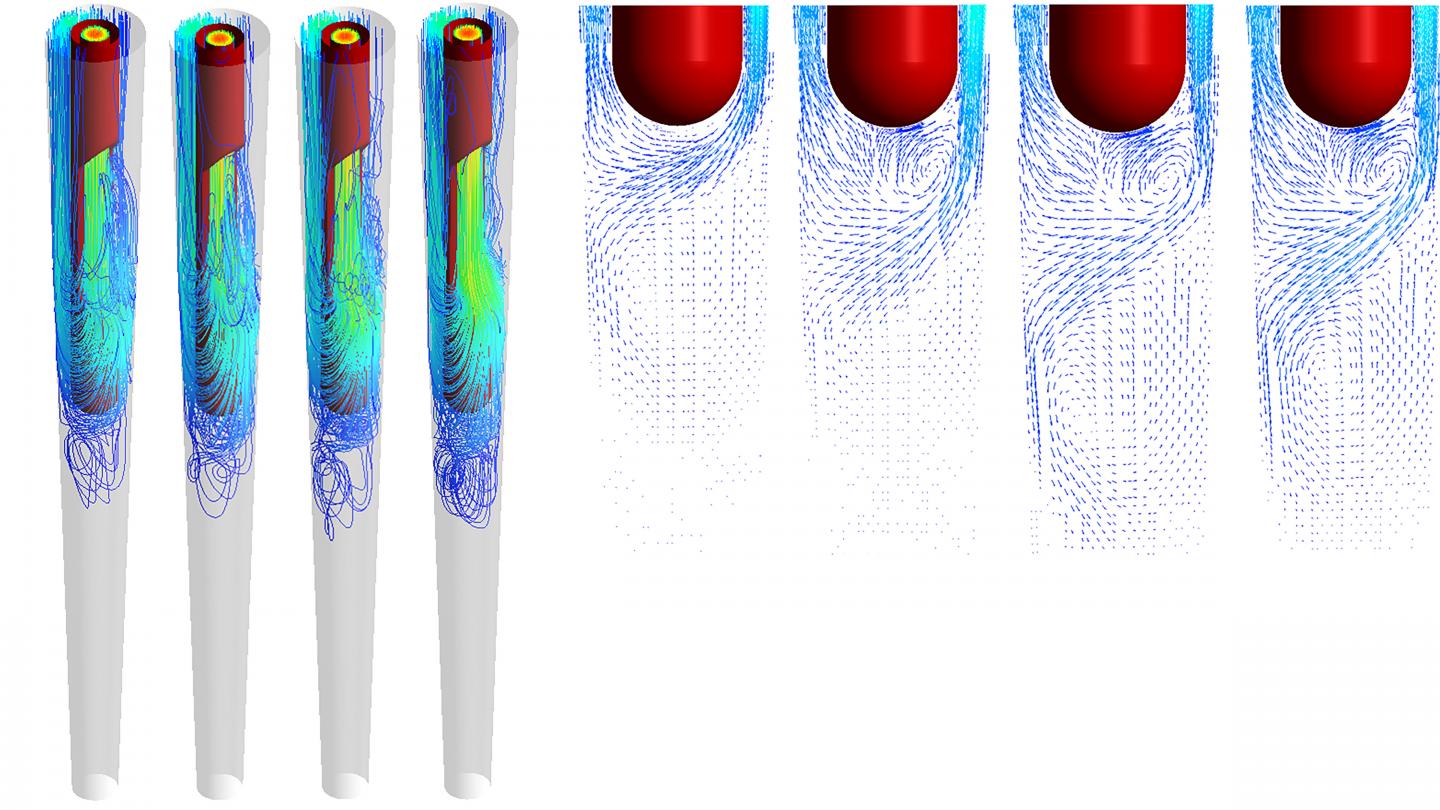
IMAGE

Credit: Hanhui Jin

WASHINGTON, August 11, 2020 — Scientists used computational fluid dynamics to determine the effect of temperature on root canal cleaning efficiency. Higher temperatures can, to a point, improve cleansing, but this benefit falls off if the temperature gets too high.

In Physics of Fluids, by AIP Publishing, scientists from China and the U.S. report calculations with a model of the conical-shaped root canal inside a tooth. This cavity is usually filled with pulp. When the pulp becomes inflamed or infected, an endodontist removes the infected pulp, and then cleans, shapes and fills the canal. The apex is then sealed.

A crucial step in this common dental procedure is irrigation, or rinsing, of the root canal cavity with an antibacterial solution, such as sodium hypochlorite. Efficient cleaning and successful destruction of any bacteria or other microbes in the cavity depend on the penetration and cleaning ability of the irrigation fluid.

The computational investigation used a structured mesh as a model of the conical root canal cavity. More than 1 million cells in the mesh completely and accurately described both the root canal and the side-vented needle through which the hypochlorite solution is injected. Fluid dynamics equations were used to model flow of the hypochlorite solution.

The scientists varied the fluid velocity, temperature and input power to determine the most efficient cleansing technique. As expected, higher fluid velocities lead to better cleansing. Perhaps counterintuitively, cleansing efficiency is higher on the wall behind the needle vent.

“The effective area on the root canal wall, in which the shear stress exceeds the critical value to clean the wall, is usually larger behind the needle outlet than in front of it,” said author Hanhui Jin.

The maximum shear stress also usually occurs on the wall behind the needle outlet, Jin explained.

The investigators also looked at the effect of temperature on cleansing. They considered four different temperatures: 22 Celsius, which is room temperature; 37 C, which is body temperature; and two higher temperatures of 45 C and 60 C. Temperatures above 60 C are painful for the patient and tend to cause root canal damage.

Increasing the temperature to 45 C, while holding the fluid velocity fixed, improved the depth of cleansing and the cleansing span across the canal’s width, but further increases in temperature beyond 45 C actually decreased the cleansing efficiency.

The investigators considered the effect of power consumption by the irrigation device. If the power consumption is held at a fixed value, the effect of temperature on cleansing efficiency is much more pronounced.

“The fluid circulation within the canal is clearly enlarged when the temperature is increased,” said Jin. Therefore, careful control of both power consumption and temperature leads to increased cleaning efficiency.

###

The article, “Effect of inflow temperature on root canal irrigation: A computational fluid dynamics study,” is authored by Mingzhou Yu, Zhengqiu Huang, Na Zhou, Zihan Xu, Shuli Deng and Hanhui Jin. The article will appear in Physics of Fluids on Aug. 11, 2020 (DOI: 10.1063/5.0014737). After that date, it can be accessed at https://aip.scitation.org/doi/10.1063/5.0014737.

ABOUT THE JOURNAL

Physics of Fluids is devoted to the publication of original theoretical, computational, and experimental contributions to the dynamics of gases, liquids, and complex fluids. See https://aip.scitation.org/journal/phf.

Media Contact
Larry Frum
[email protected]

Related Journal Article

http://dx.doi.org/10.1063/5.0014737

Tags: BacteriologyBiologyChemistry/Physics/Materials SciencesDentistry/Periodontal DiseaseMedicine/Health
Share12Tweet8Share2ShareShareShare2

Related Posts

Miniature Sensor Uses Light to Detect Touch — Chemistry

Miniature Sensor Uses Light to Detect Touch

May 8, 2026
Iron Minerals Determine Whether Dissolved Organic Matter Fuels Microbes or Becomes Long-Term Carbon Storage — Chemistry

Iron Minerals Determine Whether Dissolved Organic Matter Fuels Microbes or Becomes Long-Term Carbon Storage

May 8, 2026

Kate Evans Appointed Associate Lab Director for Biological and Environmental Systems Science at ORNL

May 8, 2026

Advancing Multiscale Modeling and Overcoming Operational Challenges in Autothermal COâ‚‚-to-Methanol Reactors

May 8, 2026
Please login to join discussion

POPULAR NEWS

  • Research Indicates Potential Connection Between Prenatal Medication Exposure and Elevated Autism Risk

    840 shares
    Share 336 Tweet 210
  • New Study Reveals Plants Can Detect the Sound of Rain

    727 shares
    Share 290 Tweet 181
  • Salmonella Haem Blocks Macrophages, Boosts Infection

    61 shares
    Share 24 Tweet 15
  • Breastmilk Balances E. coli and Beneficial Bacteria in Infant Gut Microbiomes

    57 shares
    Share 23 Tweet 14

About

We bring you the latest biotechnology news from best research centers and universities around the world. Check our website.

Follow us

Recent News

New Post-Hoc Analysis Explores Daily Oral Orforglipron Use in Adults Over 65 with Obesity, Regardless of Diabetes Status

Evaluating Digoxin Use in Patients with Symptomatic Rheumatic Heart Disease

Evaluating the Effectiveness and Safety of Digitalis Glycosides in Treating Heart Failure

Subscribe to Blog via Email

Enter your email address to subscribe to this blog and receive notifications of new posts by email.

Join 82 other subscribers
  • Contact Us

Bioengineer.org © Copyright 2023 All Rights Reserved.

Welcome Back!

Login to your account below

Forgotten Password?

Retrieve your password

Please enter your username or email address to reset your password.

Log In
No Result
View All Result
  • Homepages
    • Home Page 1
    • Home Page 2
  • News
  • National
  • Business
  • Health
  • Lifestyle
  • Science

Bioengineer.org © Copyright 2023 All Rights Reserved.