• HOME
  • NEWS
  • EXPLORE
    • CAREER
      • Companies
      • Jobs
    • EVENTS
    • iGEM
      • News
      • Team
    • PHOTOS
    • VIDEO
    • WIKI
  • BLOG
  • COMMUNITY
    • FACEBOOK
    • INSTAGRAM
    • TWITTER
Monday, March 30, 2026
BIOENGINEER.ORG
No Result
View All Result
  • Login
  • HOME
  • NEWS
  • EXPLORE
    • CAREER
      • Companies
      • Jobs
        • Lecturer
        • PhD Studentship
        • Postdoc
        • Research Assistant
    • EVENTS
    • iGEM
      • News
      • Team
    • PHOTOS
    • VIDEO
    • WIKI
  • BLOG
  • COMMUNITY
    • FACEBOOK
    • INSTAGRAM
    • TWITTER
  • HOME
  • NEWS
  • EXPLORE
    • CAREER
      • Companies
      • Jobs
        • Lecturer
        • PhD Studentship
        • Postdoc
        • Research Assistant
    • EVENTS
    • iGEM
      • News
      • Team
    • PHOTOS
    • VIDEO
    • WIKI
  • BLOG
  • COMMUNITY
    • FACEBOOK
    • INSTAGRAM
    • TWITTER
No Result
View All Result
Bioengineer.org
No Result
View All Result
Home NEWS Science News Chemistry

New DOE grant to develop catalysts for renewable energy generation

Bioengineer by Bioengineer
August 7, 2020
in Chemistry
Reading Time: 2 mins read
0
IMAGE
Share on FacebookShare on TwitterShare on LinkedinShare on RedditShare on Telegram

Wayne State University professor to lead efforts
IMAGE

Credit: Wayne State University College of Engineering

DETROIT – Shifting the current energy landscape away from fossil fuels is a major challenge that will require the development of sustainable and clean energy conversion and storage technologies including fuel cells, electrolyzers and batteries. These technologies effectively convert and store the chemical energy of fuels, along with the intermittent electrical energy generated from renewable sources — such as solar power and wind power — through specific electrochemical reactions. In order to efficiently carry out the reactions that lead to energy generation and storage using these technologies, better and cheaper catalysts must be developed.

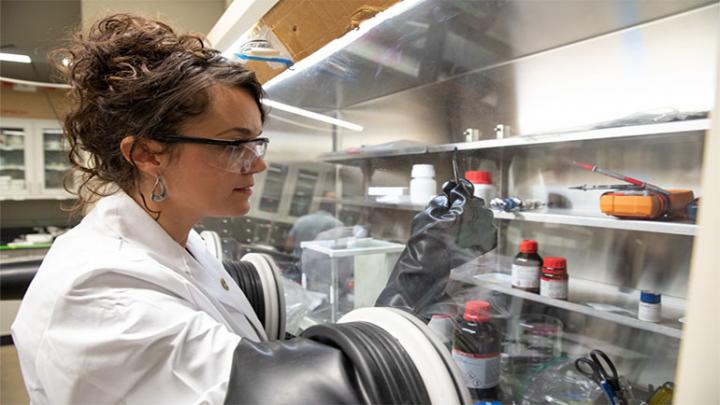
Eranda Nikolla, Ph.D., professor of chemical engineering in Wayne State University’s College of Engineering, recently received a $533,837 research award from the Department of Energy’s Office of Science for her proposal, “Tuning Catalytically Active Single Sites in Non-stoichiometric, Mixed Metal Oxides for Oxygen Electrocatalysis,” which aims to address this need.

Nikolla’s work will focus on the development of efficient electrochemical systems for energy generation and storage. She aims to combine computational tools with nanoscience and catalysis to design catalytically active cationic sites in non-stoichiometric, mixed metal oxides for oxygen reduction and evolution — key reactions in renewable electrochemical energy conversion systems, such as generation of H2 from water. The proposed work will have a significant impact on the development of efficient energy conversion systems.

“It is a great honor that our research has been funded by the U.S. Department of Energy’s Basic Energy Sciences,” said Nikolla. “This work will have a significant impact in the field by providing fundamental insights that can guide tuning of cationic sites in mixed metal oxide electrocatalysts for energy generation and storage.”

The grant number for this Department of Energy award is DE-SC0020953.

###

Wayne State University is one of the nation’s pre-eminent public research institutions in an urban setting. Through its multidisciplinary approach to research and education, and its ongoing collaboration with government, industry and other institutions, the university seeks to enhance economic growth and improve the quality of life in the city of Detroit, the state of Michigan and throughout the world. For more information about research at Wayne State University, visit http://www.research.wayne.edu.

Media Contact
Julie O’Connor
[email protected]

Tags: Biomedical/Environmental/Chemical EngineeringEnergy/Fuel (non-petroleum)Technology/Engineering/Computer Science
Share12Tweet8Share2ShareShareShare2

Related Posts

Enhancing Weather Resistance in Perovskite Solar Cells

Enhancing Weather Resistance in Perovskite Solar Cells

March 29, 2026
Innovative Approach Achieves 29.76% Efficiency in All-Perovskite Tandem Solar Cells

Innovative Approach Achieves 29.76% Efficiency in All-Perovskite Tandem Solar Cells

March 29, 2026

Molecular Umbrella Shields Solar Cells for Enhanced Protection

March 29, 2026

Microwave Technology Transforms Moon Dust into Building Materials Without Earth Supplies

March 29, 2026
Please login to join discussion

POPULAR NEWS

  • blank

    Revolutionary AI Model Enhances Precision in Detecting Food Contamination

    96 shares
    Share 38 Tweet 24
  • Imagine a Social Media Feed That Challenges Your Views Instead of Reinforcing Them

    1005 shares
    Share 397 Tweet 248
  • Promising Outcomes from First Clinical Trials of Gene Regulation in Epilepsy

    51 shares
    Share 20 Tweet 13
  • Advancements in EV Battery Technology to Surpass Climate Change-Induced Degradation

    45 shares
    Share 18 Tweet 11

About

We bring you the latest biotechnology news from best research centers and universities around the world. Check our website.

Follow us

Recent News

Prioritize Intensity Over Duration: How Harder Exercise Lowers Disease and Mortality Risks

Squirrels Scale Greater Heights to Access Superior Snacks

New Zebrafish Study Sheds Light on Why Haploid Fish Embryos Often Fail to Fully Develop

Subscribe to Blog via Email

Enter your email address to subscribe to this blog and receive notifications of new posts by email.

Join 78 other subscribers
  • Contact Us

Bioengineer.org © Copyright 2023 All Rights Reserved.

Welcome Back!

Login to your account below

Forgotten Password?

Retrieve your password

Please enter your username or email address to reset your password.

Log In
No Result
View All Result
  • Homepages
    • Home Page 1
    • Home Page 2
  • News
  • National
  • Business
  • Health
  • Lifestyle
  • Science

Bioengineer.org © Copyright 2023 All Rights Reserved.