Credit: Amar Flood
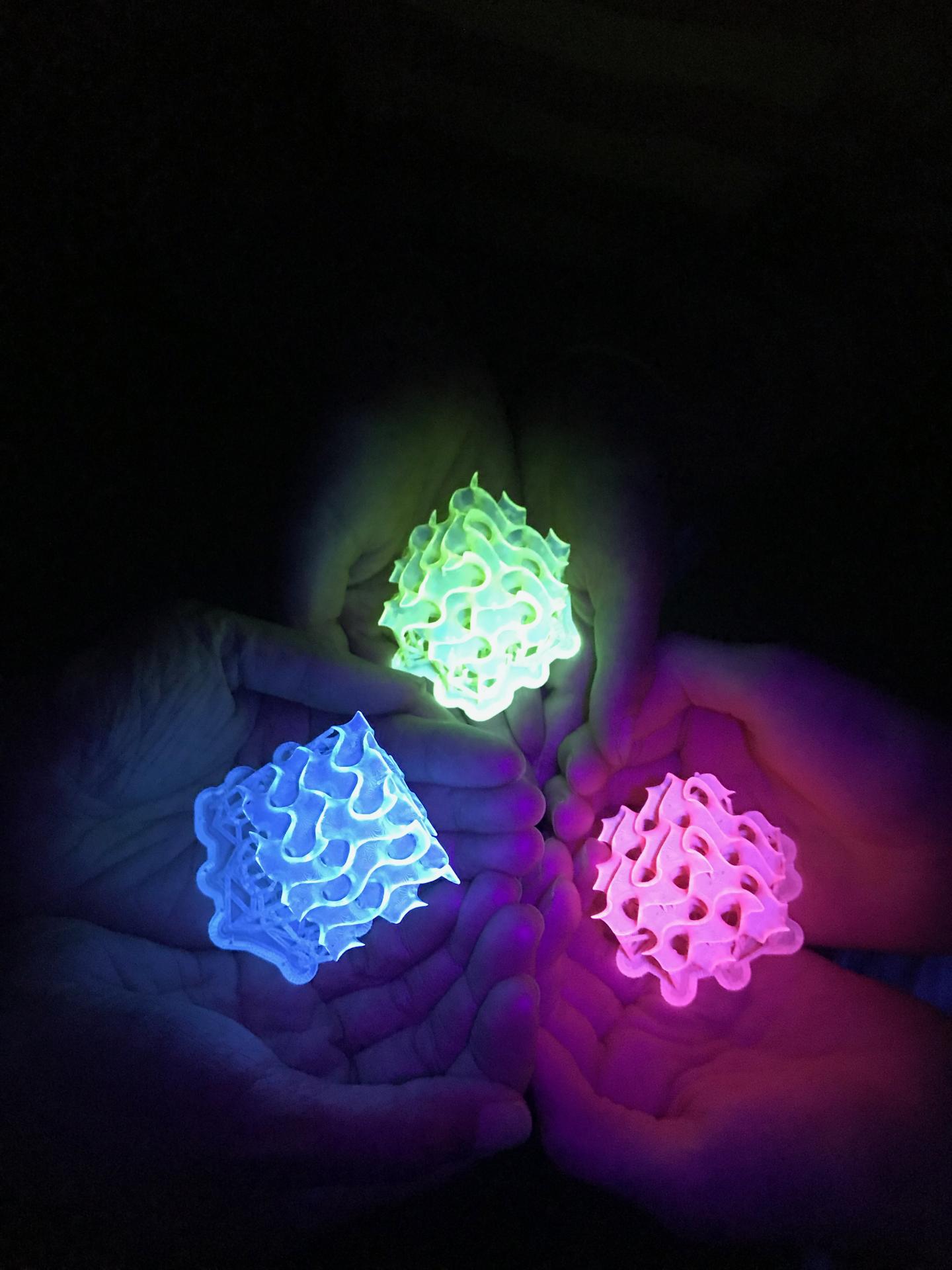
By formulating positively charged fluorescent dyes into a new class of materials called small-molecule ionic isolation lattices (SMILES), a compound’s brilliant glow can be seamlessly transferred to a solid, crystalline state, researchers report August 6 in the journal Chem. The advance overcomes a long-standing barrier to developing fluorescent solids, resulting in the brightest known materials in existence.
“These materials have potential applications in any technology that needs bright fluorescence or calls for designing optical properties, including solar energy harvesting, bioimaging, and lasers,” says Amar Flood, a chemist at Indiana University and co-senior author on the study along with Bo Laursen of the University of Copenhagen.
“Beyond these, there are interesting applications that include upconverting light to capture more of the solar spectrum in solar cells, light-switchable materials used for information storage and photochromic glass, and circularly polarized luminescence that may be used in 3D display technology,” Flood says.
While there are currently more than 100,000 different fluorescent dyes available, almost none of these can be mixed and matched in predictable ways to create solid optical materials. Dyes tend to undergo “quenching” when they enter a solid state due to how they behave when packed close together, decreasing the intensity of their fluorescence to produce a more subdued glow.
“The problem of quenching and inter-dye coupling emerges when the dyes stand shoulder-to-shoulder inside solids,” says Flood. “They cannot help but ‘touch’ each other. Like young children sitting at story time, they interfere with each other and stop behaving as individuals.”
To overcome this problem, Flood and colleagues mixed a colored dye with a colorless solution of cyanostar, a star-shaped macrocycle molecule that prevents the fluorescent molecules from interacting as the mixture solidified, keeping their optical properties intact. As the mixture became a solid, SMILES formed, which the researchers then grew into crystals, precipitated into dry powders, and finally spun into a thin film or incorporated directly into polymers. Since the cyanostar macrocycles form building blocks that generate a lattice-like checkerboard, the researchers could simply plug a dye into the lattice and, without any further adjustments, the structure would take on its color and appearance.
While previous research had already developed an approach to spacing the dyes apart using macrocycle molecules, it relied on colored macrocycles to do the job. Flood and colleagues found that colorless macrocycles were key.
“Some people think that colorless macrocycles are unattractive, but they allowed the isolation lattice to fully express the bright fluorescence of the dyes unencumbered by the colors of the macrocycles,” says Flood.
Next, the researchers plan to explore the properties of fluorescent materials formed using this novel technique, enabling them to work with dye makers in the future to realize the materials’ full potential in a variety of different applications.
“These materials are totally new, so we do not know which of their innate properties are actually going to offer superior functionality,” says Flood. “We also do not know the materials’ limits. So, we will develop a fundamental understanding of how they work, providing a robust set of design rules for making new properties. This is critical for putting these materials into the hands of others–we want to pursue crowd sourcing and to work with others in this effort.”
###
This work was supported by the National Science Foundation; the Danish Research Council; the Johnson Center for Innovation and Translational Research (JCITR) Pilot Grant Program, Indiana University; and bridge funding support from the Office of the Vice Provost for Research, the College of Arts and Sciences, and the Department of Chemistry at Indiana University. Indiana University and the University of Copenhagen have applied for a patent on this work. Three co-authors are co-founders of a company related to this work.
Chem, Benson et al.: “Plug-and-Play Optical Materials from Fluorescent Dyes and Macrocycles” https://www.cell.com/chem/fulltext/S2451-9294(20)30310-7
Chem (@Chem_CP) is the first physical science journal published by Cell Press. A sister journal to Cell, Chem, which is published monthly, provides a home for seminal and insightful research and showcases how fundamental studies in chemistry and its sub-disciplines may help in finding potential solutions to the global challenges of tomorrow. Visit: http://www.
Media Contact
Carly Britton
press@cell.com
Related Journal Article
http://dx.