• HOME
  • NEWS
  • EXPLORE
    • CAREER
      • Companies
      • Jobs
    • EVENTS
    • iGEM
      • News
      • Team
    • PHOTOS
    • VIDEO
    • WIKI
  • BLOG
  • COMMUNITY
    • FACEBOOK
    • INSTAGRAM
    • TWITTER
Tuesday, May 12, 2026
BIOENGINEER.ORG
No Result
View All Result
  • Login
  • HOME
  • NEWS
  • EXPLORE
    • CAREER
      • Companies
      • Jobs
        • Lecturer
        • PhD Studentship
        • Postdoc
        • Research Assistant
    • EVENTS
    • iGEM
      • News
      • Team
    • PHOTOS
    • VIDEO
    • WIKI
  • BLOG
  • COMMUNITY
    • FACEBOOK
    • INSTAGRAM
    • TWITTER
  • HOME
  • NEWS
  • EXPLORE
    • CAREER
      • Companies
      • Jobs
        • Lecturer
        • PhD Studentship
        • Postdoc
        • Research Assistant
    • EVENTS
    • iGEM
      • News
      • Team
    • PHOTOS
    • VIDEO
    • WIKI
  • BLOG
  • COMMUNITY
    • FACEBOOK
    • INSTAGRAM
    • TWITTER
No Result
View All Result
Bioengineer.org
No Result
View All Result
Home NEWS Science News Chemistry

Discovery could lead to more potent garlic, boosting flavor and bad breath

Bioengineer by Bioengineer
August 5, 2020
in Chemistry
Reading Time: 3 mins read
0
IMAGE
Share on FacebookShare on TwitterShare on LinkedinShare on RedditShare on Telegram

IMAGE

Credit: Virginia Tech

For centuries, people around the world have used garlic as a spice, natural remedy, and pest deterrent – but they didn’t know how powerful or pungent the heads of garlic were until they tasted them.

Video: https://video.vt.edu/media/1_h08qtb5q

But what if farmers were able to grow garlic and know exactly how potent it would be? What if buyers could pick their garlic based on its might?

A team of Virginia Tech researchers recently discovered a new step in the metabolic process that produces the enzyme allicin, which leads to garlic’s delectable flavor and aroma, a finding that upends decades of previous scientific belief. Their work could boost the malodorous – yet delicious – characteristics that garlic-lovers the world over savor.

“This information changes the whole story about how garlic could be improved or we could make the compounds responsible of its unique flavor,” said Hannah Valentino, a College of Agriculture and Life Sciences Ph.D. candidate. “This could lead to a new strain of garlic that would produce more flavor.”

The discovery of this pathway opens the door for better control of production and more consistent crops, which would help farmers. Garlic could be sold as strong or weak, depending on consumer preferences.

The research was recently published in the Journal of Biological Chemistry.

When Valentino, an Institute for Critical Technology and Applied Science doctoral fellow, and her team set out to test the generally accepted biological process that creates allicin, they found it just didn’t happen.

That’s when the team of researchers set out to discover what was really happening in garlic.

As they peeled back the layers, they realized there was no fuel to power the previous accepted biological process that creates allicin.

“By using rational design, Hannah found a potential substrate,” said Pablo Sobrado, professor of biochemistry in the College of Agriculture and Life Sciences and a member of the research team. “This is significant because by finding the metabolic pathway and understanding how the enzyme actually works and its structure gives us a blueprint of how allicin is created during biosynthesis.”

Valentino and the team – which included undergraduate students – worked in the Sobrado Lab in the Fralin Life Sciences Institute directly with the substrates that comprise garlic, doing their work solely in vitro.

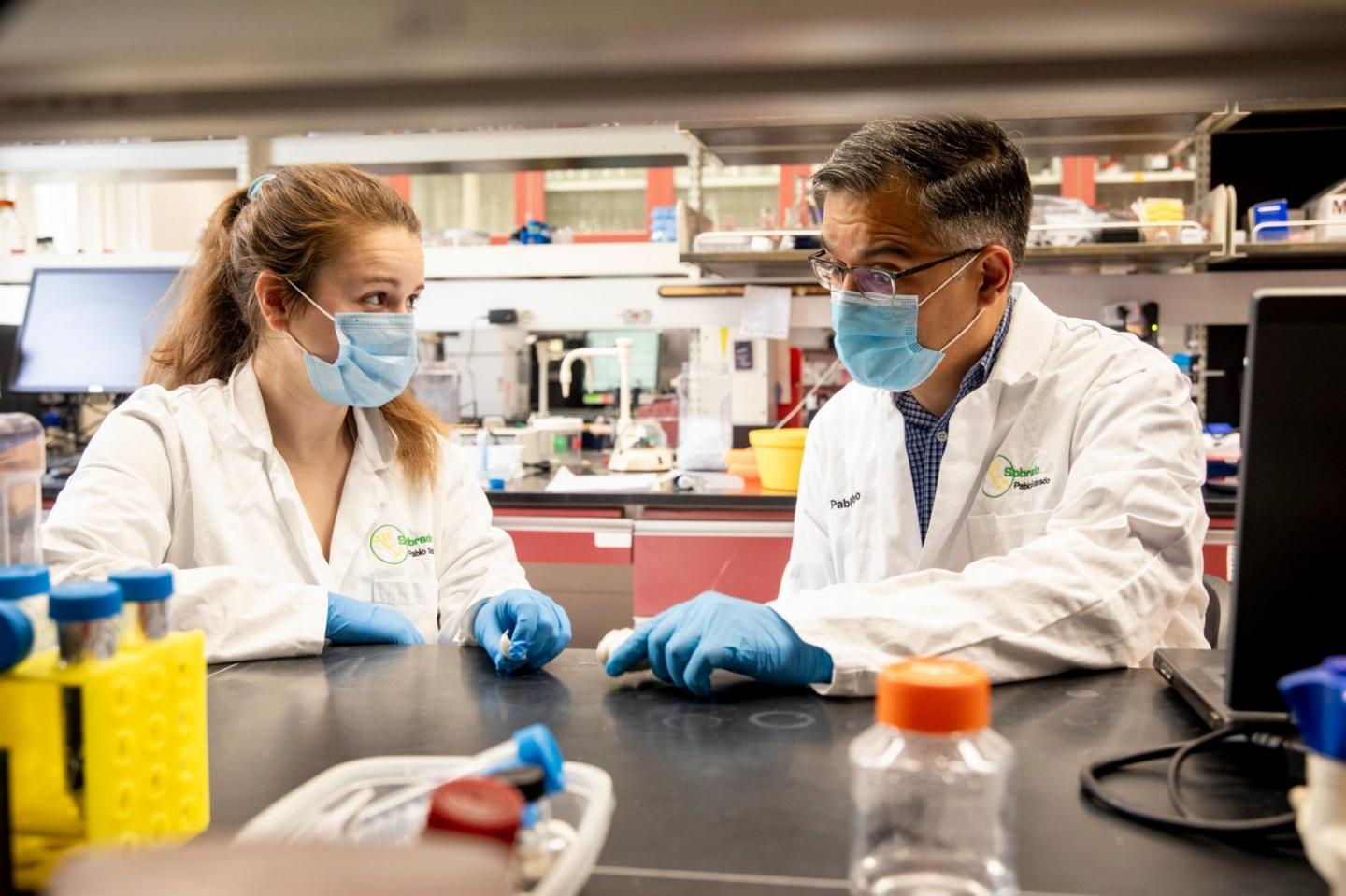
Hannah Valentino, left, and Pablo Sobrado, right, are conducting research that is laying the foundation for a future in which buyers can choose garlic based on its strength and flavor profile.

The researchers found that allicin, the component that gives garlic its smell and flavor, was produced by an entirely different biosynthetic process. Allyl-mercaptan reacts with flavin-containing monooxygenase, which then becomes allyl-sulfenic acid.

Importantly, the allicin levels can be tested, allowing farmers to know the strength of their crops without the need for genetic engineering. Greater flavor can simply be predicted, meaning powerful garlic could simply be bred or engineered.

“We have a basic understanding of the biosynthesis of allicin that it is involved in flavor and smell, but we also now understand an enzyme that we can try to modulate, or a modify, to increase or decrease the level of the flavor molecules based on these biological processes,” Sobrado said.

Because of their work, the future awaits for fields of garlic harsh enough to keep even the most terrifying vampires at bay.

###

Media Contact
Zeke Barlow
[email protected]

Original Source

https://vtnews.vt.edu/articles/2020/07/cals-potent-garlic

Tags: Agricultural Production/EconomicsAgricultureBiochemistryBusiness/EconomicsFood/Food Science
Share13Tweet8Share2ShareShareShare2

Related Posts

Humans and Zebra Finches Share Similar Speech Learning Techniques #ASA190 — Chemistry

Humans and Zebra Finches Share Similar Speech Learning Techniques #ASA190

May 11, 2026
Unveiling Dark Matter Through Molecular Insights — Chemistry

Unveiling Dark Matter Through Molecular Insights

May 11, 2026

From Touch to Sight: A Bioinspired Multisensory Framework Endows Robots with Human-Like Perception

May 11, 2026

Announcing the 2026 Carbon Future Young Investigator Award Winners

May 11, 2026
Please login to join discussion

POPULAR NEWS

  • Research Indicates Potential Connection Between Prenatal Medication Exposure and Elevated Autism Risk

    841 shares
    Share 336 Tweet 210
  • New Study Reveals Plants Can Detect the Sound of Rain

    728 shares
    Share 290 Tweet 182
  • Salmonella Haem Blocks Macrophages, Boosts Infection

    62 shares
    Share 25 Tweet 16
  • Breastmilk Balances E. coli and Beneficial Bacteria in Infant Gut Microbiomes

    57 shares
    Share 23 Tweet 14

About

We bring you the latest biotechnology news from best research centers and universities around the world. Check our website.

Follow us

Recent News

Humans and Zebra Finches Share Similar Speech Learning Techniques #ASA190

New Study Uncovers How Fungal Parasites Attack Strawberries and Raspberries

City of Hope Researchers to Present Groundbreaking Immunotherapy and Precision Medicine Advances Across Multiple Cancer Types at ASCO 2026

Subscribe to Blog via Email

Enter your email address to subscribe to this blog and receive notifications of new posts by email.

Join 82 other subscribers
  • Contact Us

Bioengineer.org © Copyright 2023 All Rights Reserved.

Welcome Back!

Login to your account below

Forgotten Password?

Retrieve your password

Please enter your username or email address to reset your password.

Log In
No Result
View All Result
  • Homepages
    • Home Page 1
    • Home Page 2
  • News
  • National
  • Business
  • Health
  • Lifestyle
  • Science

Bioengineer.org © Copyright 2023 All Rights Reserved.