• HOME
  • NEWS
  • EXPLORE
    • CAREER
      • Companies
      • Jobs
    • EVENTS
    • iGEM
      • News
      • Team
    • PHOTOS
    • VIDEO
    • WIKI
  • BLOG
  • COMMUNITY
    • FACEBOOK
    • INSTAGRAM
    • TWITTER
Saturday, February 7, 2026
BIOENGINEER.ORG
No Result
View All Result
  • Login
  • HOME
  • NEWS
  • EXPLORE
    • CAREER
      • Companies
      • Jobs
        • Lecturer
        • PhD Studentship
        • Postdoc
        • Research Assistant
    • EVENTS
    • iGEM
      • News
      • Team
    • PHOTOS
    • VIDEO
    • WIKI
  • BLOG
  • COMMUNITY
    • FACEBOOK
    • INSTAGRAM
    • TWITTER
  • HOME
  • NEWS
  • EXPLORE
    • CAREER
      • Companies
      • Jobs
        • Lecturer
        • PhD Studentship
        • Postdoc
        • Research Assistant
    • EVENTS
    • iGEM
      • News
      • Team
    • PHOTOS
    • VIDEO
    • WIKI
  • BLOG
  • COMMUNITY
    • FACEBOOK
    • INSTAGRAM
    • TWITTER
No Result
View All Result
Bioengineer.org
No Result
View All Result
Home NEWS Science News Biology

Researchers describe structure of SARS-CoV-2 proteins suitable for design of new drugs

Bioengineer by Bioengineer
July 30, 2020
in Biology
Reading Time: 2 mins read
0
IMAGE
Share on FacebookShare on TwitterShare on LinkedinShare on RedditShare on Telegram

IMAGE

Credit: Petra Krafcikova / IOCB Prague

COVID-19 has changed the lives of millions and even billions of people around the world. The disease is caused by SARS coronavirus 2 (SARS-CoV-2), an RNA virus, i.e. a virus that uses RNA to store its genetic information. In order to confront it, we must have a detailed understanding of the structure and function of its individual proteins.

One of the mechanisms that the coronavirus uses to try and outsmart our immunity and convince our cells that the viral RNA is harmless is the installation of so-called caps, special structures at the beginning of the RNA, thanks to which the viral RNA imitates human RNA, allowing the virus to infect the human body and multiply within it.

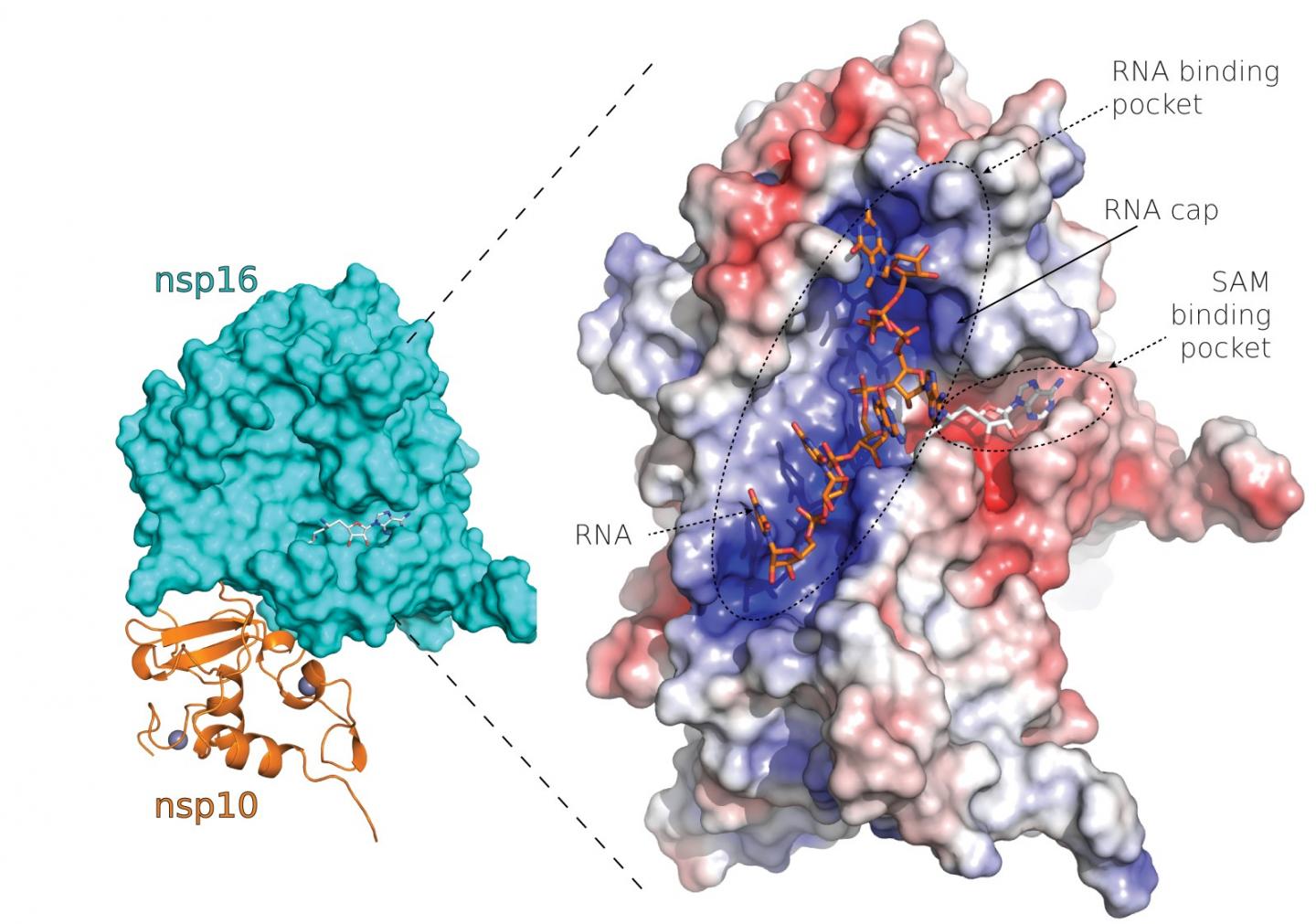
The cap installation process catalyzes the Nsp16 coronavirus protein with involvement from another viral protein, Nsp10. Headed by Dr. Even Bou?a and Dr. Radim Nencka, a group of researchers at the Institute of Organic Chemistry and Biochemistry of the Czech Academy of Sciences used X-ray crystallography to determine and analyze the precise structure of the complex of these two proteins.

This allowed the researchers to identify several fundamental characteristics of the Nsp16 and Nsp10 protein complex, namely a deep canyon on the surface of the protein complex where binding of the viral RNA occurs and a cap is installed. This canyon can be targeted by inhibitors that suppress the activity of the Nsp16 and Nsp10 protein complex and thus of the entire cap installation process and may, in the future, serve as drugs to combat many coronaviruses.

“Hundreds of research teams tried to shed light on how the COVID-19 virus is able to hide its RNA from cellular immunity. In the end, two American teams and we here in Prague were the ones who succeeded,” explains Evzen Boura, head of the Structural Membrane Biology group. “We used X-ray analysis to determine the structure of the responsible viral enzyme with inhibitor.”

###

The researchers have published the results of their work in the prestigious journal Nature Communications.

The original paper: Krafcikova, P., Silhan, J., Nencka, R. et al. Structural analysis of the SARS-CoV-2 methyltransferase complex involved in RNA cap creation bound to sinefungin. Nat Commun 11, 3717 (2020). https://doi.org/10.1038/s41467-020-17495-9

Media Contact
Dusan Brinzanik
[email protected]

Original Source

https://www.uochb.cz/en/news/190/researchers-describe-structure-of-novel-coronavirus-proteins-suitable-for-design-of-new-drugs

Related Journal Article

http://dx.doi.org/10.1038/s41467-020-17495-9

Tags: BiochemistryBiologyChemistry/Physics/Materials SciencesMolecular Biology
Share12Tweet8Share2ShareShareShare2

Related Posts

Florida Cane Toad: Complex Spread and Selective Evolution

Florida Cane Toad: Complex Spread and Selective Evolution

February 7, 2026
New Study Uncovers Mechanism Behind Burn Pit Particulate Matter–Induced Lung Inflammation

New Study Uncovers Mechanism Behind Burn Pit Particulate Matter–Induced Lung Inflammation

February 6, 2026

DeepBlastoid: Advancing Automated and Efficient Evaluation of Human Blastoids with Deep Learning

February 6, 2026

Navigating the Gut: The Role of Formic Acid in the Microbiome

February 6, 2026
Please login to join discussion

POPULAR NEWS

  • Robotic Ureteral Reconstruction: A Novel Approach

    Robotic Ureteral Reconstruction: A Novel Approach

    82 shares
    Share 33 Tweet 21
  • Digital Privacy: Health Data Control in Incarceration

    63 shares
    Share 25 Tweet 16
  • Study Reveals Lipid Accumulation in ME/CFS Cells

    57 shares
    Share 23 Tweet 14
  • Breakthrough in RNA Research Accelerates Medical Innovations Timeline

    53 shares
    Share 21 Tweet 13

About

We bring you the latest biotechnology news from best research centers and universities around the world. Check our website.

Follow us

Recent News

Evaluating Pediatric Emergency Care Quality in Ethiopia

TPMT Expression Predictions Linked to Azathioprine Side Effects

Improving Dementia Care with Enhanced Activity Kits

Subscribe to Blog via Email

Success! An email was just sent to confirm your subscription. Please find the email now and click 'Confirm' to start subscribing.

Join 73 other subscribers
  • Contact Us

Bioengineer.org © Copyright 2023 All Rights Reserved.

Welcome Back!

Login to your account below

Forgotten Password?

Retrieve your password

Please enter your username or email address to reset your password.

Log In
No Result
View All Result
  • Homepages
    • Home Page 1
    • Home Page 2
  • News
  • National
  • Business
  • Health
  • Lifestyle
  • Science

Bioengineer.org © Copyright 2023 All Rights Reserved.