Credit: NYU Abu Dhabi
- A rover expected to explore below the surface of Mars in 2022 has the potential to provide more insights
- The findings published in Scientific Reports, Springer Nature suggests the presence of traces of water on Mars, raising the question of the possibility of a life-supporting environment
Abu Dhabi, UAE – July 28, 2020: Although no life has been detected on the Martian surface, a new study from astrophysicist and research scientist at the Center for Space Science at NYU Abu Dhabi, Dimitra Atri finds that conditions below the surface could potentially support it. The subsurface – which is less harsh and has traces of water – has never been explored. According to Atri, the steady bombardment of penetrating Galactic Cosmic Rays (GCRs) might provide the energy needed to catalyze organic activity there.
Atri’s findings are reported in the study Investigating the biological potential of galactic cosmic ray-induced radiation-driven chemical disequilibrium in the Martian subsurface environment in the journal Scientific Reports, Springer Nature.
There is growing evidence suggesting the presence of an aqueous environment on ancient Mars, raising the question of the possibility of a life-supporting environment. The erosion of the Martian atmosphere resulted in drastic changes in its climate, surface water disappeared, shrinking habitable spaces on the planet, with only a limited amount of water remaining near the surface in form of brines and water-ice deposits. Life, if it ever existed, would have had to adapt to harsh modern conditions, which include low temperatures and surface pressure, and high radiation dose.
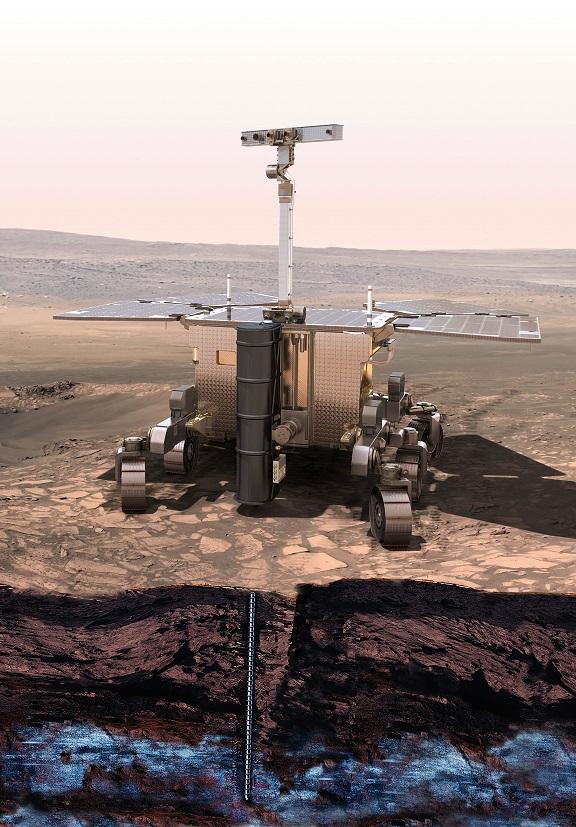
The subsurface of Mars has traces of water in the form of water-ice and brines, and undergoes radiation-driven redox chemistry. Using a combination of numerical models, space mission data, and studies of deep-cave ecosystems on Earth for his research, Atri proposes mechanisms through which life, if it ever existed on Mars, could survive and be detected with the upcoming ExoMars mission (2022) by the European Space Agency and Roscosmos. He hypothesizes that galactic cosmic radiation, which can penetrate several meters below the surface, will induce chemical reactions that can be used for metabolic energy by extant life, and host organisms using mechanisms seen in similar chemical and radiation environments on Earth.
“It is exciting to contemplate that life could survive in such a harsh environment, as few as two meters below the surface of Mars,” said Atri. “When the Rosalind Franklin rover on board the ExoMars mission (ESA and Roscosmos), equipped with a subsurface drill, is launched in 2022, it will be well-suited to detect extant microbial life and hopefully provide some important insights.”
###
About NYU Abu Dhabi
NYU Abu Dhabi is the first comprehensive liberal arts and science campus in the Middle East to be operated abroad by a major American research university. NYU Abu Dhabi has integrated a highly-selective liberal arts, engineering and science curriculum with a world center for advanced research and scholarship enabling its students to succeed in an increasingly interdependent world and advance cooperation and progress on humanity’s shared challenges. NYU Abu Dhabi’s high-achieving students have come from more than 115 nations and speak over 115 languages. Together, NYU’s campuses in New York, Abu Dhabi, and Shanghai form the backbone of a unique global university, giving faculty and students opportunities to experience varied learning environments and immersion in other cultures at one or more of the numerous study-abroad sites NYU maintains on six continents.
Media Contact
Adam Pockriss
[email protected]