• HOME
  • NEWS
  • EXPLORE
    • CAREER
      • Companies
      • Jobs
    • EVENTS
    • iGEM
      • News
      • Team
    • PHOTOS
    • VIDEO
    • WIKI
  • BLOG
  • COMMUNITY
    • FACEBOOK
    • INSTAGRAM
    • TWITTER
Friday, March 27, 2026
BIOENGINEER.ORG
No Result
View All Result
  • Login
  • HOME
  • NEWS
  • EXPLORE
    • CAREER
      • Companies
      • Jobs
        • Lecturer
        • PhD Studentship
        • Postdoc
        • Research Assistant
    • EVENTS
    • iGEM
      • News
      • Team
    • PHOTOS
    • VIDEO
    • WIKI
  • BLOG
  • COMMUNITY
    • FACEBOOK
    • INSTAGRAM
    • TWITTER
  • HOME
  • NEWS
  • EXPLORE
    • CAREER
      • Companies
      • Jobs
        • Lecturer
        • PhD Studentship
        • Postdoc
        • Research Assistant
    • EVENTS
    • iGEM
      • News
      • Team
    • PHOTOS
    • VIDEO
    • WIKI
  • BLOG
  • COMMUNITY
    • FACEBOOK
    • INSTAGRAM
    • TWITTER
No Result
View All Result
Bioengineer.org
No Result
View All Result
Home NEWS Science News Biology

Study identifies spread of bee disease via flowers

Bioengineer by Bioengineer
July 23, 2020
in Biology
Reading Time: 3 mins read
0
IMAGE
Share on FacebookShare on TwitterShare on LinkedinShare on RedditShare on Telegram

IMAGE

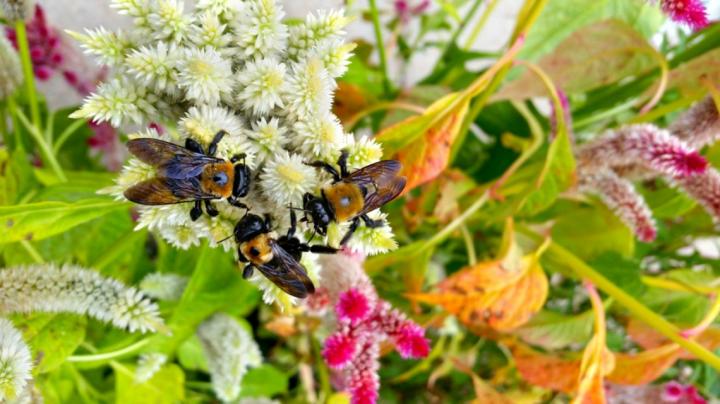
Credit: Paige Muñiz

ITHACA, N.Y. – One in 11 flowers carries disease-causing parasites known to contribute to bee declines, according to a Cornell University study that identifies how flowers act as hubs for transmitting diseases to bees and other pollinators.

The study, published July 20 in Nature Ecology and Evolution, also found that one in eight individual bees had at least one parasite.

The study was conducted in field sites in upstate New York, where the researchers screened 2,624 flowers from 89 species and 2,672 bees from 110 species for bee parasites through an entire growing season. They used molecular data to identify five common protozoan (free-living, single-celled) and fungal parasites.

“We know very little about transmission of these diseases,” said senior author Scott McArt, assistant professor of entomology in the College of Agriculture and Life Sciences. “Our study shows that transmission can likely occur on a lot of different flowers, and the amount of disease in a community is shaped by both the floral community and the bee community.”

The researchers found three main factors – flower abundance, numbers of social bees and bee diversity – played roles in disease transmission.

As the season progresses, the number of flowers goes up. For example, in the fall, flower-laden goldenrod dominates many New York fields. At the same time, the proportion of flowers with parasites goes down, lowering the risk that a bee will pick up a parasite when it visits a flower.

“That has really important conservation implications, because if you want to limit disease spread, just plant a lot of flowers,” said McArt, adding that planting flowers also provides food for pollinators. “It’s a win-win: If we plant flowers and create a lot of forage, we can also dilute disease.”

The study revealed that social bees, such as honeybees and bumblebees, were more likely to be infected with parasites than solitary bee species. The researchers found that later in the season, the number of social bees increases, while bee diversity overall decreases.

And as a general rule, diversity of species lowers the spread of disease.

“Both bee diversity and fewer of the social bees make it less likely for bees [overall] to be infected. That’s another win for conservation: if we promote bee diversity, there will be less disease,” McArt said. High numbers of infections in the social species may also spill over to infect other species, he said.

Future studies will try to determine whether increased flower abundance cancels out the negative effects of increased numbers of social bees combined with lower overall bee diversity later in the summer.

More study is also needed to understand why social bees are so susceptible to parasites, whether they lack defenses and if they are sharing disease in close colony quarters.

###

The research is funded through a five year, $2.2 million National Institutes of Health grant to understand the spread of pathogens that infect bees.

Peter Graystock, a former postdoctoral researcher, and Wee Hao Ng, a postdoctoral researcher, both in McArt’s lab, are co-first authors of the study. Paige Muñiz, McArt’s lab manager and an expert bee taxonomist, is a co-author.

Media Contact
Lindsey Hadlock
[email protected]

Original Source

https://news.cornell.edu/stories/2020/07/study-identifies-spread-bee-disease-flowers

Related Journal Article

http://dx.doi.org/10.1038/s41559-020-1247-x

Tags: BiodiversityBiologyEcology/EnvironmentEntomology
Share12Tweet8Share2ShareShareShare2

Related Posts

How to sway group opinions: Encourage opponents to stay undecided

How to sway group opinions: Encourage opponents to stay undecided

March 23, 2026
Deep Learning Model Maps How Individual Cells Shape Disease Outcomes

Deep Learning Model Maps How Individual Cells Shape Disease Outcomes

March 20, 2026

Removing only 15 female sharks annually could endanger the entire population, scientists warn

March 20, 2026

Scientists Urge Fragrance Industry to Transition from Sustainability Talk to Active Funding of Plant Conservation

March 20, 2026
Please login to join discussion

POPULAR NEWS

  • blank

    Revolutionary AI Model Enhances Precision in Detecting Food Contamination

    96 shares
    Share 38 Tweet 24
  • Imagine a Social Media Feed That Challenges Your Views Instead of Reinforcing Them

    1003 shares
    Share 397 Tweet 248
  • Uncovering Functions of Cavernous Malformation Proteins in Organoids

    54 shares
    Share 22 Tweet 14
  • Promising Outcomes from First Clinical Trials of Gene Regulation in Epilepsy

    51 shares
    Share 20 Tweet 13

About

We bring you the latest biotechnology news from best research centers and universities around the world. Check our website.

Follow us

Recent News

In-Sensor Cryptography Links Physical Process to Digital Identity

Can Psychosocial Factors Influence Cancer Risk?

Depression Factors in Elderly: Pre vs. Post-COVID Analysis

Subscribe to Blog via Email

Success! An email was just sent to confirm your subscription. Please find the email now and click 'Confirm' to start subscribing.

Join 78 other subscribers
  • Contact Us

Bioengineer.org © Copyright 2023 All Rights Reserved.

Welcome Back!

Login to your account below

Forgotten Password?

Retrieve your password

Please enter your username or email address to reset your password.

Log In
No Result
View All Result
  • Homepages
    • Home Page 1
    • Home Page 2
  • News
  • National
  • Business
  • Health
  • Lifestyle
  • Science

Bioengineer.org © Copyright 2023 All Rights Reserved.