• HOME
  • NEWS
  • EXPLORE
    • CAREER
      • Companies
      • Jobs
    • EVENTS
    • iGEM
      • News
      • Team
    • PHOTOS
    • VIDEO
    • WIKI
  • BLOG
  • COMMUNITY
    • FACEBOOK
    • INSTAGRAM
    • TWITTER
Wednesday, October 7, 2026
BIOENGINEER.ORG
No Result
View All Result
  • Login
  • HOME
  • NEWS
  • EXPLORE
    • CAREER
      • Companies
      • Jobs
        • Lecturer
        • PhD Studentship
        • Postdoc
        • Research Assistant
    • EVENTS
    • iGEM
      • News
      • Team
    • PHOTOS
    • VIDEO
    • WIKI
  • BLOG
  • COMMUNITY
    • FACEBOOK
    • INSTAGRAM
    • TWITTER
  • HOME
  • NEWS
  • EXPLORE
    • CAREER
      • Companies
      • Jobs
        • Lecturer
        • PhD Studentship
        • Postdoc
        • Research Assistant
    • EVENTS
    • iGEM
      • News
      • Team
    • PHOTOS
    • VIDEO
    • WIKI
  • BLOG
  • COMMUNITY
    • FACEBOOK
    • INSTAGRAM
    • TWITTER
No Result
View All Result
Bioengineer.org
No Result
View All Result
Home NEWS Science News Biology

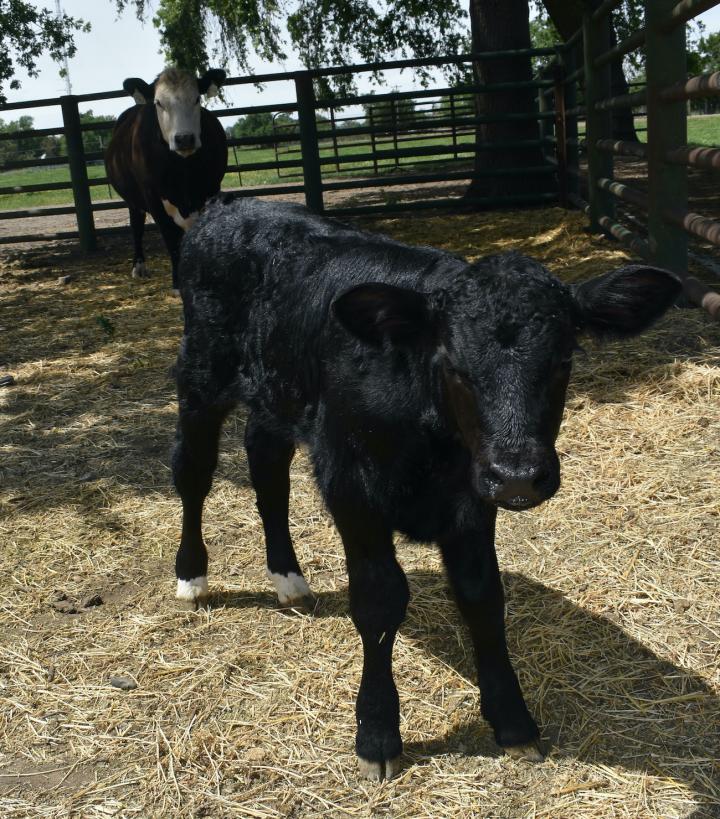
Meet Cosmo, a bull calf designed to produce 75% male offspring

Bioengineer by Bioengineer
July 23, 2020
in Biology
Reading Time: 3 mins read
0
IMAGE
Share on FacebookShare on TwitterShare on LinkedinShare on RedditShare on Telegram

Scientists use CRISPR technology to insert sex-determining gene
IMAGE

Credit: Alison Van Eenennaam/UC Davis

Scientists at the University of California, Davis, have successfully produced a bull calf, named Cosmo, who was genome-edited as an embryo so that he’ll produce more male offspring. The research was presented in a poster today (July 23) at the American Society of Animal Science meeting.

Using the genome-editing technology CRISPR, researchers can make targeted cuts to the genome or insert useful genes, which is called a gene knock-in. In this case, scientists successfully inserted or knocked-in the cattle SRY gene, the gene that is responsible for initiating male development, into a bovine embryo. It’s the first demonstration of a targeted gene knock-in for large sequences of DNA via embryo-mediated genome editing in cattle.

“We anticipate Cosmo’s offspring that inherit this SRY gene will grow and look like males, regardless of whether they inherit a Y chromosome,” said Alison Van Eenennaam, animal geneticist with the UC Davis Department of Animal Science.

MORE MALES, MORE BEEF

Van Eenennaam says part of the motivation to produce more male cattle is that male cattle are about 15 percent more efficient at converting feed into weight gain. They are more fuel-efficient than females. Additionally, they tend to be processed at a heavier weight.

It could also be a win for the environment, with fewer cattle needed to produce the same amount of beef. “Ranchers could produce some females as replacements and direct a higher proportion of male cattle for market,” said Joey Owen, a postdoctoral researcher in animal science who is leading the project with Van Eenennaam.

AN ARDUOUS JOURNEY

The SRY gene was inserted into bovine chromosome 17, which is a genomic safe harbor site. That ensures the genetic elements function predictably and don’t disrupt the expression or regulation of adjacent genes. Chromosome 17 was chosen after unsuccessful attempts to knock-in the gene on the X chromosome, which would have resulted in a bull that produced only male offspring. Cosmo is expected to produce 75 percent male offspring — the normal 50 percent XY animals, and another 25percent XX animals that inherit the SRY gene.

“It took two and a half years to develop the method to insert a gene into the developing embryo and another two years to successfully establish a pregnancy,” said Owen. But in April of 2020, a healthy 110-pound male calf was born.

“This has been a real labor of love,” said Van Eenennaam.

She said this is just the beginning of the research. Cosmo will reach sexual maturity in a year, and he will be bred to study if inheriting the SRY gene on chromosome 17 is sufficient to trigger the male developmental pathway in XX embryos, and result in offspring that will grow and look like males. As the Food and Drug Administration regulates gene-editing of animals as if they were drugs, Cosmo and his offspring will not enter the food supply.

###

Other researchers on the team include James Murray, Pablo Ross, Sadie Hennig and Jason Lin with the UC Davis Department of Animal Science, and Bret McNabb and Tamer Mansour of the UC Davis School of Veterinary Medicine.

This project was supported by Biotechnology Risk Assessment Grant Program from the U.S. Department of Agriculture, the California Agricultural Experiment Station at UC Davis and the USDA NIFA National Needs Graduate and Postgraduate Fellowship.

Media Contact
Amy Quinton
[email protected]

Original Source

http://www.ucdavis.edu/news/meet-cosmo-bull-calf-designed-produce-75-male-offspring

Tags: Agricultural Production/EconomicsAgricultureBiologyFood/Food ScienceGenesGenetics
Share12Tweet8Share2ShareShareShare2

Related Posts

Satellite Tags Reveal Sea Turtles Break the Rules of Beach Loyalty

Satellite Tags Reveal Sea Turtles Break the Rules of Beach Loyalty

October 7, 2026
New Tick Species Hidden in Ecuador's Cloud Forests Named After the Reserve Where It Was Found

New Tick Species Hidden in Ecuador’s Cloud Forests Named After the Reserve Where It Was Found

October 7, 2026

One Spiking Neural Network Learns What Happens, When, and How Likely

October 7, 2026

Engineered Flavonoid Cousins of Fisetin Clear Senescent Cells and Boost Healthspan in Mice

October 7, 2026
Please login to join discussion

POPULAR NEWS

  • Alloys That Shrink Their Own Grains: New PIX Mechanism Refines Metals With Heat Alone

    Alloys That Shrink Their Own Grains: New PIX Mechanism Refines Metals With Heat Alone

    29 shares
    Share 12 Tweet 7
  • Endurance Exercise Reshapes the Liver in Males and Females Through Distinct Molecular Routes

    29 shares
    Share 12 Tweet 7
  • Single Transcription Factor PU.1 Rapidly Converts Fibroblasts into Macrophage-Lineage Cells

    29 shares
    Share 12 Tweet 7
  • New Scale Measures How Ready Nurse Educators Really Are for the AI Era

    29 shares
    Share 12 Tweet 7

About

We bring you the latest biotechnology news from best research centers and universities around the world. Check our website.

Follow us

Recent News

Alloys That Shrink Their Own Grains: New PIX Mechanism Refines Metals With Heat Alone

Endurance Exercise Reshapes the Liver in Males and Females Through Distinct Molecular Routes

Single Transcription Factor PU.1 Rapidly Converts Fibroblasts into Macrophage-Lineage Cells

Subscribe to Blog via Email

Success! An email was just sent to confirm your subscription. Please find the email now and click 'Confirm' to start subscribing.

Join 85 other subscribers
  • Contact Us

Bioengineer.org © Copyright 2023 All Rights Reserved.

Welcome Back!

Login to your account below

Forgotten Password?

Retrieve your password

Please enter your username or email address to reset your password.

Log In
No Result
View All Result
  • Homepages
    • Home Page 1
    • Home Page 2
  • News
  • National
  • Business
  • Health
  • Lifestyle
  • Science

Bioengineer.org © Copyright 2023 All Rights Reserved.