• HOME
  • NEWS
  • EXPLORE
    • CAREER
      • Companies
      • Jobs
    • EVENTS
    • iGEM
      • News
      • Team
    • PHOTOS
    • VIDEO
    • WIKI
  • BLOG
  • COMMUNITY
    • FACEBOOK
    • INSTAGRAM
    • TWITTER
Tuesday, January 20, 2026
BIOENGINEER.ORG
No Result
View All Result
  • Login
  • HOME
  • NEWS
  • EXPLORE
    • CAREER
      • Companies
      • Jobs
        • Lecturer
        • PhD Studentship
        • Postdoc
        • Research Assistant
    • EVENTS
    • iGEM
      • News
      • Team
    • PHOTOS
    • VIDEO
    • WIKI
  • BLOG
  • COMMUNITY
    • FACEBOOK
    • INSTAGRAM
    • TWITTER
  • HOME
  • NEWS
  • EXPLORE
    • CAREER
      • Companies
      • Jobs
        • Lecturer
        • PhD Studentship
        • Postdoc
        • Research Assistant
    • EVENTS
    • iGEM
      • News
      • Team
    • PHOTOS
    • VIDEO
    • WIKI
  • BLOG
  • COMMUNITY
    • FACEBOOK
    • INSTAGRAM
    • TWITTER
No Result
View All Result
Bioengineer.org
No Result
View All Result
Home NEWS Science News Chemistry

Kazan University chemists offer a new look at polymers for space industry

Bioengineer by Bioengineer
July 22, 2020
in Chemistry
Reading Time: 2 mins read
0
IMAGE
Share on FacebookShare on TwitterShare on LinkedinShare on RedditShare on Telegram

They were in the first in the world to research the solid-state polymerization of aryl cyanates
IMAGE

Credit: Kazan Federal University

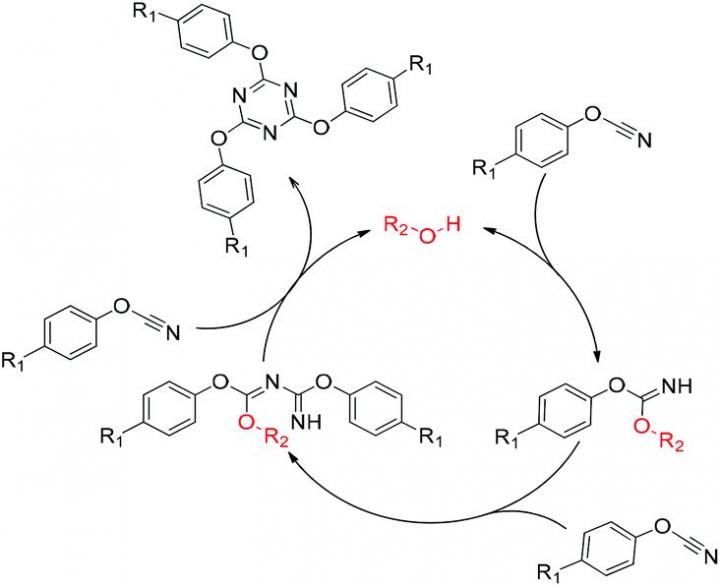
Employees of the Department of Physical Chemistry of Kazan Federal University have found out that the mechanisms of polymerization of aryl cyanates in the solid state and in the melt differ in the number of broken multiple bonds of the monomer at the stage that determines the rate of the process.

Solid phase polymerization is widely used to create polymers with controlled structure, molecular weight, and other parameters. In the industry, a number of polycarbonates, polyamides and polyesters for various purposes are obtained by this method. Aryl cyanates are used to create polymer composite materials used, in particular, in the aerospace industry.

As senior researcher Andrey Galukhin explained, for solid-phase polymerization, it is necessary for the reaction to start at a temperature below the melting point. However, for some monomers this condition is not met, so this type of polymerization is not available for them. These include aryl cyanates, which have high thermal, chemical and radiation resistance. It is thanks to these properties that they have found application in the aerospace industry, where they are used as parts of composite materials. The high stability of aryl cyanates is due to the presence of 1,3,5-triazine aromatic fragments as cross-linking sites of polymer chains.

Kazanian scientists were the first to study the solid phase polymerization of aryl cyanate. They assumed that the solid state polymerization of this substance would be very different from the same process in the melt. The authors synthesized a unique monomer with a high melting point (403°C). Since the polymerization temperature of this substance is below its melting point, this made the solid phase reaction possible. A detailed study with differential scanning calorimetry made it possible to obtain important information about the kinetics of this process. It was possible to find out that the mechanisms of solid-phase polymerization and polymerization in a monomer melt differ in the number of broken multiple bonds of the monomer at the stage that determines the rate of the process. Also, it turned out that the rate of solid-phase polymerization does not depend on the degree of monomer conversion, that is, the kinetics is described by a zero-order reaction. The reason for this behavior lies in the topochemical nature of the process taking place in flat monomer crystals.

“Aryl cyanates play a very important role in the aeronautical and aerospace industries, where they are used as binders in composite materials to create various dimensionally stable structures. Expanding our knowledge of the relationship between the reactivity of these monomers and their structure will open up new possibilities for the targeted design of materials with desired properties,” concluded Galukhin.

###

Media Contact
Yury Nurmeev
[email protected]

Original Source

https://kpfu.ru/eng/news-eng/aryl-cyanates-polymerization.html

Related Journal Article

http://dx.doi.org/10.1039/D0PY00554A

Tags: Chemistry/Physics/Materials SciencesPolymer Chemistry
Share12Tweet8Share2ShareShareShare2

Related Posts

Creating Synthetic Protein-Binding DNA Systems in Cells

January 17, 2026
blank

Chiral Catalysis Powers Rotary Molecular Motors

January 16, 2026

Selective GlcNAc to GalNAc Epimerization via Kinetic Control

January 15, 2026

Thermal [2+2] Cycloaddition Builds Gem-Difluoro Bicycloalkanes

January 13, 2026
Please login to join discussion

POPULAR NEWS

  • Enhancing Spiritual Care Education in Nursing Programs

    155 shares
    Share 62 Tweet 39
  • PTSD, Depression, Anxiety in Childhood Cancer Survivors, Parents

    148 shares
    Share 59 Tweet 37
  • Robotic Ureteral Reconstruction: A Novel Approach

    78 shares
    Share 31 Tweet 20
  • Study Reveals Lipid Accumulation in ME/CFS Cells

    55 shares
    Share 22 Tweet 14

About

We bring you the latest biotechnology news from best research centers and universities around the world. Check our website.

Follow us

Recent News

A Decade of Evolving Human Behavior and Physiology

Telehealth Addiction Services Transform Rural Hospital Care

Modeling Fatigue and Damage in Annulus Fibrosus

Subscribe to Blog via Email

Enter your email address to subscribe to this blog and receive notifications of new posts by email.

Join 71 other subscribers
  • Contact Us

Bioengineer.org © Copyright 2023 All Rights Reserved.

Welcome Back!

Login to your account below

Forgotten Password?

Retrieve your password

Please enter your username or email address to reset your password.

Log In
No Result
View All Result
  • Homepages
    • Home Page 1
    • Home Page 2
  • News
  • National
  • Business
  • Health
  • Lifestyle
  • Science

Bioengineer.org © Copyright 2023 All Rights Reserved.