• HOME
  • NEWS
  • EXPLORE
    • CAREER
      • Companies
      • Jobs
    • EVENTS
    • iGEM
      • News
      • Team
    • PHOTOS
    • VIDEO
    • WIKI
  • BLOG
  • COMMUNITY
    • FACEBOOK
    • INSTAGRAM
    • TWITTER
Monday, January 12, 2026
BIOENGINEER.ORG
No Result
View All Result
  • Login
  • HOME
  • NEWS
  • EXPLORE
    • CAREER
      • Companies
      • Jobs
        • Lecturer
        • PhD Studentship
        • Postdoc
        • Research Assistant
    • EVENTS
    • iGEM
      • News
      • Team
    • PHOTOS
    • VIDEO
    • WIKI
  • BLOG
  • COMMUNITY
    • FACEBOOK
    • INSTAGRAM
    • TWITTER
  • HOME
  • NEWS
  • EXPLORE
    • CAREER
      • Companies
      • Jobs
        • Lecturer
        • PhD Studentship
        • Postdoc
        • Research Assistant
    • EVENTS
    • iGEM
      • News
      • Team
    • PHOTOS
    • VIDEO
    • WIKI
  • BLOG
  • COMMUNITY
    • FACEBOOK
    • INSTAGRAM
    • TWITTER
No Result
View All Result
Bioengineer.org
No Result
View All Result
Home NEWS Science News Chemistry

POSTECH solves the durability issue of hydrogen cars

Bioengineer by Bioengineer
July 14, 2020
in Chemistry
Reading Time: 3 mins read
0
IMAGE
Share on FacebookShare on TwitterShare on LinkedinShare on RedditShare on Telegram

IMAGE

Credit: Yong-Tae Kim (POSTECH)

When a bicycle gets wet in the rain, the frame and chain become corroded or rusty which shorten the life of the bike. Oil needs to be regularly applied to prevent this from happening. Battery cells are devices that create electrical energy through moving electrons by triggering oxidation and reduction reactions separately. But they also corrode when exposed to oxygen. Can these cells also be greased to prevent rusting?

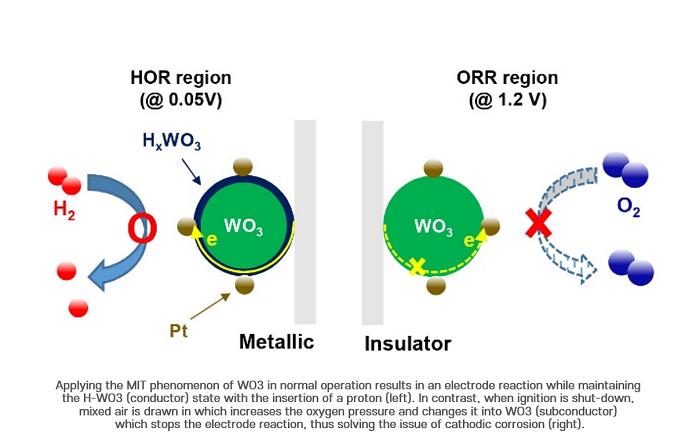
A research team led by Professor Yong-Tae Kim and doctoral student Sang Moon Jung of Materials Science and Engineering at POSTECH used a catalyst (Pt/HxWO3) that combines platinum and hydrogen tungsten bronze to solve the corrosion in fuel cells that occur when hydrogen cars are shut down. The catalyst, recently introduced in Nature Catalysis – a sister journal of Nature – has been shown to promote hydrogen oxidation and selectively suppress oxygen reduction reactions (ORR).

As eco-friendly hydrogen cars become more common, the race for research and development for improving fuel cell performance – the heart of hydrogen cars – is getting fierce around the world. The performance of automotive fuel cells are severely low owing to their intermittent shut-downs compared to power-generating fuel cells that do not stop once started. This is because when ignition is turned off, the ORR occurs as air is temporarily introduced into the anode, and corrosion of the cathodic components accelerates as the potential of cathod surges instantaneously.

The research team focused on the Metal Insulator Transition (MIT) phenomenon, which can selectively change the conductivity of materials depending on the surrounding environment, to solve the problem of durability degradation in automotive fuel cells.

n particular, the research team focused on the tungsten oxide (WO3) that has traditionally been used as an electrical discoloration material since it greatly changes conductivity via the insertion and reduction of protons. Applying the MIT phenomenon of WO3 in normal operation results in an electrode reaction while maintaining the H-WO3 (conductor) state with the insertion of a proton. In contrast, when ignition is shut-down, mixed air is drawn in which increases the oxygen pressure and changes it into WO3 (subconductor) which stops the electrode reaction, thus solving the issue of cathodic corrosion.

The Pt/HxWO3 selective hydrogen oxidation reaction (HOR) catalysts imparted by the metal-insulator transition phenomenon showed more than twice the durability of conventional commercial Pt/C catalyst materials in shut-down conditions in the MEA evaluation of automotive fuel cells.

Professor Yong-Tae Kim who led the research commented, “This research has dramatically improved the durability of automotive fuel cells.” He added, “It is anticipated that the commercialization of hydrogen cars may be further facilitated through these findings.”

###

This research was conducted with the support from the Future Materials Discovery Project and the hydrogen energy innovation technology development program of the Ministry of Science and ICT.

Media Contact
Jinyoung Huh
[email protected]

Original Source

http://postech.ac.kr/eng/postech-solves-the-durability-issue-of-hydrogen-cars/?pageds=1&k=&c=

Related Journal Article

http://dx.doi.org/10.1038/s41929-020-0475-4

Tags: Chemistry/Physics/Materials SciencesElectrical Engineering/ElectronicsElectromagneticsEnergy/Fuel (non-petroleum)Nanotechnology/MicromachinesResearch/Development
Share12Tweet8Share2ShareShareShare2

Related Posts

blank

Cobalt-Catalyzed Thioester Coupling via Siloxycarbene

January 12, 2026
blank

Advancing Alkene Chemistry: Homologative Difunctionalization Breakthrough

January 8, 2026

Biocompatible Ligand Enables Safe In-Cell Protein Arylation

January 8, 2026

Monovalent Pseudo-Natural Products Boost IDO1 Degradation

January 7, 2026
Please login to join discussion

POPULAR NEWS

  • Enhancing Spiritual Care Education in Nursing Programs

    154 shares
    Share 62 Tweet 39
  • PTSD, Depression, Anxiety in Childhood Cancer Survivors, Parents

    146 shares
    Share 58 Tweet 37
  • Robotic Ureteral Reconstruction: A Novel Approach

    71 shares
    Share 28 Tweet 18
  • Study Reveals Lipid Accumulation in ME/CFS Cells

    51 shares
    Share 20 Tweet 13

About

We bring you the latest biotechnology news from best research centers and universities around the world. Check our website.

Follow us

Recent News

Digital Twin Enables Explainable Production Anomaly Detection

Self-Powered Elastomer Emits Solar-Blind UV Light

Global Religious Diversity Across 117 Countries Revealed

Subscribe to Blog via Email

Success! An email was just sent to confirm your subscription. Please find the email now and click 'Confirm' to start subscribing.

Join 71 other subscribers
  • Contact Us

Bioengineer.org © Copyright 2023 All Rights Reserved.

Welcome Back!

Login to your account below

Forgotten Password?

Retrieve your password

Please enter your username or email address to reset your password.

Log In
No Result
View All Result
  • Homepages
    • Home Page 1
    • Home Page 2
  • News
  • National
  • Business
  • Health
  • Lifestyle
  • Science

Bioengineer.org © Copyright 2023 All Rights Reserved.