• HOME
  • NEWS
  • EXPLORE
    • CAREER
      • Companies
      • Jobs
    • EVENTS
    • iGEM
      • News
      • Team
    • PHOTOS
    • VIDEO
    • WIKI
  • BLOG
  • COMMUNITY
    • FACEBOOK
    • INSTAGRAM
    • TWITTER
Saturday, February 7, 2026
BIOENGINEER.ORG
No Result
View All Result
  • Login
  • HOME
  • NEWS
  • EXPLORE
    • CAREER
      • Companies
      • Jobs
        • Lecturer
        • PhD Studentship
        • Postdoc
        • Research Assistant
    • EVENTS
    • iGEM
      • News
      • Team
    • PHOTOS
    • VIDEO
    • WIKI
  • BLOG
  • COMMUNITY
    • FACEBOOK
    • INSTAGRAM
    • TWITTER
  • HOME
  • NEWS
  • EXPLORE
    • CAREER
      • Companies
      • Jobs
        • Lecturer
        • PhD Studentship
        • Postdoc
        • Research Assistant
    • EVENTS
    • iGEM
      • News
      • Team
    • PHOTOS
    • VIDEO
    • WIKI
  • BLOG
  • COMMUNITY
    • FACEBOOK
    • INSTAGRAM
    • TWITTER
No Result
View All Result
Bioengineer.org
No Result
View All Result
Home NEWS Science News Chemistry

Deep learning enables early detection and classification of live bacteria using holography

Bioengineer by Bioengineer
July 13, 2020
in Chemistry
Reading Time: 2 mins read
0
IMAGE
Share on FacebookShare on TwitterShare on LinkedinShare on RedditShare on Telegram

IMAGE

Credit: by Hongda Wang, Hatice Ceylan Koydemir, Yunzhe Qiu, Bijie Bai, Yibo Zhang, Yiyin Jin, Sabiha Tok, Enis Cagatay Yilmaz, Esin Gumustekin, Yilin Luo, Yair Rivenson, Aydogan Ozcan

Waterborne diseases affect more than 2 billion people worldwide, causing substantial economic burden. For example, the treatment of waterborne diseases costs more than $2 billion annually in the United States alone, with 90 million cases recorded per year. Among waterborne pathogen-related problems, one of the most common public health concerns is the presence of total coliform bacteria and Escherichia coli (E. coli) in drinking water, which indicates fecal contamination. Traditional culture-based bacteria detection methods often take 24-48 hours, followed by visual inspection and colony counting by an expert, according to the United States Environmental Protection Agency (EPA) guidelines. Alternatively, molecular detection methods based on, for example, the amplification of nucleic acids, can reduce the detection time to a few hours, but they generally lack the sensitivity for detecting bacteria at very low concentrations, and are not capable of differentiating between live and dead microorganisms. Furthermore, there is no EPA-approved nucleic acid-based method for detecting coliform bacteria in water samples.

Therefore, there is an urgent need for an automated method that can achieve rapid and high-throughput bacterial colony detection with high sensitivity to provide a powerful alternative to the currently available EPA-approved gold-standard methods that take at least 24 hours and require an expert for colony counting.

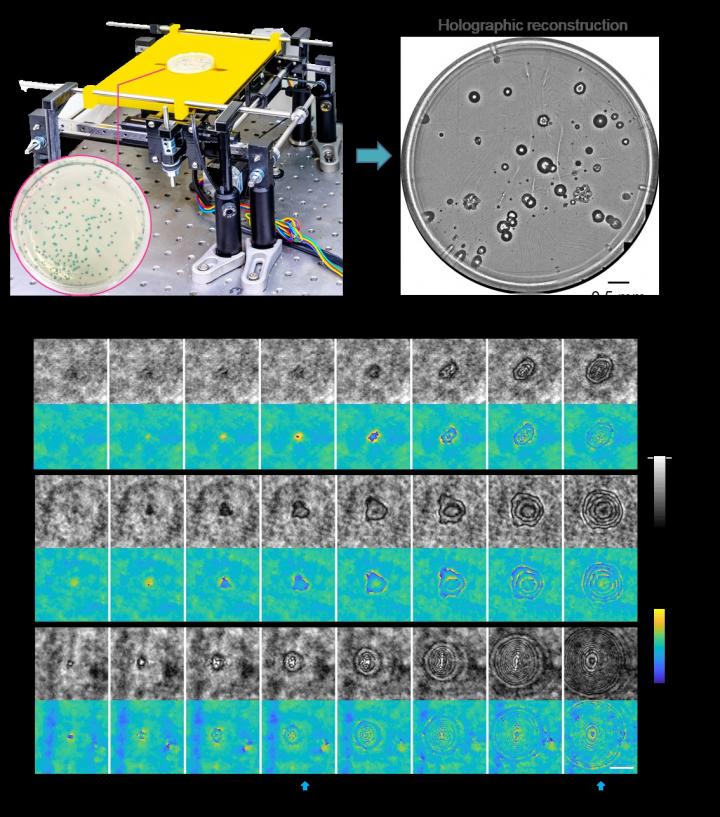
In a new paper published in Light: Science & Applications, a team of scientists, led by Professor Aydogan Ozcan from the Electrical and Computer Engineering Department at the University of California, Los Angeles (UCLA), USA, and co-workers have developed an AI-powered smart imaging system for early-detection and classification of live bacteria in water samples. Based on holography, they designed a highly sensitive and high-throughput imaging system, which continuously captures microscopic images of a whole culture plate, where bacteria grow, to rapidly detect colony growth by analyzing these time-lapse images with a deep neural network. Following the detection of each colony growth, a second neural network is used to classify the type of bacteria.

The efficacy of this unique platform was demonstrated by performing early detection and classification of three types of bacteria, i.e., E. coli, Klebsiella aerogenes (K. aerogenes), and Klebsiella pneumoniae (K. pneumoniae), and the UCLA researchers achieved a limit-of-detection of 1 colony forming bacterium per 1 Liter of water sample under 9 hours of total test time, demonstrating a time saving of more than 12 hours for bacteria detection as compared to the gold-standard EPA methods. These results highlight the transformative potential of this AI-powered holographic imaging platform, which not only enables highly sensitive, rapid and cost-effective detection of live bacteria, but also provides a powerful and versatile tool for microbiology research.

###

Media Contact
Aydogan Ozcan
[email protected]

Related Journal Article

http://dx.doi.org/10.1038/s41377-020-00358-9

Tags: Chemistry/Physics/Materials SciencesOptics
Share13Tweet8Share2ShareShareShare2

Related Posts

blank

Breakthrough in Environmental Cleanup: Scientists Develop Solar-Activated Biochar for Faster Remediation

February 7, 2026
blank

Cutting Costs: Making Hydrogen Fuel Cells More Affordable

February 6, 2026

Scientists Develop Hand-Held “Levitating” Time Crystals

February 6, 2026

Observing a Key Green-Energy Catalyst Dissolve Atom by Atom

February 6, 2026
Please login to join discussion

POPULAR NEWS

  • Robotic Ureteral Reconstruction: A Novel Approach

    Robotic Ureteral Reconstruction: A Novel Approach

    82 shares
    Share 33 Tweet 21
  • Digital Privacy: Health Data Control in Incarceration

    63 shares
    Share 25 Tweet 16
  • Study Reveals Lipid Accumulation in ME/CFS Cells

    57 shares
    Share 23 Tweet 14
  • Breakthrough in RNA Research Accelerates Medical Innovations Timeline

    53 shares
    Share 21 Tweet 13

About

We bring you the latest biotechnology news from best research centers and universities around the world. Check our website.

Follow us

Recent News

Phage-Antibiotic Combo Beats Resistant Peritoneal Infection

Boosting Remote Healthcare: Stepped-Wedge Trial Insights

Barriers and Boosters of Seniors’ Physical Activity in Karachi

Subscribe to Blog via Email

Enter your email address to subscribe to this blog and receive notifications of new posts by email.

Join 73 other subscribers
  • Contact Us

Bioengineer.org © Copyright 2023 All Rights Reserved.

Welcome Back!

Login to your account below

Forgotten Password?

Retrieve your password

Please enter your username or email address to reset your password.

Log In
No Result
View All Result
  • Homepages
    • Home Page 1
    • Home Page 2
  • News
  • National
  • Business
  • Health
  • Lifestyle
  • Science

Bioengineer.org © Copyright 2023 All Rights Reserved.