• HOME
  • NEWS
  • EXPLORE
    • CAREER
      • Companies
      • Jobs
    • EVENTS
    • iGEM
      • News
      • Team
    • PHOTOS
    • VIDEO
    • WIKI
  • BLOG
  • COMMUNITY
    • FACEBOOK
    • INSTAGRAM
    • TWITTER
Wednesday, July 15, 2026
BIOENGINEER.ORG
No Result
View All Result
  • Login
  • HOME
  • NEWS
  • EXPLORE
    • CAREER
      • Companies
      • Jobs
        • Lecturer
        • PhD Studentship
        • Postdoc
        • Research Assistant
    • EVENTS
    • iGEM
      • News
      • Team
    • PHOTOS
    • VIDEO
    • WIKI
  • BLOG
  • COMMUNITY
    • FACEBOOK
    • INSTAGRAM
    • TWITTER
  • HOME
  • NEWS
  • EXPLORE
    • CAREER
      • Companies
      • Jobs
        • Lecturer
        • PhD Studentship
        • Postdoc
        • Research Assistant
    • EVENTS
    • iGEM
      • News
      • Team
    • PHOTOS
    • VIDEO
    • WIKI
  • BLOG
  • COMMUNITY
    • FACEBOOK
    • INSTAGRAM
    • TWITTER
No Result
View All Result
Bioengineer.org
No Result
View All Result
Home NEWS Science News Biology

Research: Crop plants are taking up microplastics

Bioengineer by Bioengineer
July 13, 2020
in Biology
Reading Time: 3 mins read
0
IMAGE
Share on FacebookShare on TwitterShare on LinkedinShare on RedditShare on Telegram

IMAGE

Credit: YIC

Microplastics (MPs), i.e., tiny plastic particles less than 5 millimeters in length, can now be found throughout the ocean and other aquatic ecosystems, and even in our seafood and salt. As MPs have become ubiquitous, scientists have become concerned about the transfer of MPs from the environment to the food chain and the potential impact of MPs on human health.

Scientists from the Chinese Academy of Sciences (CAS) recently found that microplastics are indeed contaminating edible plants, including vegetables we eat. The study was published in Nature Sustainability on July 13.

The study was led by LUO Yongming, a professor both at the Yantai Institute of Coastal Zone Research (YIC) and the Nanjing Institute of Soil Science of CAS.

Most MPs are emitted to the terrestrial environment and accumulate in large amounts in soil. In addition, secondary particles are formed by the degradation of plastics. Wastewater, an important source of water for agricultural irrigation, also contains small-sized MPs.

Despite the prevalence of MPs throughout the environment, the matter of MP uptake by crop plants has not received much attention.

For decades, scientists believed that plastic particles were simply too large to pass through the physical barriers of intact plant tissue. But this new study disproves this assumption.

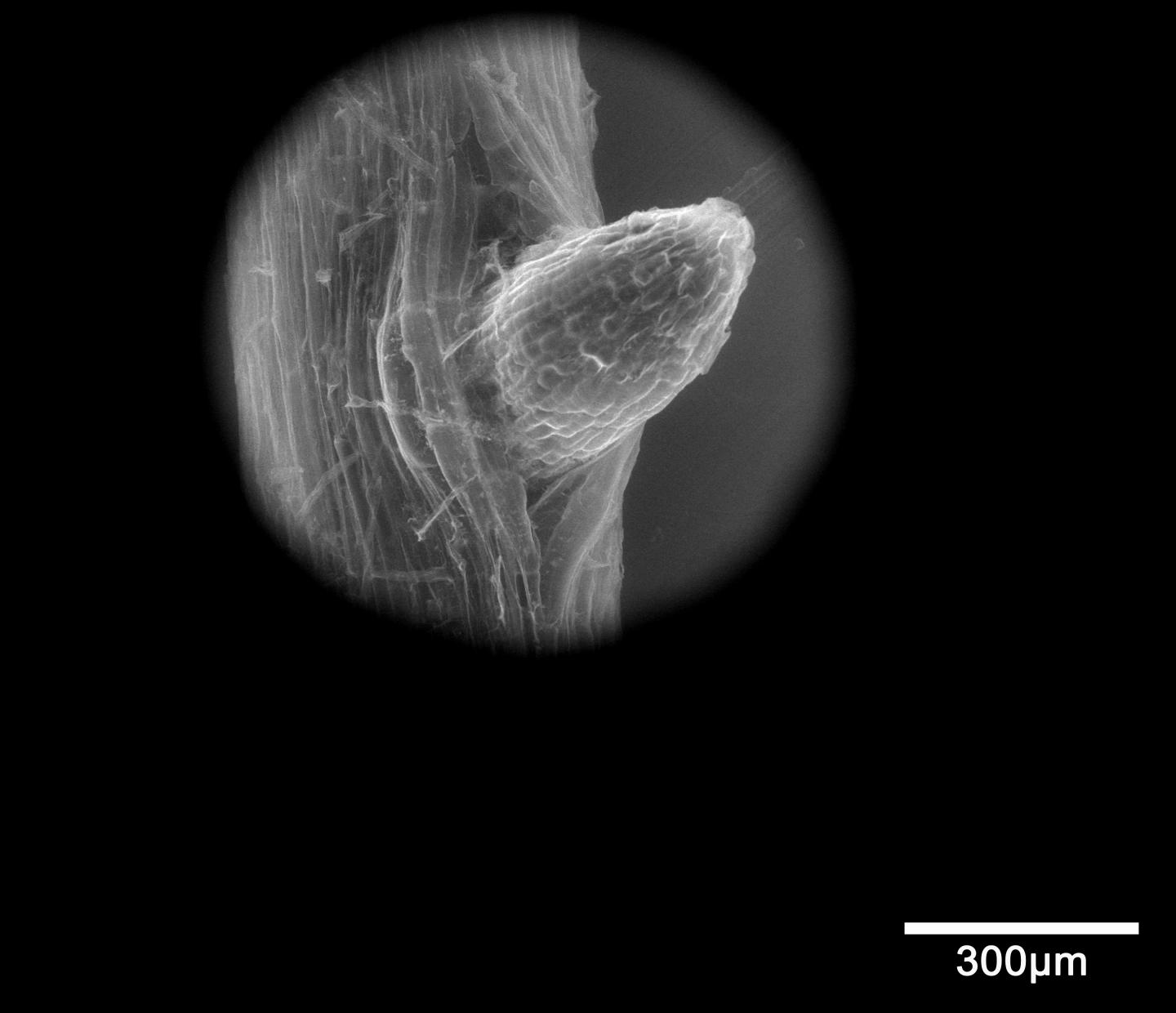
“Cracks at the emerging sites of new lateral roots of lettuce and wheat crops can take in MPs from the surrounding soil and water. Those MPs can then be transferred from the roots up to the edible parts of the crop,” said Prof. LUO.

Scientists already knew that particles as tiny as 50 nanometers in size could penetrate plant roots. But Prof. LUO’s group revealed that particles about 40 times that size can get into plants as well.

The MPs identified in this study were spherical plastic particles up to 2 micrometers in size with a small degree of mechanical flexibility. These features allowed the MPs to squeeze into the small apoplastic space of plant root cells.

“Another mechanism is that at the lateral root emergence sites there are small cracks, and then the particles go through those cracks and enter the xylem vessels. Thus it is even possible that particles larger than the ones we studied might also be taken up by plants,” said Dr. LI Lianzhen, first author of the study.

These findings shed new light on the possibility of food chain transfer of MPs. If MPs are getting into our crop plants, they are also getting into our meat and dairy. This raises obvious concerns about growing crops on fields contaminated with wastewater treatment discharge or sewage sludge, a process that could introduce MPs into the food chain. It also raises the key question of how MPs affect human health, a question for which there is as yet no clear answer.

Aside from the possible health impact, MPs in crops is also undesirable from the standpoint of agricultural sustainability.

###

This work was supported by the National Nature Science Foundation of China and the Key Research Program of Frontier Sciences, CAS.

Media Contact
LUO Yongming
[email protected]

Related Journal Article

http://dx.doi.org/10.1038/s41893-020-0567-9

Tags: AgriculturePlant SciencesPollution/Remediation
Share12Tweet8Share2ShareShareShare2

Related Posts

Targeted Nanoparticles Make Tumors’ Copper Into a Lethal Weapon

Targeted Nanoparticles Make Tumors’ Copper Into a Lethal Weapon

July 15, 2026
Kansas City University Review Identifies Astrocytes as Drivers of Chronic Traumatic Encephalopathy

Kansas City University Review Identifies Astrocytes as Drivers of Chronic Traumatic Encephalopathy

July 15, 2026

Elephants Use Ground Vibrations for Communication via Specialized Middle Ear Anatomy

July 15, 2026

Sequential mating reduces medaka sperm speed, impacting fertilization success

July 15, 2026
Please login to join discussion

POPULAR NEWS

  • New Drug Candidate Developed at McMaster Shows Potential for Treating Brain Cancer

    58 shares
    Share 23 Tweet 15
  • A varied menu

    51 shares
    Share 22 Tweet 12
  • 研究人员开发认知工具包,实现阿尔茨海默症早期检测

    50 shares
    Share 20 Tweet 13
  • Porcine Heart Transplant

    50 shares
    Share 20 Tweet 13
>

About

We bring you the latest biotechnology news from best research centers and universities around the world. Check our website.

Follow us

Recent News

SIRT5-SUCLG2 Desuccinylation Axis Delays Ovarian Aging Through Mitochondrial-Epigenetic Control

Quality Improvement Project Enhances Neonatology Research Experience for Families

Study identifies Europe’s most critical wetlands for climate action

Subscribe to Blog via Email

Enter your email address to subscribe to this blog and receive notifications of new posts by email.

Join 85 other subscribers
  • Contact Us

Bioengineer.org © Copyright 2023 All Rights Reserved.

Welcome Back!

Login to your account below

Forgotten Password?

Retrieve your password

Please enter your username or email address to reset your password.

Log In
No Result
View All Result
  • Homepages
    • Home Page 1
    • Home Page 2
  • News
  • National
  • Business
  • Health
  • Lifestyle
  • Science

Bioengineer.org © Copyright 2023 All Rights Reserved.