Researchers enhance the accuracy of X-ray free-electron laser measurements closer to the diameter of typical atoms than previously possible
Credit: Osaka University
Osaka, Japan – Imagine taking movies of the fastest chemical processes, or imaging atomic-scale detail of single virus particles without damaging them. Researchers from Japan have advanced the state-of-the-art in such endeavors, by enhancing the utility of a special X-ray laser for nanometer-scale measurements.
In a study recently published in Journal of Synchrotron Radiation, researchers from Osaka University, in collaboration with RIKEN and Japan Synchrotron Radiation Research Institute (JASRI), have reduced the beam diameter in an X-ray free-electron laser to 6 nanometers in width. This considerably improves the utility of these lasers for imaging structures closer to the atomic level than possible in prior work.
To “see” extremely small and otherwise invisible objects, and observe ultrafast chemical processes, researchers commonly use synchrotron X-ray facilities. X-ray free-electron lasers are an alternative that can–in principle–image atomic-scale detail of, for example, a virus particle, on the timescale of an electron transition, without damaging the particle. To do this, you need an incredibly bright X-ray laser that focuses extremely fast laser pulses on the nanometer scale.
“Using multilayer focusing mirrors, we narrowed the width of our laser beam down to a diameter of 6 nanometers,” says lead author of the study Takato Inoue. “This is not quite the diameter of a typical atom, but we’re making good progress.”
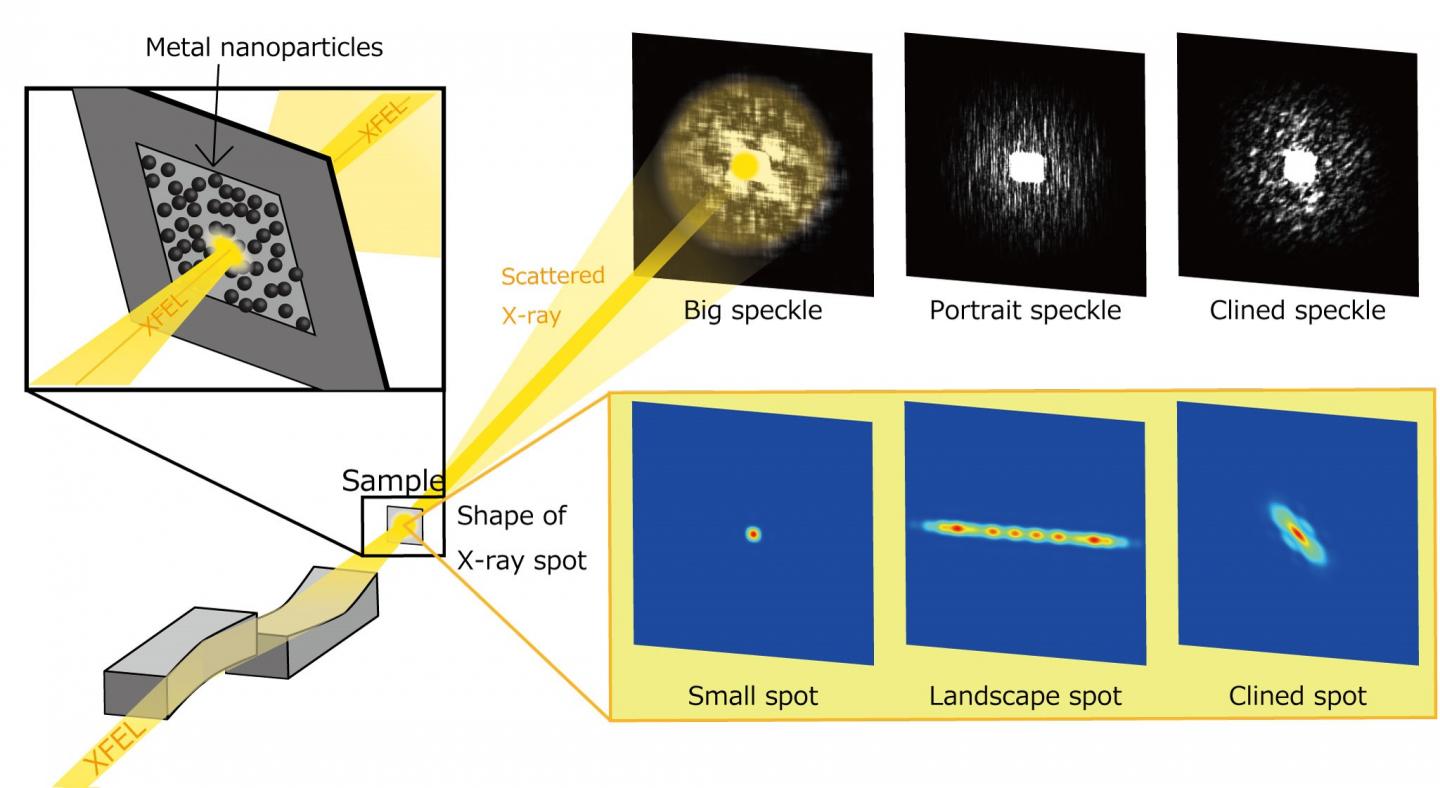
Until now, it has been difficult to focus X-ray free-electron lasers to such small diameters. That’s because of challenges in fabricating the required mirrors, and confirming the focused size of the lasers. The researcher team addressed the focusing problem by analyzing the shape of the laser’s interference patterns, known as speckle profiles.
“We generated speckle profiles by coherent X-ray scattering of randomly distributed metal nanoparticles,” explains Satoshi Matsuyama, senior author. “This enabled experimental measurements of the laser beam profile, which were in good agreement with theoretical calculations.”
Because the laser beam diameter can be so precisely measured, further advancements are now feasible. For example, by using atoms for the scattering analysis, X-ray free-electron laser measurements can be improved to a 1-nanometer focus.
The researchers anticipate that extremely high-intensity lasers, over a million trillion times brighter than the Sun, will now be useful for imaging ultrafast molecular processes–at atomic-scale detail–that are beyond the capabilities of the most advanced synchrotrons. With such technology, protein molecules and other small important biological entities can be imaged without damaging them under the strategy of “diffraction before destruction,” by using a single laser pulse.
###
The article, “Generation of an X-ray nanobeam of a free-electron laser using reflective optics with speckle interferometry,” was published in Journal of Synchrotron Radiation at DOI: https:/
About Osaka University
Osaka University was founded in 1931 as one of the seven imperial universities of Japan and is now one of Japan’s leading comprehensive universities with a broad disciplinary spectrum. This strength is coupled with a singular drive for innovation that extends throughout the scientific process, from fundamental research to the creation of applied technology with positive economic impacts. Its commitment to innovation has been recognized in Japan and around the world, being named Japan’s most innovative university in 2015 (Reuters 2015 Top 100) and one of the most innovative institutions in the world in 2017 (Innovative Universities and the Nature Index Innovation 2017). Now, Osaka University is leveraging its role as a Designated National University Corporation selected by the Ministry of Education, Culture, Sports, Science and Technology to contribute to innovation for human welfare, sustainable development of society, and social transformation.
Website: https:/
Media Contact
Saori Obayashi
[email protected]
Original Source
https:/
Related Journal Article
http://dx.