Credit: Fu Feng, Guangyuan Si, Changjun Min, Xiaocong Yuan, Michael Somekh
Optical singularities are key elements in modern optics and have been widely researched. In particular, phase and polarization singularities have been manipulated in various applications, such as imaging and metrology, nonlinear optics, optical tweezers, sensing, quantum information, and optical communication. In theory, both singularities can be detected simultaneously if one can detect the topological charge and photon spin at the same time. Several methods have been proposed to detect the topological charge of the OAM in recent years, including holography, metasurfaces, optical transformation, and photonic circuits. However, these methods have drawbacks including the need to align the beam precisely with the structure, the need for complex detection processes, such as near-field microscopy, and the low diffraction efficiencies of some elements. These drawbacks strongly limit their applications in new optical systems with optical fibres or integrated on-chip devices.
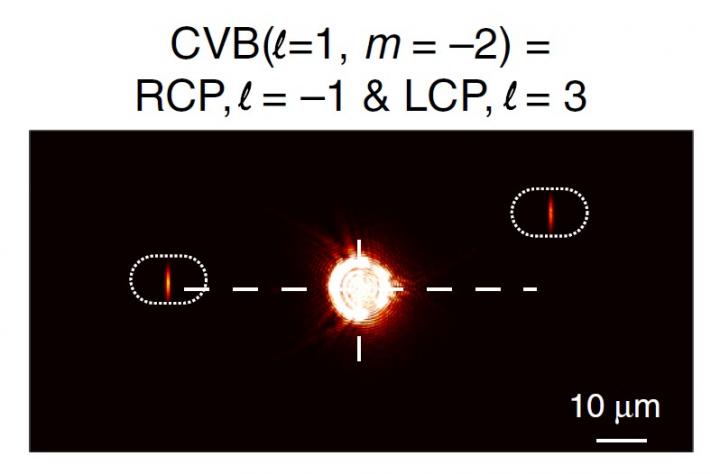
In a new paper published in Light Science & Application, a team of scientists, led by Professor Changjun Min, Xiaocong Yuan, Mike Somekh from Nanophotonics Research Center, Shenzhen Key Laboratory of Micro-Scale Optical Information Technology, Shenzhen University, Shenzhen 518060, China and co-workers have developed an on-chip plasmonic spin-Hall nanograting for simultaneously detecting phase and polarization singularities. They have designed a symmetry-breaking nanograting structure first to unidirectionally launch the SPP wave according to the sign of the topological charge of the incident wave. The propagation angle of the generated SPP increases with the value of the topological charge. The topological charge value of the incident beam can be accurately determined by placing an output coupling grating on both sides of the nanograting to couple the generated SPP wave to the far field and analysing the far-field optical microscopy image. Additionally, a spin-Hall structure is integrated onto the nanograting so that the nanograting can respond to the spin of the incident beam. This combined structure directionally couples the incident OAM beam to different positions depending on the polarization and topological charge of the beam. It is proved experimentally that the structure detects the polarization singularity and phase singularity of the incident CVB beam simultaneously. This device is very promising for achieving a highly compact photonic integrated circuit. These scientists summarize the operational principle of their structure:
“We design a SPP based meta-surface which can detect simultaneously phase and polarization singularities of the incident wave for two purposes in one: (1) to rapidly and simultaneously detect the phase and polarization singularities with single shot image; (2) to enable optical communication with photonics singularities of electromagnetic waves.”
“This device is very promising for achieving a highly compact photonic integrated circuit. It has shown great potential in large-scale photonic integrated circuits and would benefit diverse applications such as optical on-chip information processing and optical communications. We are now trying to intergrate an additional coupound phase modulation structure onto the device to cancel the diffraction effect of the SPP wave during generation. This would further enhance the resolution and detection limit of the system.” they added
“The presented technique can be used for new generation of optical communication. As photonic singularities are new degree of freedom which can carry far more information compare to what the intensity modulation, frequency modulation we use now. The tiny volum of the device and its capacity of information processing will open a new gate to modern communication in both classic regime and quantum regime.” The scientists forecast.
###
Media Contact
Fu Feng
[email protected]
Related Journal Article
http://dx.