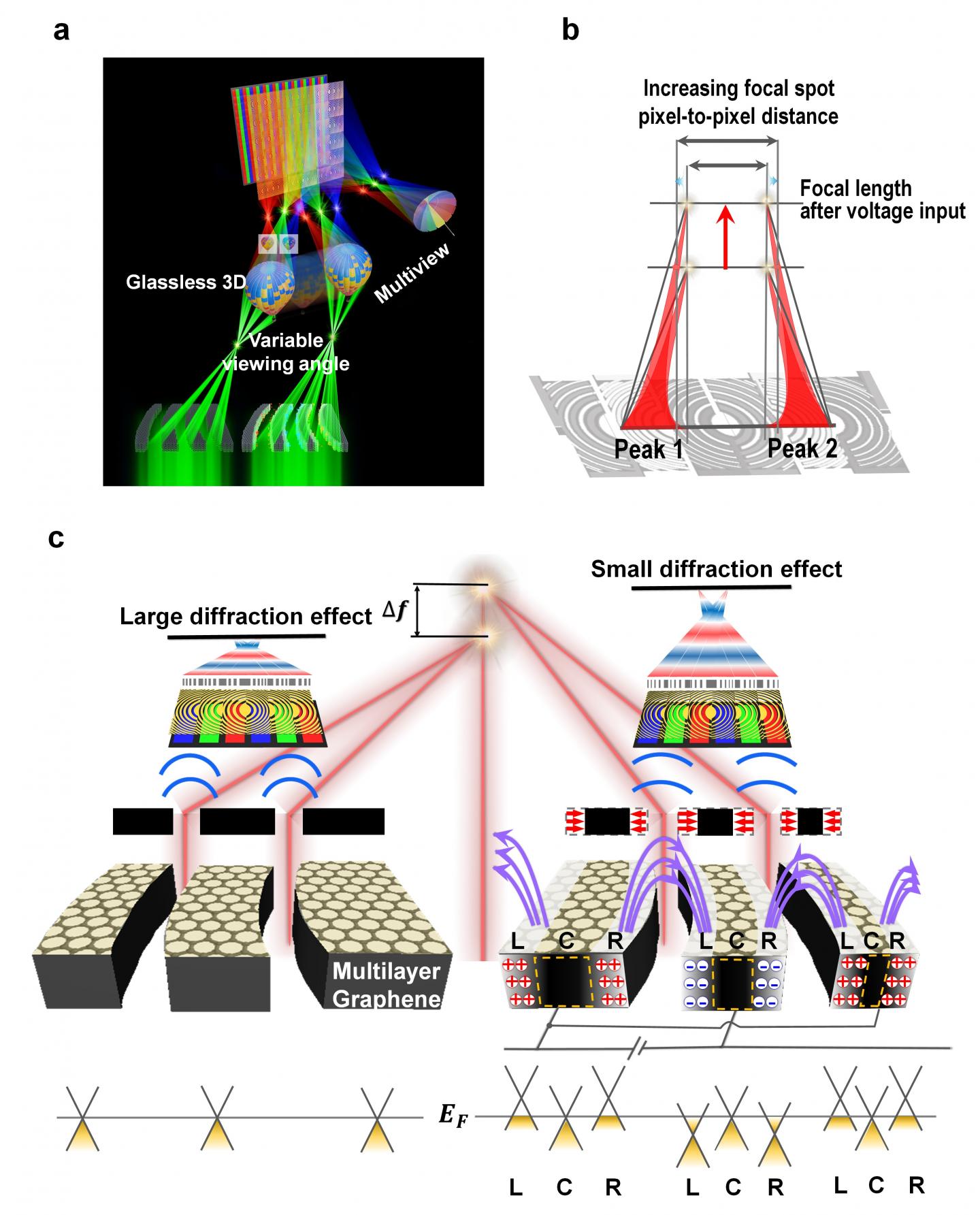
Credit: ??Sehong Park, Gilho Lee, Byeongho Park, Youngho Seo, Chae bin Park, Young Tea Chun, Chulmin Joo, Junsuk Rho, Jong Min Kim, James Hone & Seong Chan Jun
Traditional tuneable lenses consisting of complex lenses with manipulation systems have limited designs because of the spatial occupancy, which eventually confines their applications in advanced pixel-based devices, such as flat panel displays. The graphene can be patterned into nanoribbons, then a graphene-based FZP lens can be an ideal combination of near and far optical fields because the optical conductivity of graphene can be tuned by adjusting the Fermi level or by varying the geometry. In the past, the lenticular lens and parallax barrier used in multiview autostereoscopic displays were considered infeasible in displays owing to their thickness, low transmittance, high aberration, and low resolution. Therefore, an original device with high optical performances and advantageous physical properties was constantly demanded.
As published in Light Science & Application journal in June 2020, the research team held by Professor Seong Chan Jun at Yonsei University, Korea, with fellow researchers from POSTECH, University of Cambridge, UK and Columbia University, USA have developed graphene-based ultrathin subpixel square lens that works by controlling the carrier distribution within the Fermi level and accordingly altering the absorbance characteristics. The Fresnel lens made of graphene enables electrically tuneable focusing based on the difference in the absorption characteristics depending on the position of Fermi level. By designing in an arc ribbon pattern, the effective spacing of the arc ribbons is controlled by the difference in the carrier distribution depending on the position of the electric field. Accordingly, a variation in the diffraction characteristics of the slit is achieved such that the focal length can be adjusted in the visible regime without any change in the design. Furthermore, the lens can be customized according to the wavelength of each subpixel in the display device without any additional light source or device. Thus, a multifunctional display using an ultrathin square subpixel lens with high transmittance and high resolution can be facilitated.
This graphene ultrathin lens is uniquely designed for the user’s field of view (FOV) in multi-view autostereoscopic displays. Composed of 5 layers of graphene, the electrically focus-tunable ultrathin device exhibits 82% of transmittance and above 60% of focusing efficiency. Furthermore, it shows 19.42% shift in focal length which achieves multi-focusing property according to the observer’s FOV. Therefore, this ultrathin focusing device allows the realization of multiview autostereoscopic display without additional calibration system. The scientists summarize the working principle of the device as follows:
“The electric field normal to the plane due to the DC bias concentrates the carrier density at the edges of the arc ribbon. The arc ribbon absorbs light in the central area (C), but the Fermi level on the left (L) and right (R) sides shifts away from the Dirac point due to the increase in the carriers. This results in a longer focal length because the decrease in the size of the arc ribbon increases the linearity of the diffraction by the arc ribbon”
“This subpixel lens can be uniquely designed according to the wavelength of each RGB subpixels. Therefore, the chromatic aberration that frequently occurs in conventional lenticular devices can be eliminated, and each individual wavelength of light can be focused into a single focal spot.”
“The device’s structural advantage within the subpixel scale can be embedded into each individual pixel in glassless 3D displays, privacy displays, and multiview displays for display applications. In addition, this design can be customised for 3D hologram displays, acoustic applications, and optical devices comprising metasurfaces, as expected by the researchers.”
###
Media Contact
Sehong Park
[email protected]
Related Journal Article
http://dx.